View methods side by side.
Choose up to four methods. Add them using the search and share the comparison by copying its link.
| Criterion |  Decision Making Constraint Analysis | 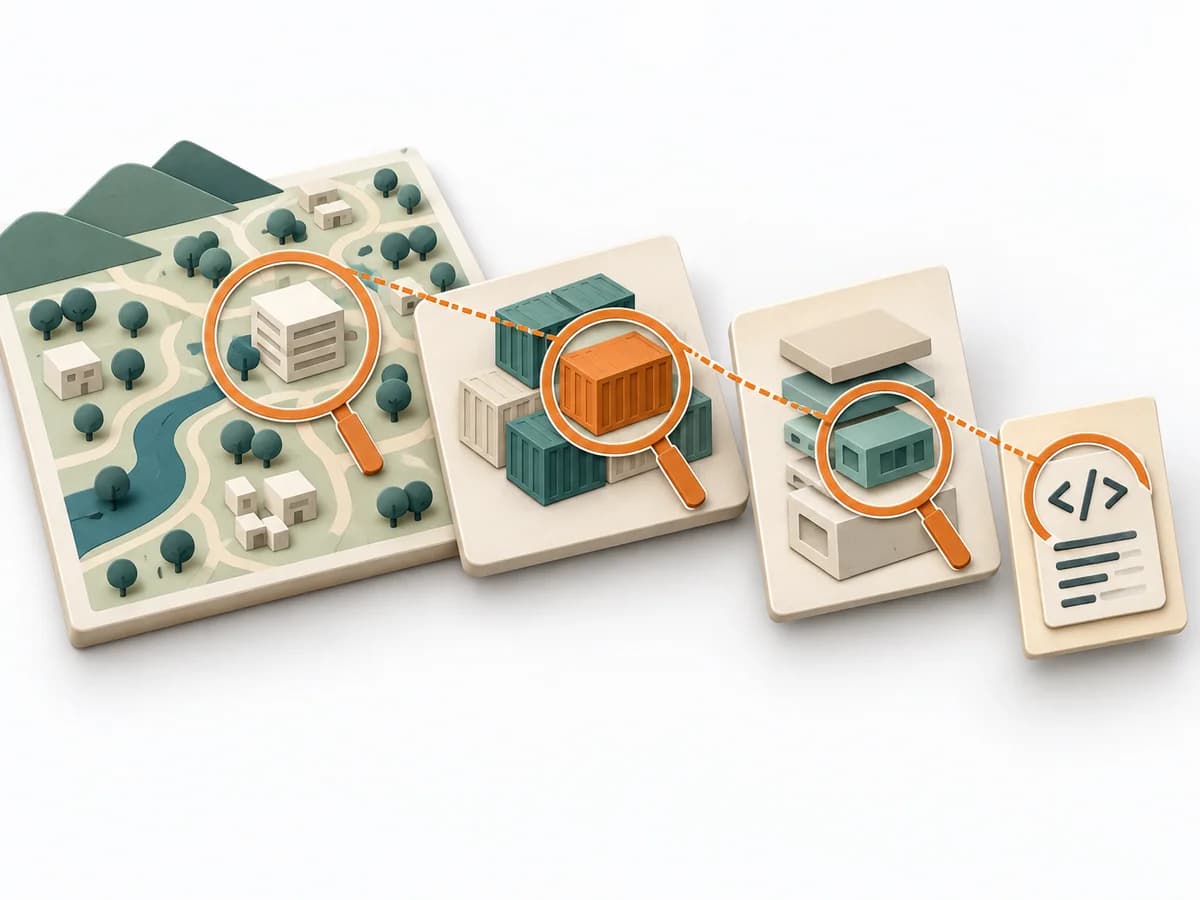 Architecture C4 Model |  Operations Root Cause Analysis |  Operations Kepner-Tregoe |
|---|---|---|---|---|
Purposedifferent | When an initiative stalls, the limit often lies not in the idea but in hard or soft boundary conditions. Constraint Analysis separates these limits and shows which of them can actually be shaped. | The C4 Model makes a system legible across several resolution levels, from context down to code. It suits situations where different audiences need to understand the same architecture from different altitudes. | When a problem keeps recurring and the cause stays unclear, the method exposes the underlying mechanism. It separates symptom, guess, and robust explanation from one another. | For a disturbance that's hard to pin down, the method cleanly separates problem, cause, and decision. It reduces mixing when symptoms allow several interpretations. |
Complexitydifferent | Low | Low | Medium | High |
Timedifferent | 30-90 min | 1-4 h | 1-4 h | 2-8 h |
Participantsdifferent | 2-8 | 1-5 | 3-8 | 2-8 |
Formatsame | Workshop + async | Workshop + async | Workshop + async | Workshop + async |
Outputdifferent | Constraint List, Hard/Soft Classification, Option Impact Notes, Decision Boundaries | Context Diagram, Container Diagram, Component Diagram | Problem Statement, Cause Hypotheses, Confirmed Causes, Action Plan | Problem Analysis, Decision Analysis, Risk Plan |
Tagsno overlap | ConstraintsDecisionPlanningOptions | ArchitectureCommunicationVisualization | Root causeProblem solvingQualityIncident | Problem solvingRoot causeDecisionOperations |