View methods side by side.
Choose up to four methods. Add them using the search and share the comparison by copying its link.
| Criterion | 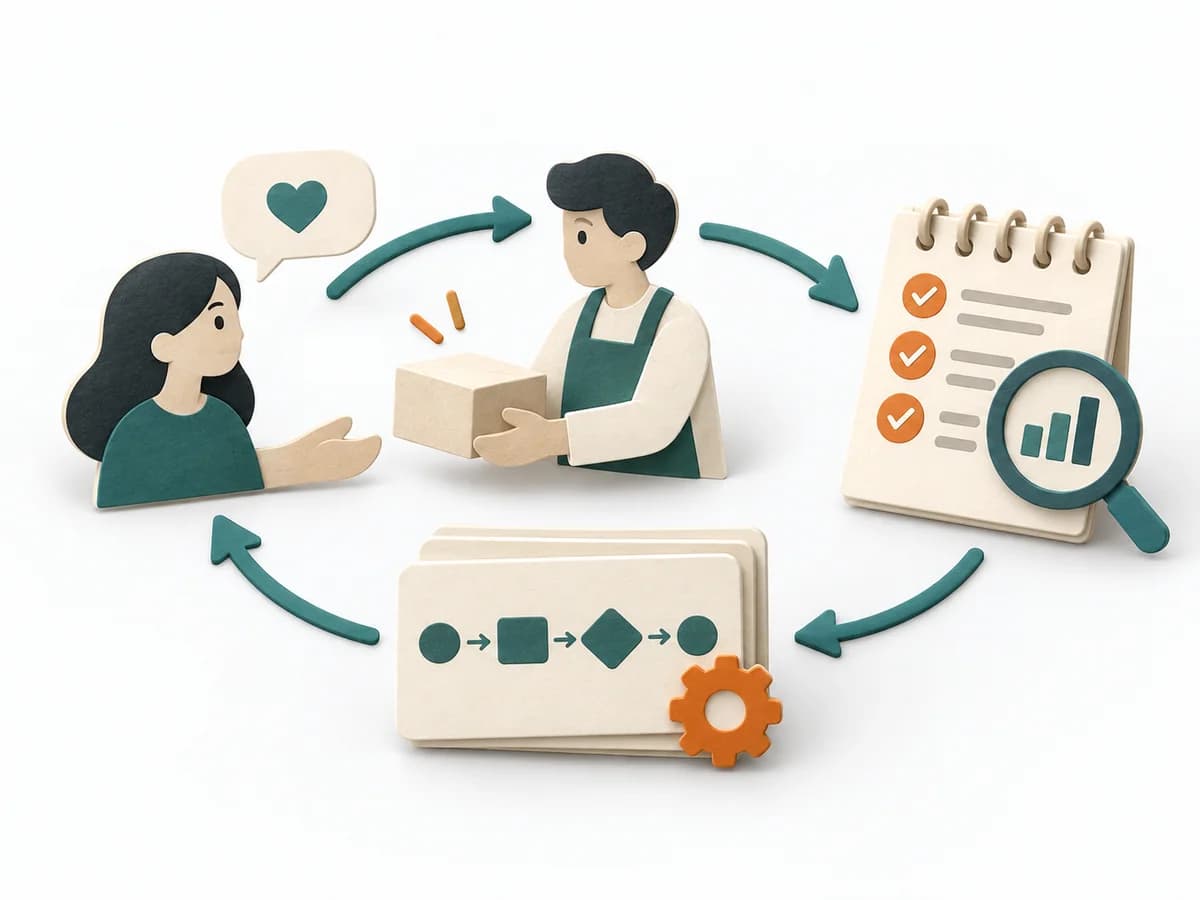 Product Discovery Concierge MVP |  Domain Modeling EventStorming |  Product Discovery Assumption Mapping |  Product Discovery Experiment Canvas |
|---|---|---|---|---|
Purposedifferent | When an idea can first fail or grow through genuine hands-on support, it relies on manual work instead of automation. It shows whether user value holds up even under manual execution. | When a domain consists of many events, rules, and states, it creates a shared modeling space for the team. It bundles language, flows, and boundaries before domain knowledge fragments into siloed views. | When assumptions still sit unordered in the room, it weighs uncertainty against leverage. It makes visible which hypotheses should be checked first. | When experiments become unreadable after the fact, it arranges hypothesis, signal, and learning goal on a single canvas. It separates problem, assumption, solution, and evidence. The result is captured as a Completed Experiment Canvas and a Success Metric. |
Complexitydifferent | Medium | Medium | Medium | Low |
Timedifferent | 1-4 Wochen | 2-8 h | 45-60 min | 30-60 min |
Participantsdifferent | 3-10 Kunden | 5-12 | 2-8 | 1-5 |
Formatdifferent | Workshop + async | Workshop | Workshop + async | Workshop + async |
Outputdifferent | Concierge Learnings, Service Blueprint, MVP Risks | Event Timeline, Ubiquitous Language, Boundaries, Open Questions | Assumption map, Test backlog, Risk ranking | Completed Experiment Canvas, Success Metric |
Tagsno overlap | MVPValidationServiceDiscovery | Domain-Driven DesignEventsDiscoveryWorkshop | AssumptionsRiskExperimentsValidation | ExperimentsValidationDiscoveryHypothesis |