View methods side by side.
Choose up to four methods. Add them using the search and share the comparison by copying its link.
| Criterion |  Knowledge Modeling Concept Mapping | 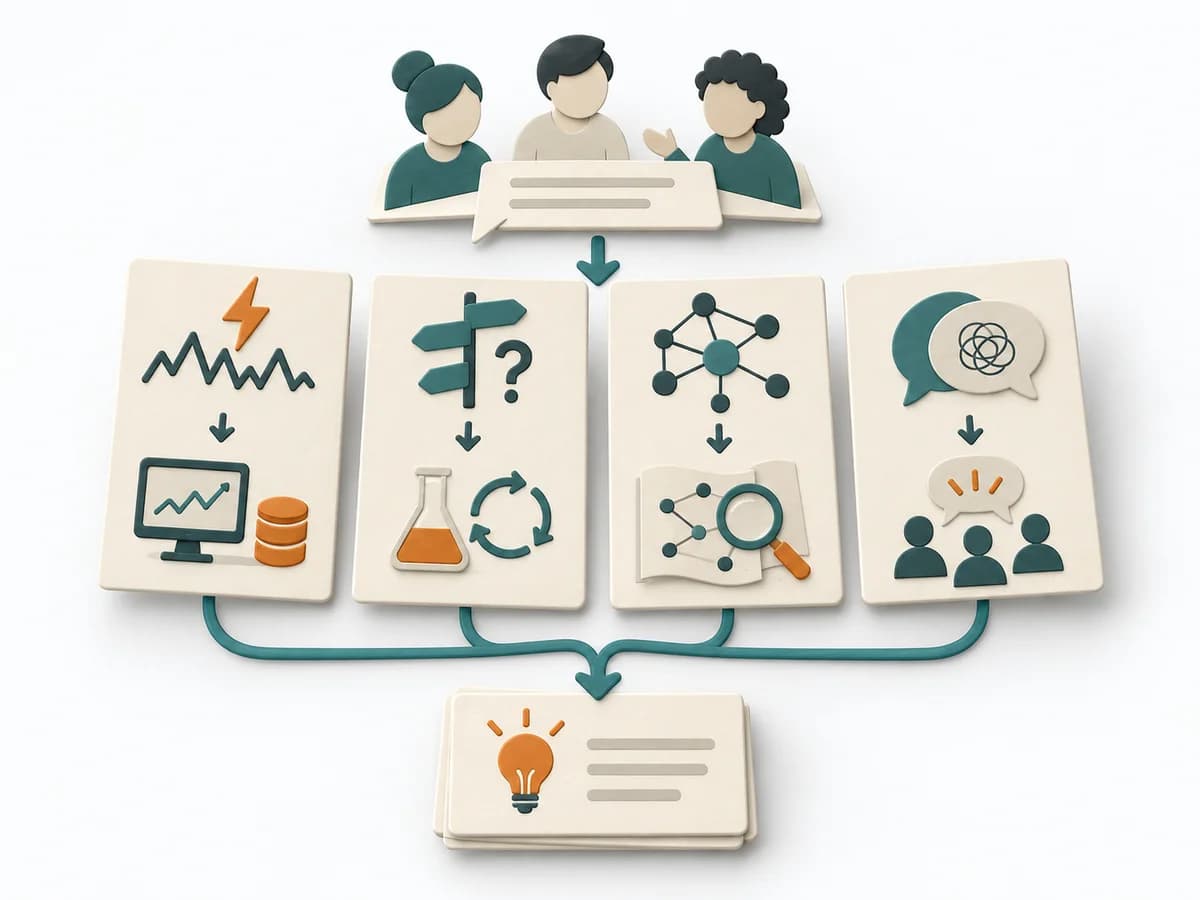 Systems Thinking VUCA Scan |  Decision Making Cynefin Workshop |  Decision Making Force Field Analysis |
|---|---|---|---|---|
Purposedifferent | Concept Mapping arranges terms and relationships in a network that makes subject-matter connections tangible. It fits when a topic needs to be understood structurally rather than linearly. | The VUCA Scan helps read difficult situations more precisely. Instead of treating unclarity as generally complicated, the method separates fast change, missing knowledge, systemic entanglement, and ambiguous interpretation. | When problems are unclear, chaotic, or only seemingly familiar, standard recipes fall short. A Cynefin Workshop sorts situations by the nature of their problem and connects them with matching action logic. | In change initiatives, supporting and restraining forces sit at the table at the same time. Force Field Analysis makes these tensions explicit and shows where change can be pushed forward by strengthening or relieving. |
Complexitydifferent | Medium | Low | Medium | Low |
Timedifferent | 1-2 h | 30-90 min | 60-180 min | 45-90 min |
Participantsdifferent | 1-8 | 1-10 | 4-20 | 3-12 |
Formatdifferent | Workshop + async | Workshop + async | Workshop | Workshop |
Outputdifferent | Concept Map, Relationship Labels, Knowledge Gaps | VUCA Map, Response Options, Signal and Learning Plan | Cynefin Map, Domain-specific Actions, Sensemaking Notes | Force Field Map, Change Levers, Risk Notes |
Tagsno overlap | KnowledgeConceptsMappingSensemaking | SensemakingUncertaintyComplexityStrategyForesight | ComplexitySensemakingDecision | ChangeDecisionStrategy |