View methods side by side.
Choose up to four methods. Add them using the search and share the comparison by copying its link.
| Criterion |  Knowledge Modeling Concept Mapping | 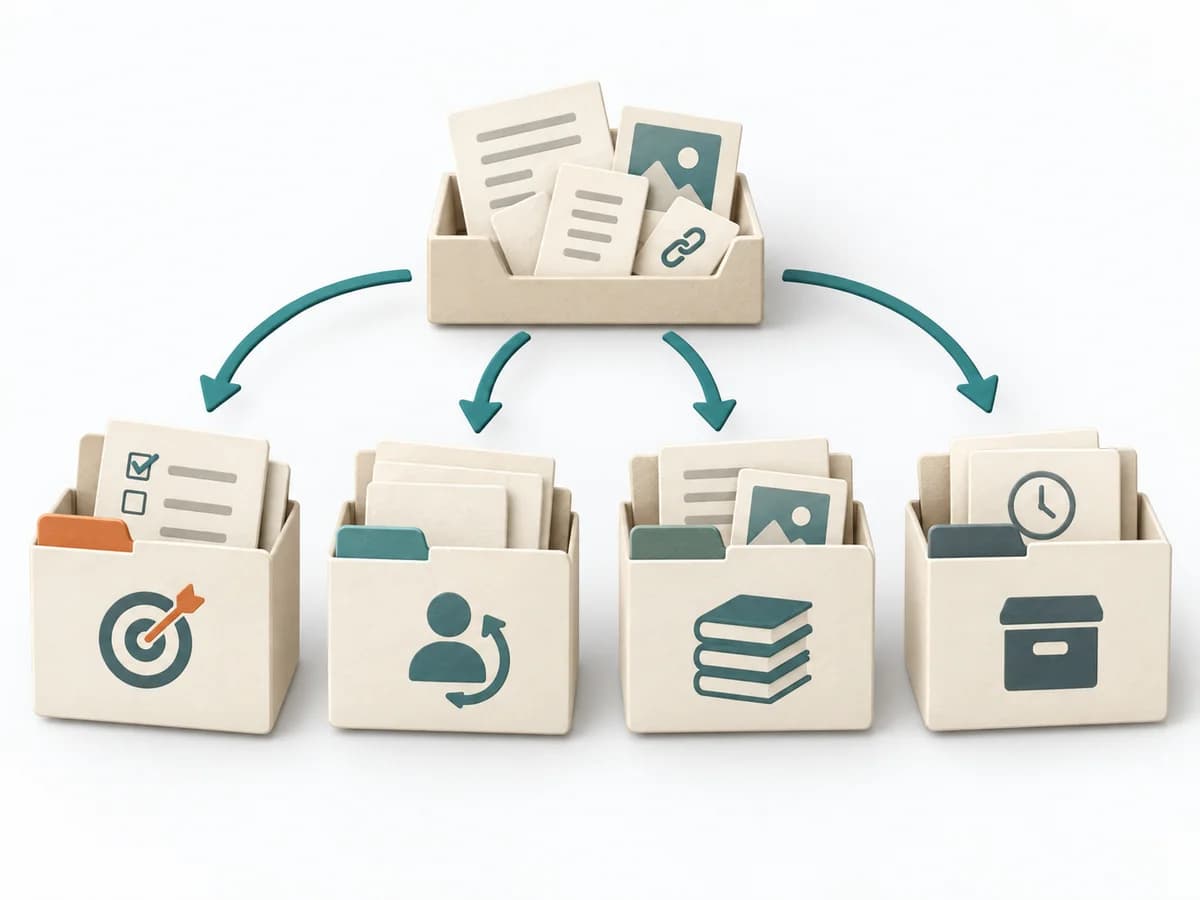 Knowledge Modeling PARA Method |  Product Discovery Smoke Test |  Product Discovery Experiment Canvas |
|---|---|---|---|---|
Purposedifferent | Concept Mapping arranges terms and relationships in a network that makes subject-matter connections tangible. It fits when a topic needs to be understood structurally rather than linearly. | The PARA Method organizes knowledge into Projects, Areas, Resources, and Archives. It creates order when digital notes, files, and tasks no longer cleanly fit current work. | When demand only needs to be roughly verified, it tests interest with minimal effort. It measures whether people would take a next step at all. | When experiments become unreadable after the fact, it arranges hypothesis, signal, and learning goal on a single canvas. It separates problem, assumption, solution, and evidence. The result is captured as a Completed Experiment Canvas and a Success Metric. |
Complexitydifferent | Medium | Medium | Low | Low |
Timedifferent | 1-2 h | 1-3 h Setup, laufend | 1-5 Tage | 30-60 min |
Participantsdifferent | 1-8 | 1 | Nutzertraffic | 1-5 |
Formatdifferent | Workshop + async | Async | Async | Workshop + async |
Outputdifferent | Concept Map, Relationship Labels, Knowledge Gaps | PARA Structure, Project Notes, Knowledge Archive | Interest Metrics, Conversion Signal, Learning Note | Completed Experiment Canvas, Success Metric |
Tagsno overlap | KnowledgeConceptsMappingSensemaking | KnowledgeProductivityOrganization | ValidationExperimentsDemandGrowth | ExperimentsValidationDiscoveryHypothesis |