View methods side by side.
Choose up to four methods. Add them using the search and share the comparison by copying its link.
| Criterion | 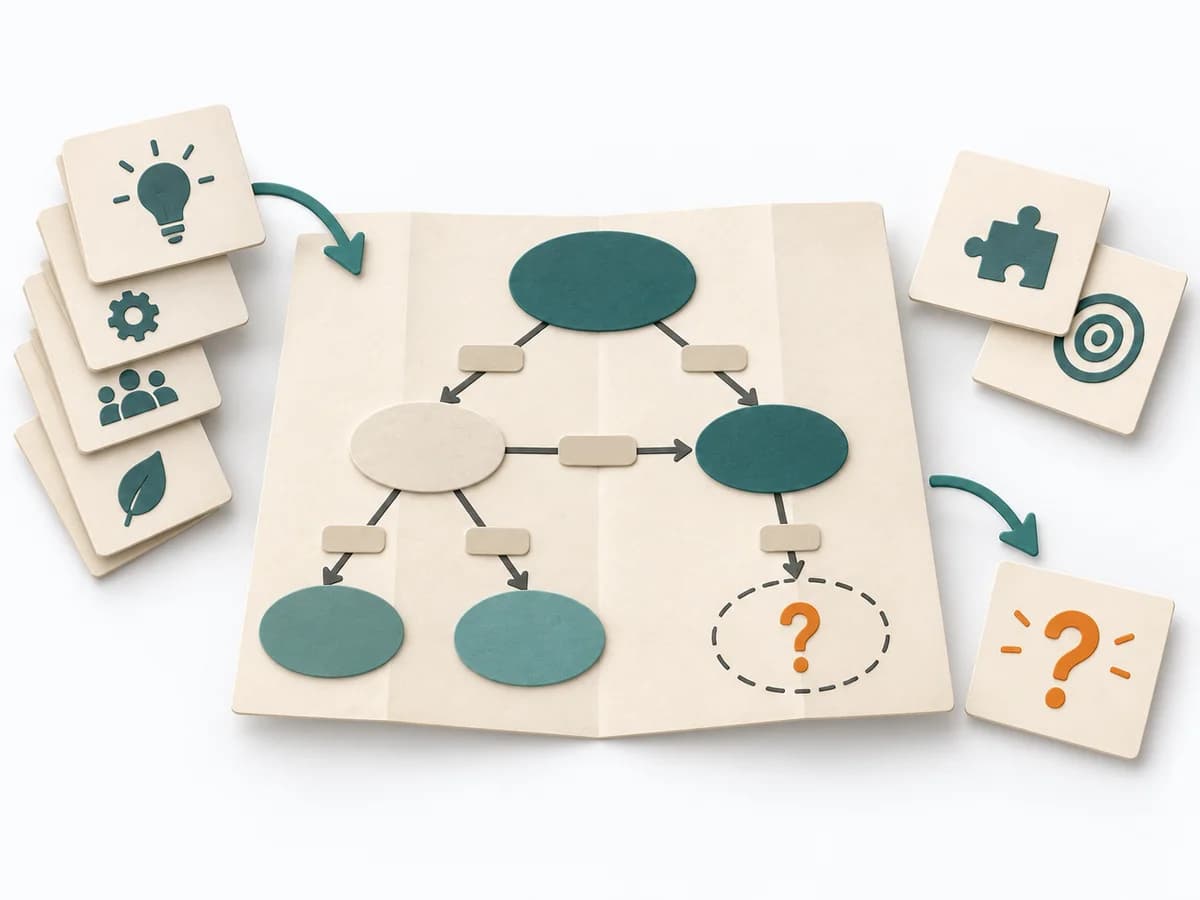 Knowledge Modeling Concept Mapping |  Knowledge Modeling IBIS |  Growth Flywheel |  Growth Funnel Analysis |
|---|---|---|---|---|
Purposedifferent | Concept Mapping arranges terms and relationships in a network that makes subject-matter connections tangible. It fits when a topic needs to be understood structurally rather than linearly. | IBIS structures thinking about complex questions as a sequence of issues, ideas, and arguments. The method keeps discussions open without forcing them into premature consensus. | Growth often breaks down where a reinforcing mechanism builds up too much friction. A Flywheel shows the cycle of value, repetition, and reinforcement meant to sustain growth. | When many visitors or users drop off along the way, the reason behind the number often stays hidden. Funnel Analysis exposes these transitions and makes visible exactly where the path collapses. |
Complexitysame | Medium | Medium | Medium | Medium |
Timedifferent | 1-2 h | 1-3 h | 60-120 min | 1-3 h |
Participantsdifferent | 1-8 | 2-8 | 3-8 | 1-5 |
Formatdifferent | Workshop + async | Workshop + async | Workshop | Async |
Outputdifferent | Concept Map, Relationship Labels, Knowledge Gaps | Issue Map, Positions, Argument Notes | Flywheel Map, Friction Points, Growth Levers, Experiment Backlog | Funnel report, Drop-off analysis, Optimization hypotheses |
Tagsno overlap | KnowledgeConceptsMappingSensemaking | RationaleKnowledgeDecision | GrowthRetentionConversion | AnalyticsConversionGrowth |