View methods side by side.
Choose up to four methods. Add them using the search and share the comparison by copying its link.
| Criterion |  Knowledge Modeling Concept Mapping |  Growth Hooked Model |  Decision Making Argument Mapping | 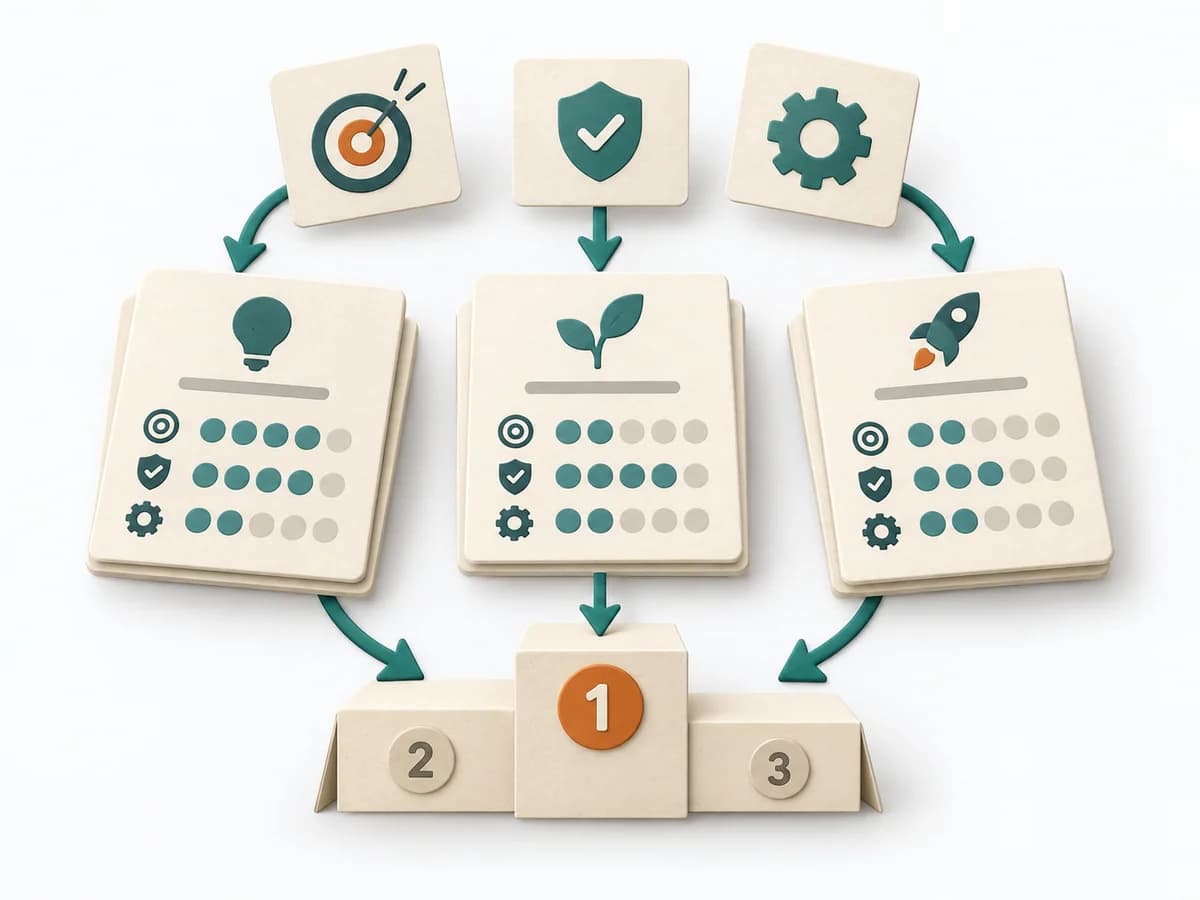 Product Strategy ICE Scoring |
|---|---|---|---|---|
Purposedifferent | Concept Mapping arranges terms and relationships in a network that makes subject-matter connections tangible. It fits when a topic needs to be understood structurally rather than linearly. | The Hooked Model helps clarify engagement loops, user behavior, and experiments. It makes repeat behavior measurable and captures the result as a hooked loop, trigger map, and reward design. | When statements, evidence, and counterarguments get mixed up, a debate quickly loses its structure. Argument Mapping breaks a thesis down into its reasoning and makes visible what it really rests on. | When ideas need sorting quickly, it condenses impact, confidence, and effort into one compact score. It connects customer value, product logic, and decision priorities. The result is captured as an ICE table and top-ideas list. |
Complexitydifferent | Medium | Medium | Medium | Low |
Timedifferent | 1-2 h | Multiple workshops over several weeks | 1-3 h | 30-60 min |
Participantsdifferent | 1-8 | 2-8 | 1-8 | 2-8 |
Formatsame | Workshop + async | Workshop + async | Workshop + async | Workshop + async |
Outputdifferent | Concept Map, Relationship Labels, Knowledge Gaps | Hooked loop, Trigger map, Reward design, Ethics check | Argument Map, Evidence Gaps, Decision Rationale | ICE Table, Top Idea List |
Tagsno overlap | KnowledgeConceptsMappingSensemaking | GrowthBehaviorRetention | SensemakingDecisionRationale | PrioritizationScoringGrowthDecision |