View methods side by side.
Choose up to four methods. Add them using the search and share the comparison by copying its link.
| Criterion |  Knowledge Modeling Concept Mapping |  Business Strategy GAP Analysis | 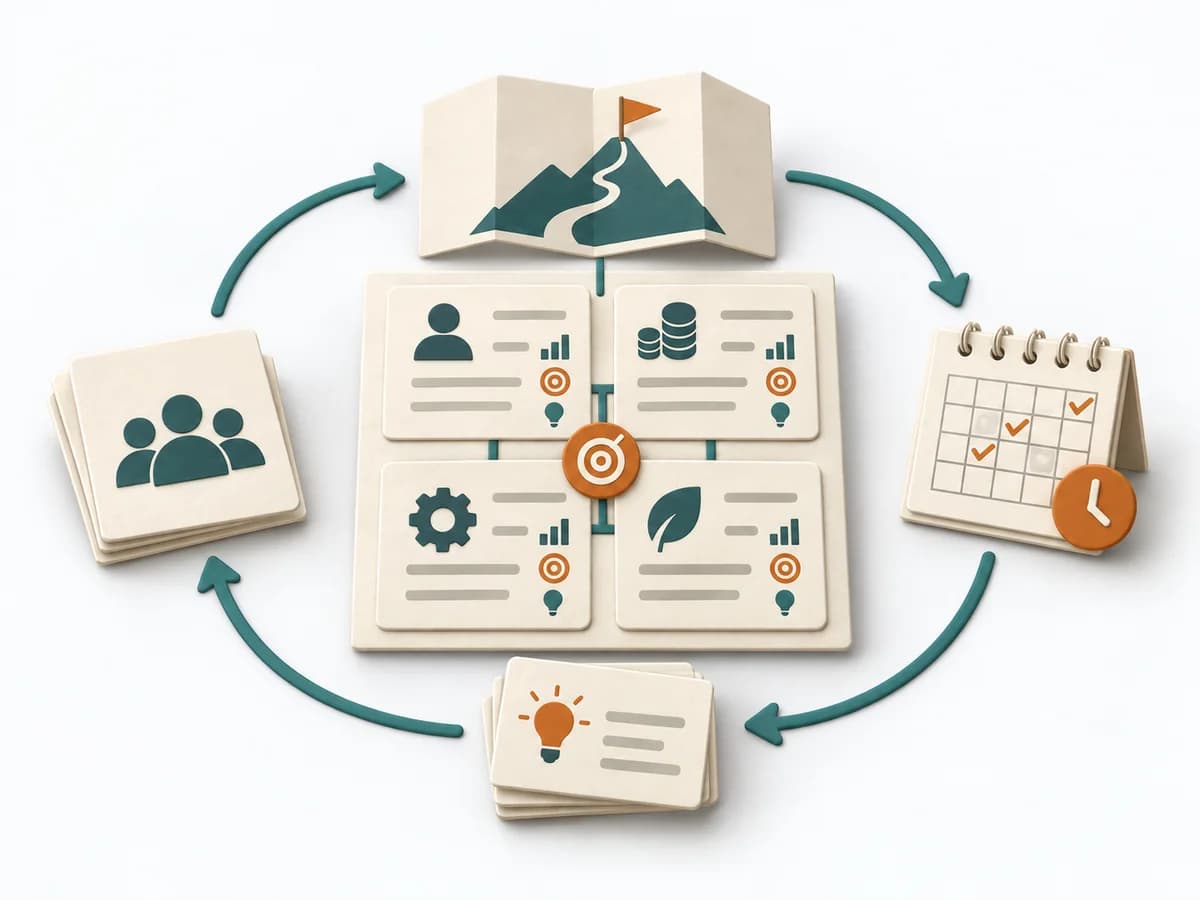 Business Strategy Balanced Scorecard |  Knowledge Modeling Knowledge Mapping |
|---|---|---|---|---|
Purposedifferent | Concept Mapping arranges terms and relationships in a network that makes subject-matter connections tangible. It fits when a topic needs to be understood structurally rather than linearly. | GAP Analysis compares the current state with a target picture and makes the distance manageable. It becomes useful when, ahead of new initiatives, it must become clear which capabilities, processes, or resources are missing. | Balanced Scorecard translates strategy into a few interconnected perspectives and metrics. It holds impact, steering, and learning together in daily work instead of narrowing strategy down to financial figures. | Knowledge Mapping makes knowledge, gaps, and transfer paths visible across a field. It fits when expertise should not just exist but also be findable and transferable. |
Complexitydifferent | Medium | Medium | High | Medium |
Timedifferent | 1-2 h | 1-3 h | Halber Tag bis mehrere Wochen | 1-3 h |
Participantsdifferent | 1-8 | 2-8 | 4-12 | 3-12 |
Formatdifferent | Workshop + async | Workshop + async | Workshop + async | Workshop |
Outputdifferent | Concept Map, Relationship Labels, Knowledge Gaps | Gap Matrix, Action Plan, Risk Notes | Balanced Scorecard, Strategic Measures, Initiative Map | Knowledge Map, Critical Knowledge Areas, Transfer Plan |
Tagsno overlap | KnowledgeConceptsMappingSensemaking | StrategyAnalysisPlanning | StrategyMetricsExecution | KnowledgeMappingRisk |