View methods side by side.
Choose up to four methods. Add them using the search and share the comparison by copying its link.
| Criterion |  Knowledge Modeling Concept Mapping |  Domain Modeling EventStorming |  Facilitation Mind Mapping | 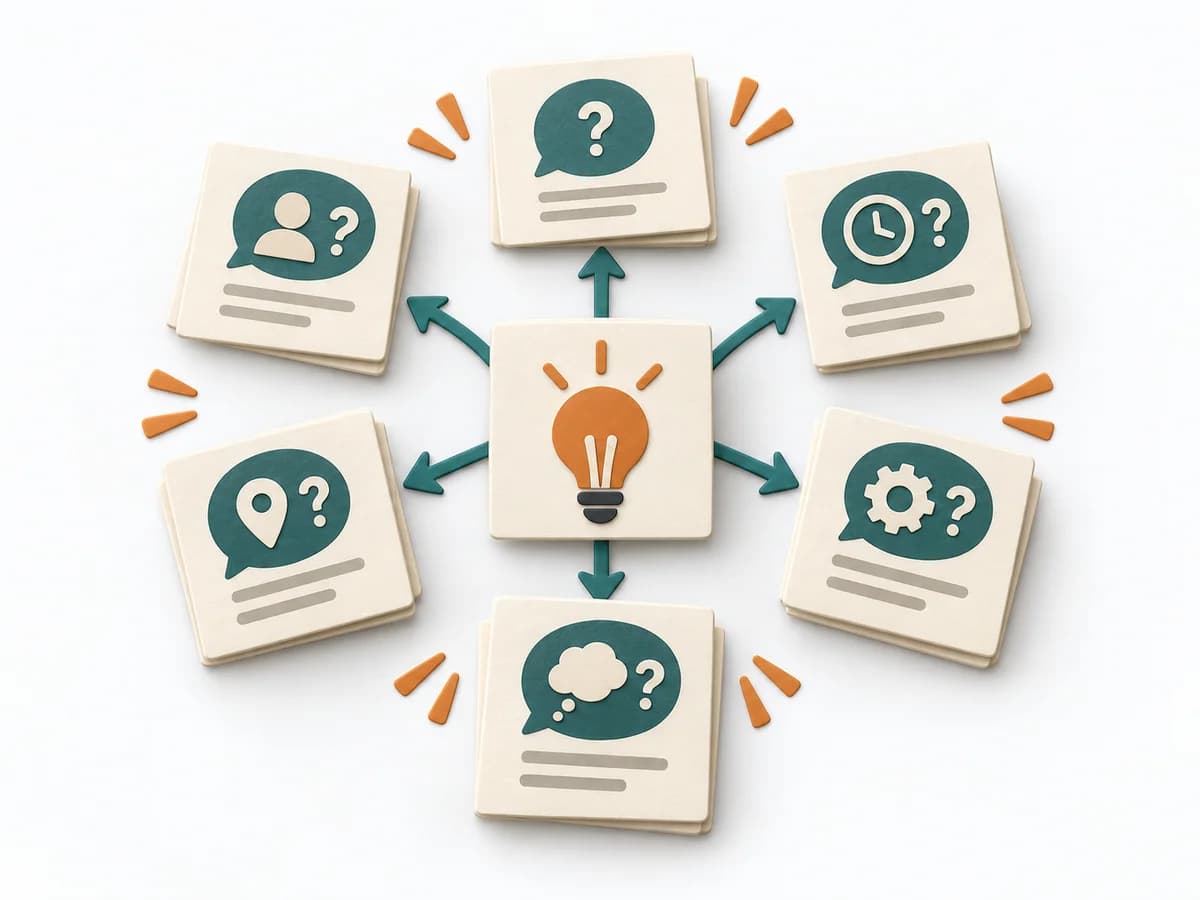 Innovation Starbursting |
|---|---|---|---|---|
Purposedifferent | Concept Mapping arranges terms and relationships in a network that makes subject-matter connections tangible. It fits when a topic needs to be understood structurally rather than linearly. | When a domain consists of many events, rules, and states, it creates a shared modeling space for the team. It bundles language, flows, and boundaries before domain knowledge fragments into siloed views. | When a topic is still unclear and too many thoughts surface at once, Mind Mapping creates an open surface for ordering them. It makes connections, subtopics, and starting points visible without fixing them too early. | Helps clarify ideas, open questions, and testable next steps in concrete terms. It opens the thinking space, collects ideas, and leads to testable options. The result is captured as a star-shaped question map, question list, and assumption list. |
Complexitydifferent | Medium | Medium | Low | Low |
Timedifferent | 1-2 h | 2-8 h | 15-45 min | 30-60 min |
Participantsdifferent | 1-8 | 5-12 | 1-10 | 3-10 |
Formatdifferent | Workshop + async | Workshop | Workshop + async | Workshop + async |
Outputdifferent | Concept Map, Relationship Labels, Knowledge Gaps | Event Timeline, Ubiquitous Language, Boundaries, Open Questions | Mind Map, Topic Clusters, Open Questions | Star-Shaped Question Map, Question List, Assumption List |
Tagsno overlap | KnowledgeConceptsMappingSensemaking | Domain-Driven DesignEventsDiscoveryWorkshop | BrainstormingIdeasMappingStructureFacilitation | BrainstormingIdeationWorkshopDiscovery |