View methods side by side.
Choose up to four methods. Add them using the search and share the comparison by copying its link.
| Criterion |  Knowledge Modeling Concept Mapping |  Domain Modeling EventStorming |  Knowledge Modeling Knowledge Mapping | 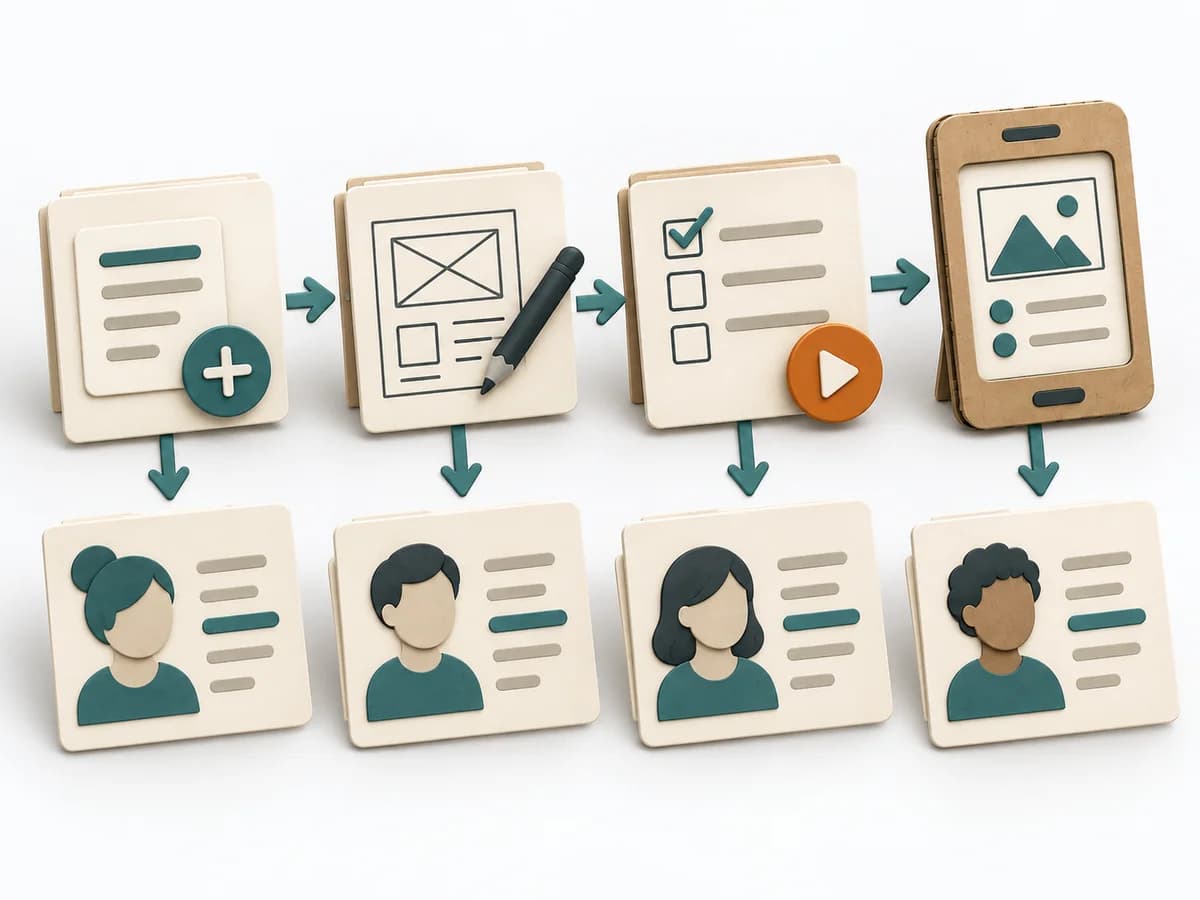 Knowledge Modeling Event Modeling |
|---|---|---|---|---|
Purposedifferent | Concept Mapping arranges terms and relationships in a network that makes subject-matter connections tangible. It fits when a topic needs to be understood structurally rather than linearly. | When a domain consists of many events, rules, and states, it creates a shared modeling space for the team. It bundles language, flows, and boundaries before domain knowledge fragments into siloed views. | Knowledge Mapping makes knowledge, gaps, and transfer paths visible across a field. It fits when expertise should not just exist but also be findable and transferable. | Event Modeling connects business workflows with commands, events, and views into one coherent mental model. It helps design behavior, UI, and technical slices from the same underlying logic. |
Complexitysame | Medium | Medium | Medium | Medium |
Timedifferent | 1-2 h | 2-8 h | 1-3 h | 2-6 h |
Participantsdifferent | 1-8 | 5-12 | 3-12 | 2-8 |
Formatdifferent | Workshop + async | Workshop | Workshop | Workshop + async |
Outputdifferent | Concept Map, Relationship Labels, Knowledge Gaps | Event Timeline, Ubiquitous Language, Boundaries, Open Questions | Knowledge Map, Critical Knowledge Areas, Transfer Plan | Event Model, UI Flow, Commands, Read Models |
Tagsno overlap | KnowledgeConceptsMappingSensemaking | Domain-Driven DesignEventsDiscoveryWorkshop | KnowledgeMappingRisk | EventsBlueprintDomain-Driven DesignBehavior |