View methods side by side.
Choose up to four methods. Add them using the search and share the comparison by copying its link.
| Criterion |  Knowledge Modeling Concept Mapping | 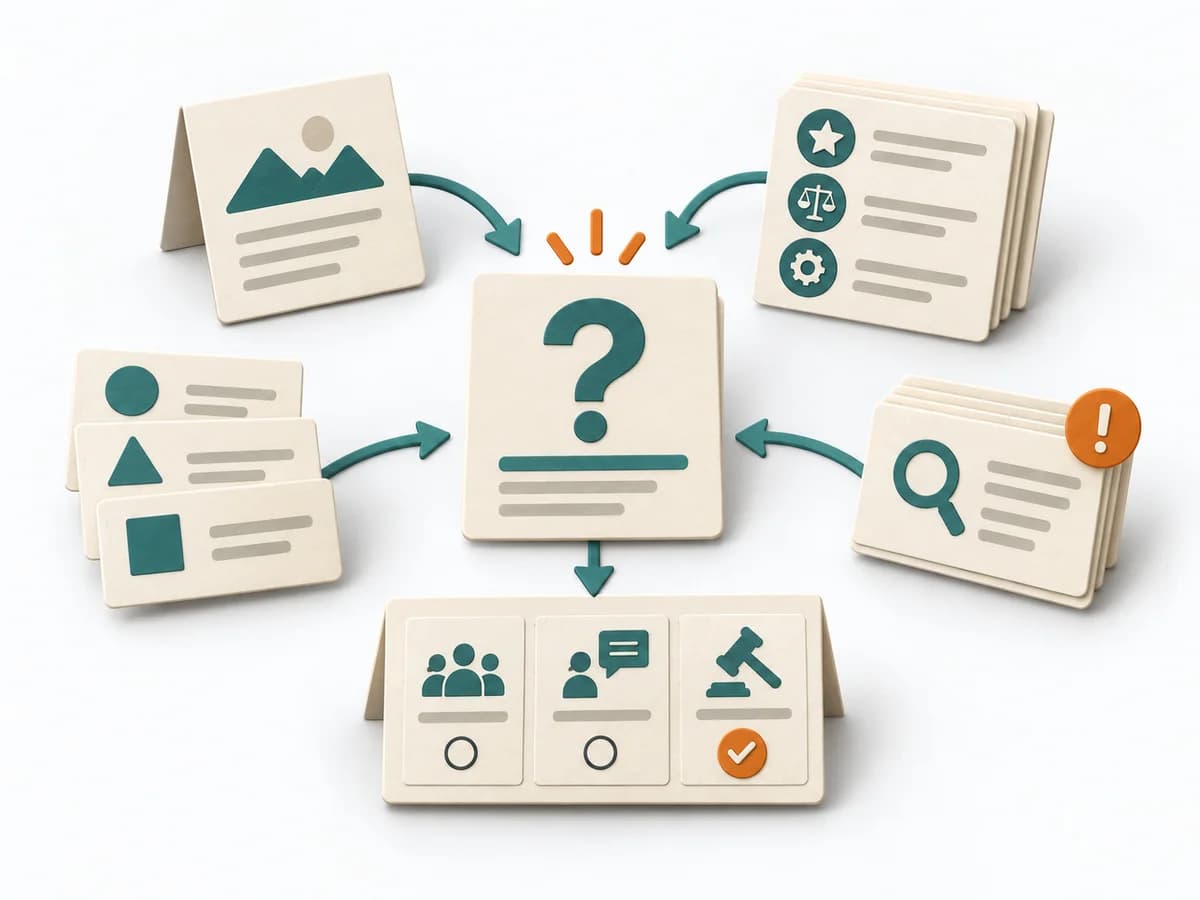 Decision Making Decision Framing Workshop |  Agile ROAM Board |  Decision Making Option Framing |
|---|---|---|---|---|
Purposedifferent | Concept Mapping arranges terms and relationships in a network that makes subject-matter connections tangible. It fits when a topic needs to be understood structurally rather than linearly. | When a decision is poorly framed, even good answers deliver little value. A Decision Framing Workshop sharpens the problem, goal, and boundaries before the actual weighing begins. | When work needs to move between different states or columns, it makes that movement and its handoffs legible. It sorts work by value, risk, and delivery ability. The result is captured as a ROAM Board and an Owner List. | In early decisions, alternatives are often still vague, incomplete, or blended together. Option Framing brings every possibility into a comparable form and makes visible which variant actually fits the question. |
Complexitydifferent | Medium | Medium | Low | Medium |
Timedifferent | 1-2 h | 60-120 min | 20-40 min initial, dann laufend | 45-120 min |
Participantsdifferent | 1-8 | 4-10 | 3-15 | 3-8 |
Formatdifferent | Workshop + async | Workshop | Workshop + async | Workshop + async |
Outputdifferent | Concept Map, Relationship Labels, Knowledge Gaps | Decision Frame, Decision Question, Criteria List, Evidence Plan | ROAM Board, Owner List | Option Frames, Assumption Notes, Comparable Shortlist, Decision Inputs |
Tagsno overlap | KnowledgeConceptsMappingSensemaking | Decision framingAlignmentCriteriaOptions | RiskAgileTrackingAlignment | OptionsDecision framingStrategyComparison |