View methods side by side.
Choose up to four methods. Add them using the search and share the comparison by copying its link.
| Criterion |  Knowledge Modeling Concept Mapping | 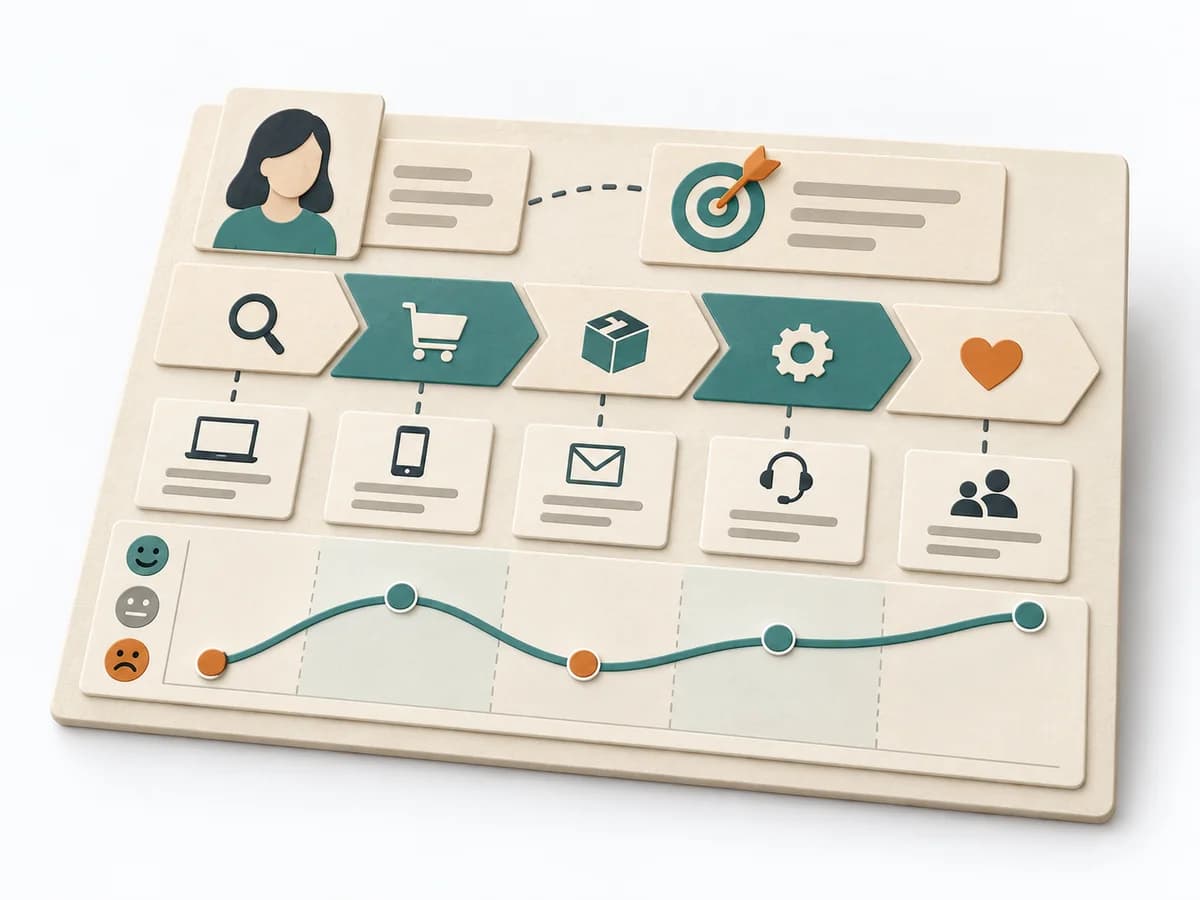 UX Design Customer Journey Canvas |  Operations ALPEN Method |  UX Research Customer Journey Mapping |
|---|---|---|---|---|
Purposedifferent | Concept Mapping arranges terms and relationships in a network that makes subject-matter connections tangible. It fits when a topic needs to be understood structurally rather than linearly. | When a journey needs to be understood across several phases, it arranges experience, touchpoints, and opportunities into one picture. It makes gaps and friction along the user path clear. | With an overloaded day full of too many tasks, a realistic picture of the day emerges. The method connects estimating, deciding, and buffer thinking so planning fits available energy and time. | When a user journey falls apart across many touchpoints, customer journey mapping makes the experience visible as a coherent arc. Phases, emotions, and breaks become legible enough to prioritize critical moments deliberately. |
Complexitydifferent | Medium | Medium | Low | Medium |
Timedifferent | 1-2 h | 1-3 h | 10-20 min daily | 2-4 h |
Participantsdifferent | 1-8 | 3-10 | 1 | 4-10 |
Formatdifferent | Workshop + async | Workshop | Async | Workshop |
Outputdifferent | Concept Map, Relationship Labels, Knowledge Gaps | Customer Journey Canvas, Pain Points, Experience Opportunities | Daily Plan, Time Estimates, Review Notes | Journey Map, Pain-point List, Opportunity Backlog |
Tagsno overlap | KnowledgeConceptsMappingSensemaking | JourneyCustomerService designCanvas | PlanningTime managementProductivityOperations | JourneyServiceService design |