View methods side by side.
Choose up to four methods. Add them using the search and share the comparison by copying its link.
| Criterion |  Operations Change Analysis |  Delivery MoSCoW | 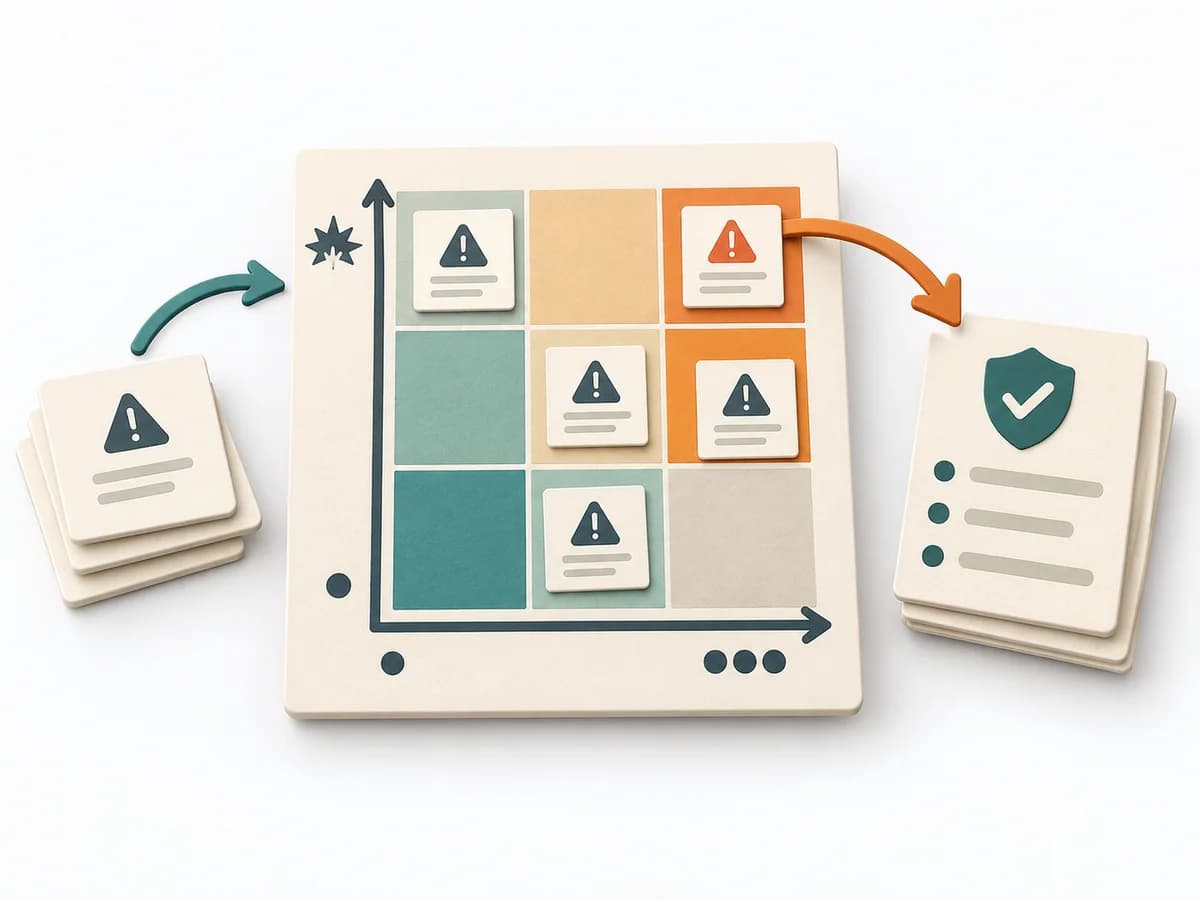 Decision Making Risk Matrix |  Operations Fault Tree Analysis |
|---|---|---|---|---|
Purposedifferent | For a deviation after a change, the method isolates the influence of the altered condition. It narrows down which differences are relevant and which are just accompanying noise. | When a release carries too many demands and priorities are only ever negotiated, MoSCoW creates clear boundaries for the next cut. Must, Should, Could, and Won't make commitment, room for maneuver, and trade-off logic visible to everyone involved. | When a project faces many possible disruptions, it quickly becomes unclear which risks deserve attention first. It separates options, evaluation criteria, and open risks. The result is captured as a Risk Matrix and a Top Risk List. | For a critical top event with several possible triggers, the method logically models failure paths. It makes visible which combinations of conditions can lead to damage. |
Complexitydifferent | Medium | Low | Low | High |
Timedifferent | 45-120 min | 30-90 min | 30-60 min | 2-6 h |
Participantsdifferent | 2-6 | 3-12 | 3-10 | 3-8 |
Formatsame | Workshop + async | Workshop + async | Workshop + async | Workshop + async |
Outputdifferent | Change Matrix, Cause Hypotheses, Validation Questions, Action List | Prioritized Backlog, Release Scope, Tradeoff Notes | Risk Matrix, Top Risk List | Fault Tree, Critical Paths, Cause Hypotheses, Control Actions |
Tagsno overlap | ChangeRoot causeTroubleshootingComparison | PrioritizationScopeDecision | RiskDecisionPrioritizationAssessment | RiskRoot causeSafety |