View methods side by side.
Choose up to four methods. Add them using the search and share the comparison by copying its link.
| Criterion |  Operations Change Analysis |  Decision Making Assumption Surfacing | 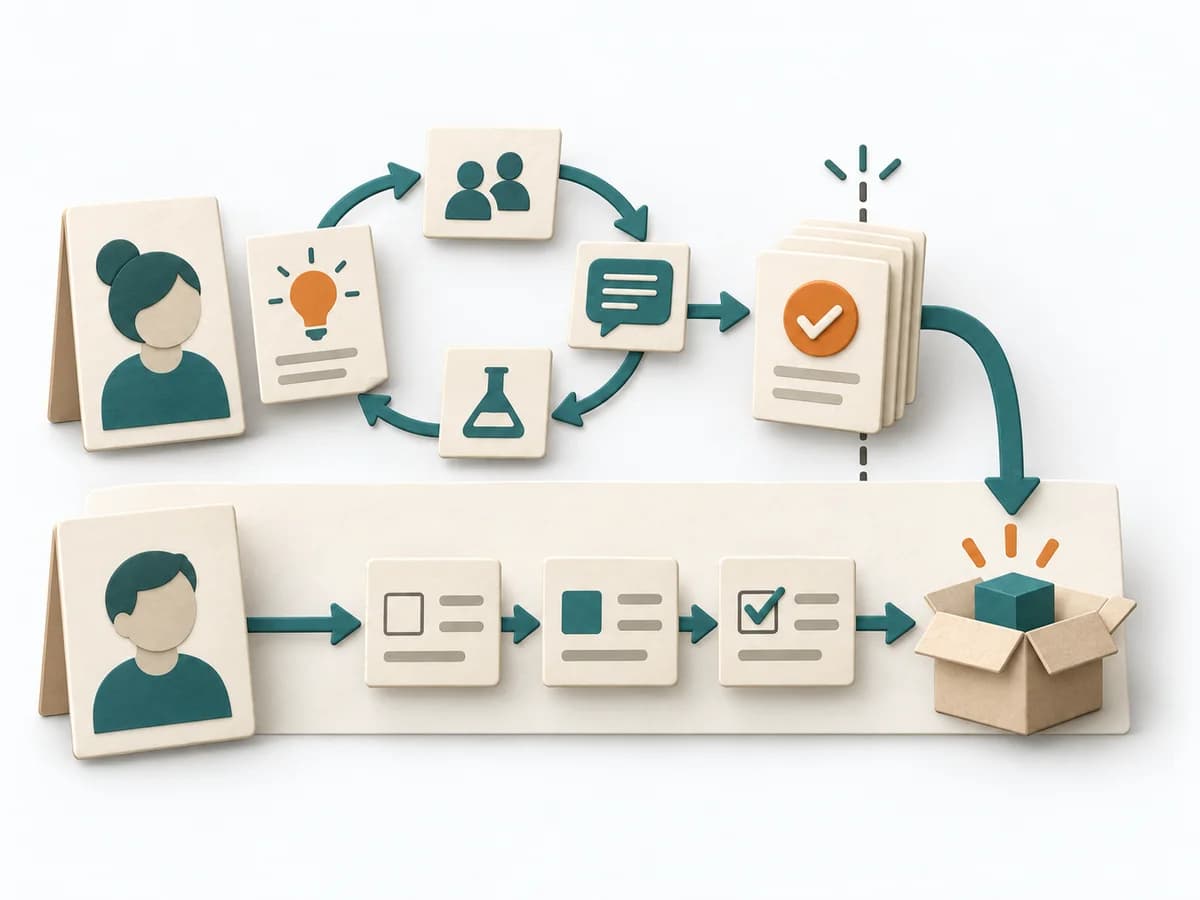 Product Discovery Dual-Track Agile |  Operations Failure Mode and Effects Analysis |
|---|---|---|---|---|
Purposedifferent | For a deviation after a change, the method isolates the influence of the altered condition. It narrows down which differences are relevant and which are just accompanying noise. | Plans often contain assumptions that were never openly stated and remain dangerous precisely because of that. Assumption Surfacing makes these silent premises visible and prioritizes which of them carry the initiative or could sink it. | When uncertainty and delivery run in parallel, it separates learning work from implementation while keeping both connected. It prevents unvalidated ideas from falling directly into the delivery stream. | For a process, product, or service with noticeable failure risks, the method assesses possible failure modes in advance. It directs attention to combinations of occurrence, effect, and detectability. |
Complexitydifferent | Medium | Low | Medium | High |
Timedifferent | 45-120 min | 45-90 min | Laufend, Wochen bis Monate | 2-6 h |
Participantsdifferent | 2-6 | 2-8 | 4-10 | 3-10 |
Formatdifferent | Workshop + async | Workshop + async | Workshop + async | Workshop |
Outputdifferent | Change Matrix, Cause Hypotheses, Validation Questions, Action List | Assumption List, Critical Assumptions, Learning Plan | Discovery Backlog, Delivery Backlog, Experiment-Ergebnisse, Validierte Stories | FMEA Table, Risk Priority, Mitigation Actions |
Tagsno overlap | ChangeRoot causeTroubleshootingComparison | AssumptionsRiskDecisionDiscovery | AgileDiscoveryDelivery | RiskQualityOperationsRoot cause |