View methods side by side.
Choose up to four methods. Add them using the search and share the comparison by copying its link.
| Criterion | 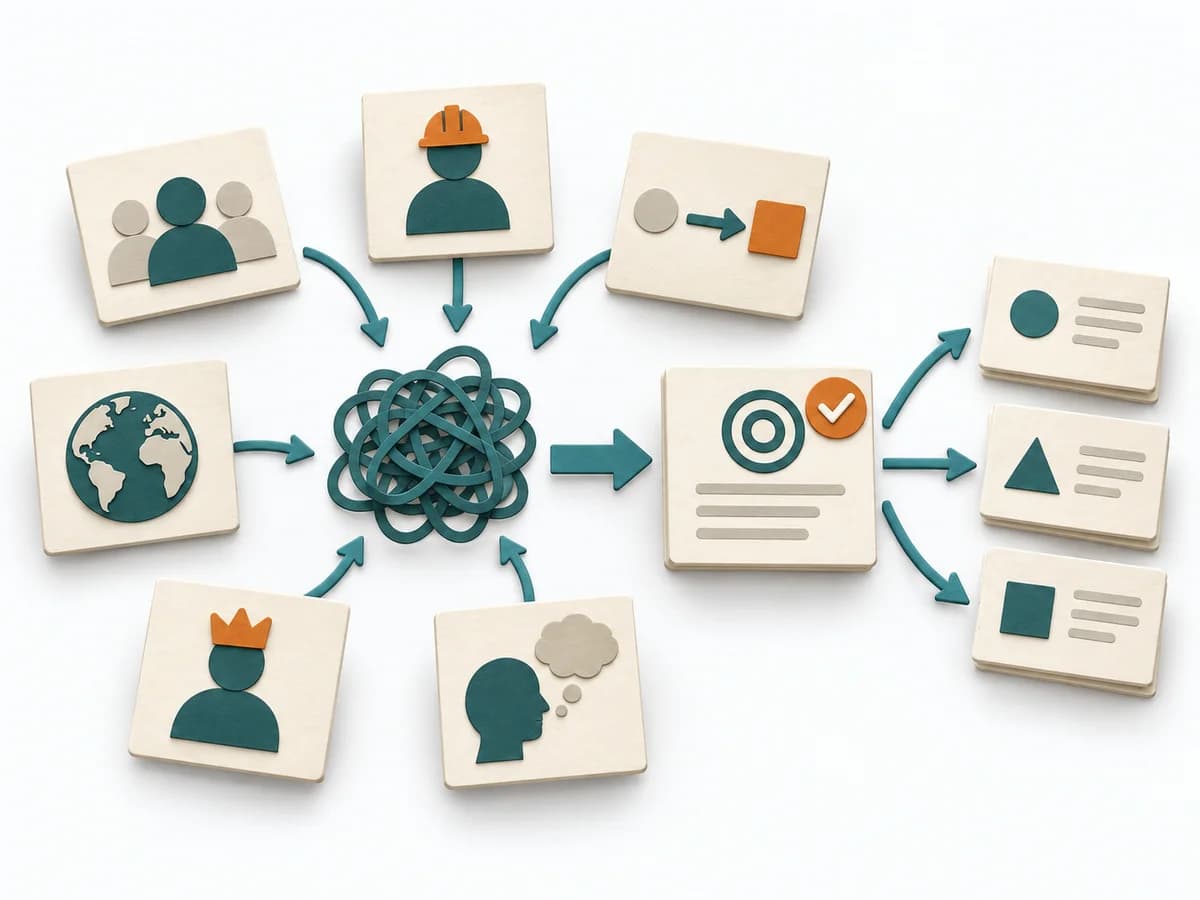 Systems Thinking CATWOE Analysis |  Domain Modeling Context Map |  Domain Modeling Bounded Context Canvas |  Systems Thinking Leverage Points |
|---|---|---|---|---|
Purposedifferent | CATWOE structures a problem from six viewpoints and prevents too narrow a view of the situation. Different experiences of the system become comparably discussable this way. | When several contexts need to talk to each other, it makes their relationships and dependencies legible. It helps sort integration pressure and responsibilities across system boundaries. | When a business context is still loosely outlined, it shapes language, responsibility, and integration space. It clarifies what belongs together and where a boundary needs to hold. | Leverage Points show exactly where interventions in a system produce a disproportionate effect. It draws relationships, patterns, and feedback loops. The result is captured as a leverage map and action strategy. |
Complexitydifferent | Medium | Medium | Medium | High |
Timedifferent | 45-90 min | 1-3 h | 1-3 h | Half day |
Participantsdifferent | 3-8 | 2-8 | 3-8 | 3-12 |
Formatdifferent | Workshop + async | Workshop + async | Workshop + async | Workshop |
Outputdifferent | CATWOE Canvas, Root Definition, Stakeholder Perspectives, Constraints | Context Map, Integration Patterns, Boundary Notes | Context Canvas, Glossary, Integration Notes | Leverage Map, Action Strategy |
Tagsno overlap | Systems thinkingFramingStakeholders | Domain-Driven DesignBoundariesStrategy | Domain-Driven DesignBoundariesModeling | Systems thinkingChangeStrategy |