View methods side by side.
Choose up to four methods. Add them using the search and share the comparison by copying its link.
| Criterion |  Domain Modeling Bounded Context Canvas |  Domain Modeling Domain Context Map | 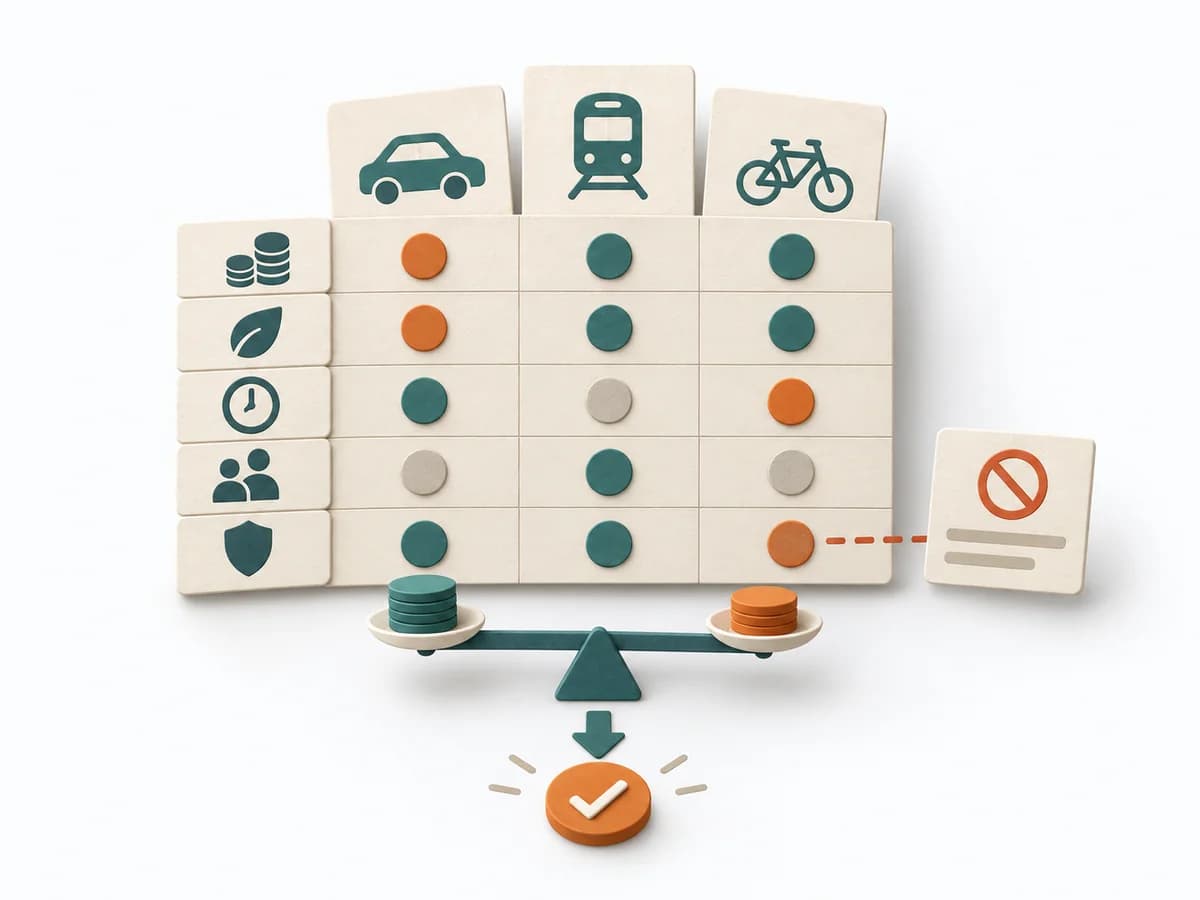 Decision Making Trade-off Analysis |  Decision Making Constraint Analysis |
|---|---|---|---|---|
Purposedifferent | When a business context is still loosely outlined, it shapes language, responsibility, and integration space. It clarifies what belongs together and where a boundary needs to hold. | When a domain model and its associated contexts need to be thought through together, it creates a shared overview. It connects the business view and organizational boundary into a readable whole. | With limited resources, quality, speed, cost, and risk almost always compete with each other. Trade-off Analysis makes these tensions explicit and prevents decisions from producing hidden side effects. | When an initiative stalls, the limit often lies not in the idea but in hard or soft boundary conditions. Constraint Analysis separates these limits and shows which of them can actually be shaped. |
Complexitydifferent | Medium | Medium | Medium | Low |
Timedifferent | 1-3 h | 1-3 h | 45-120 min | 30-90 min |
Participantsdifferent | 3-8 | 3-10 | 2-8 | 2-8 |
Formatdifferent | Workshop + async | Workshop | Workshop + async | Workshop + async |
Outputdifferent | Context Canvas, Glossary, Integration Notes | Domain Context Map, Boundary Notes, Ownership Map | Trade-off Matrix, Criteria List, Decision Rationale, Accepted Downsides | Constraint List, Hard/Soft Classification, Option Impact Notes, Decision Boundaries |
Tagsno overlap | Domain-Driven DesignBoundariesModeling | Domain-Driven DesignContextBoundaries | TradeoffsDecisionCriteriaOptions | ConstraintsDecisionPlanningOptions |