View methods side by side.
Choose up to four methods. Add them using the search and share the comparison by copying its link.
| Criterion |  Domain Modeling Bounded Context Canvas |  Domain Modeling Context Map | 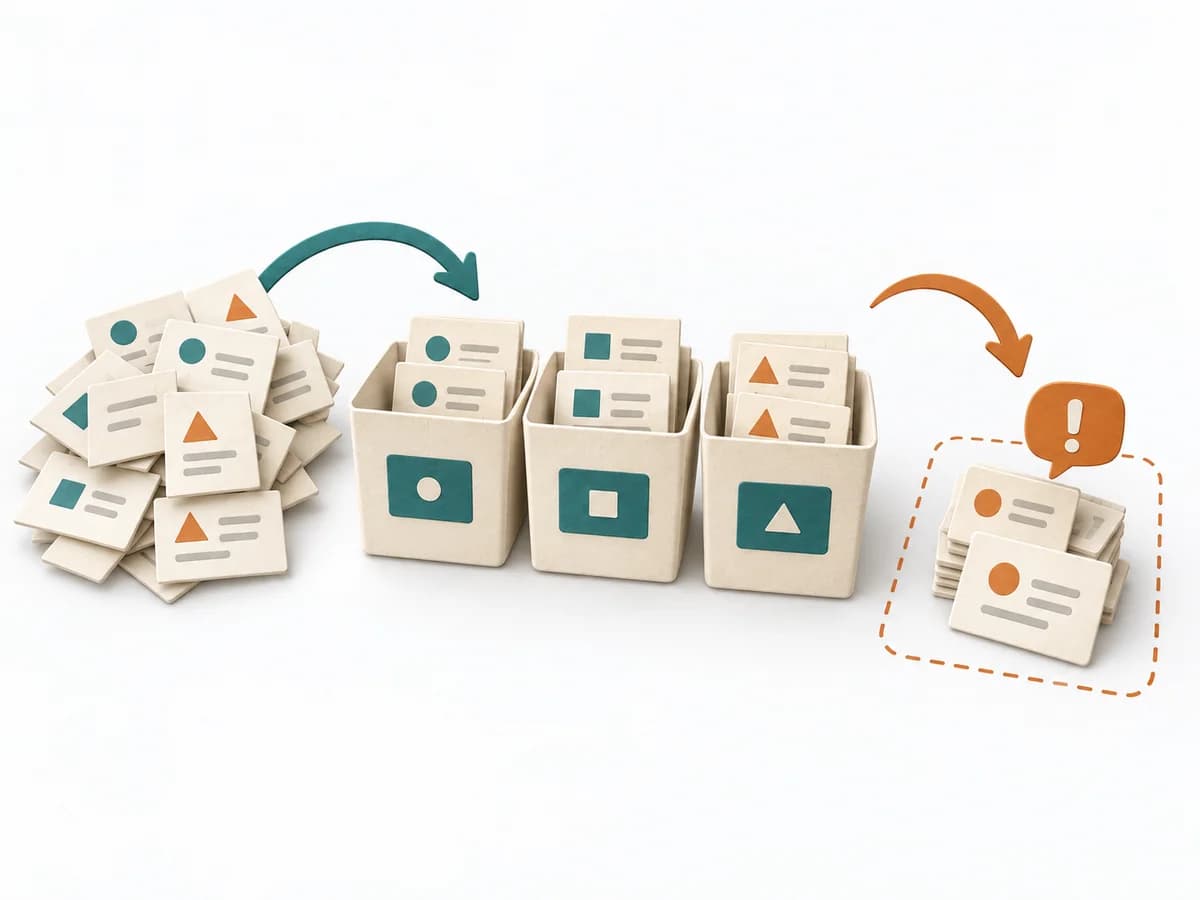 Agile Bucket System |  Agile Planning Poker |
|---|---|---|---|---|
Purposedifferent | When a business context is still loosely outlined, it shapes language, responsibility, and integration space. It clarifies what belongs together and where a boundary needs to hold. | When several contexts need to talk to each other, it makes their relationships and dependencies legible. It helps sort integration pressure and responsibilities across system boundaries. | When a large batch of work needs a fast, rough estimate, it sorts items into predefined size buckets. It sorts work by value, risk, and delivery ability. The result is captured as a Bucketed Backlog, Relative Estimates, and Split Candidates. | When estimates within the team diverge too much, it puts differing expectations on a common test bench. It separates rough complexity from unspoken assumptions. |
Complexitydifferent | Medium | Medium | Medium | Low |
Timedifferent | 1-3 h | 1-3 h | 30-90 min | 2-5 min je Item |
Participantsdifferent | 3-8 | 2-8 | 3-12 | 3-9 |
Formatdifferent | Workshop + async | Workshop + async | Workshop | Workshop + async |
Outputdifferent | Context Canvas, Glossary, Integration Notes | Context Map, Integration Patterns, Boundary Notes | Bucketed Backlog, Relative Estimates, Split Candidates | Relative Estimates, Assumption Notes, Split Candidates |
Tagsno overlap | Domain-Driven DesignBoundariesModeling | Domain-Driven DesignBoundariesStrategy | EstimationBacklogRelative sizing | EstimationAgileRelative sizingTeam |