View methods side by side.
Choose up to four methods. Add them using the search and share the comparison by copying its link.
| Criterion |  DevOps Blameless Postmortem | 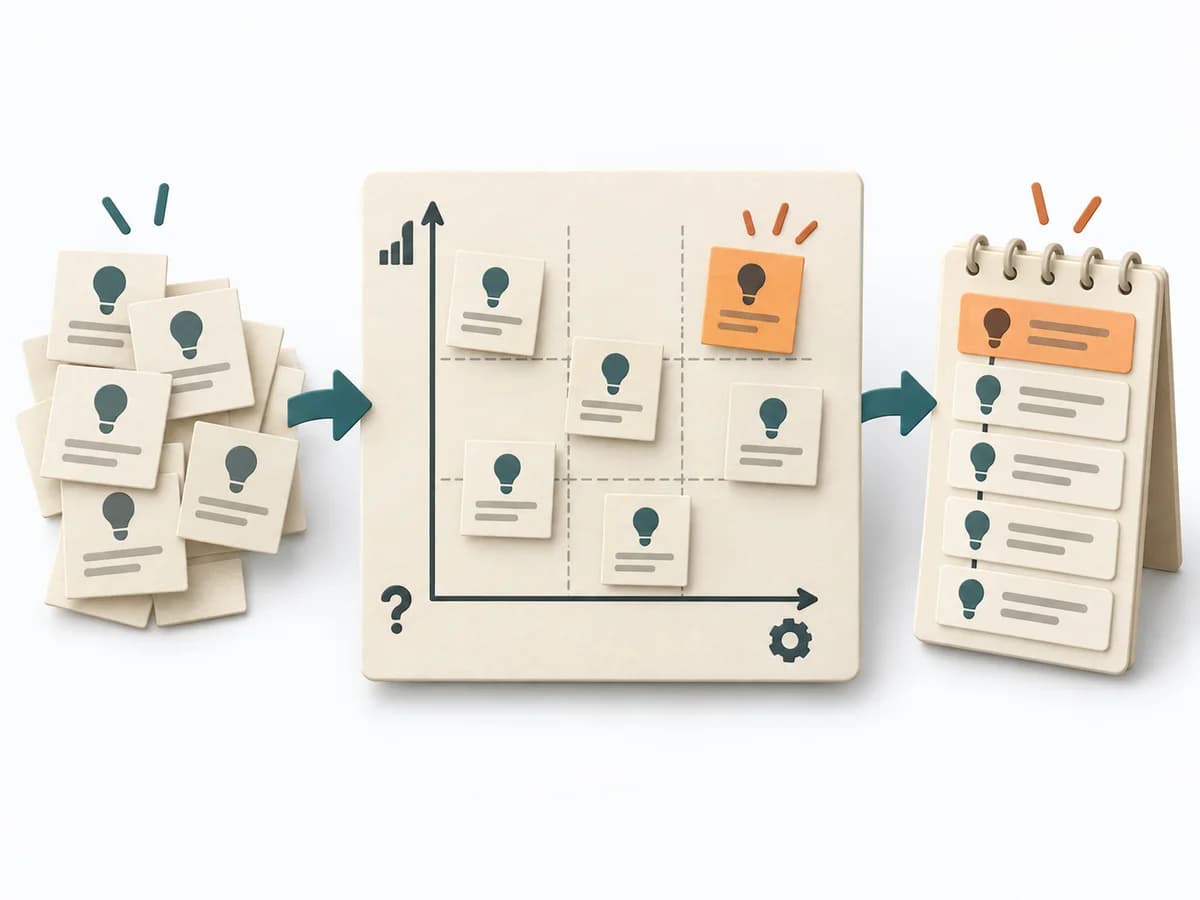 Product Discovery Hypothesis Prioritization Canvas |  Decision Making Force Field Analysis |  Product Discovery Experiment Canvas |
|---|---|---|---|---|
Purposedifferent | After an incident with damage or a near miss, the method creates a sober field for learning without assigning blame. It directs attention to the course of events, conditions, and effective countermeasures. | When many hypotheses compete for attention, it brings order to their learning sequence and importance. It separates problem, assumption, solution, and evidence. The result is captured as a prioritization canvas and a hypothesis backlog. | In change initiatives, supporting and restraining forces sit at the table at the same time. Force Field Analysis makes these tensions explicit and shows where change can be pushed forward by strengthening or relieving. | When experiments become unreadable after the fact, it arranges hypothesis, signal, and learning goal on a single canvas. It separates problem, assumption, solution, and evidence. The result is captured as a Completed Experiment Canvas and a Success Metric. |
Complexitydifferent | Medium | Medium | Low | Low |
Timedifferent | 30-90 min | 60-90 min | 45-90 min | 30-60 min |
Participantsdifferent | 3-12 | 3-8 | 3-12 | 1-5 |
Formatdifferent | Workshop + async | Workshop | Workshop | Workshop + async |
Outputdifferent | Postmortem Doc, Action Items, Timeline | Prioritization Canvas, Hypothesis Backlog | Force Field Map, Change Levers, Risk Notes | Completed Experiment Canvas, Success Metric |
Tagsno overlap | Site Reliability EngineeringIncidentLearningReliability | ExperimentsPrioritizationDiscoveryHypothesis | ChangeDecisionStrategy | ExperimentsValidationDiscoveryHypothesis |