View methods side by side.
Choose up to four methods. Add them using the search and share the comparison by copying its link.
Selected:Blameless PostmortemARID (Active Reviews for Intermediate Designs)Hypothesis Prioritization CanvasLearning Card
| Criterion |  DevOps Blameless Postmortem |  Architecture ARID (Active Reviews for Intermediate Designs) | 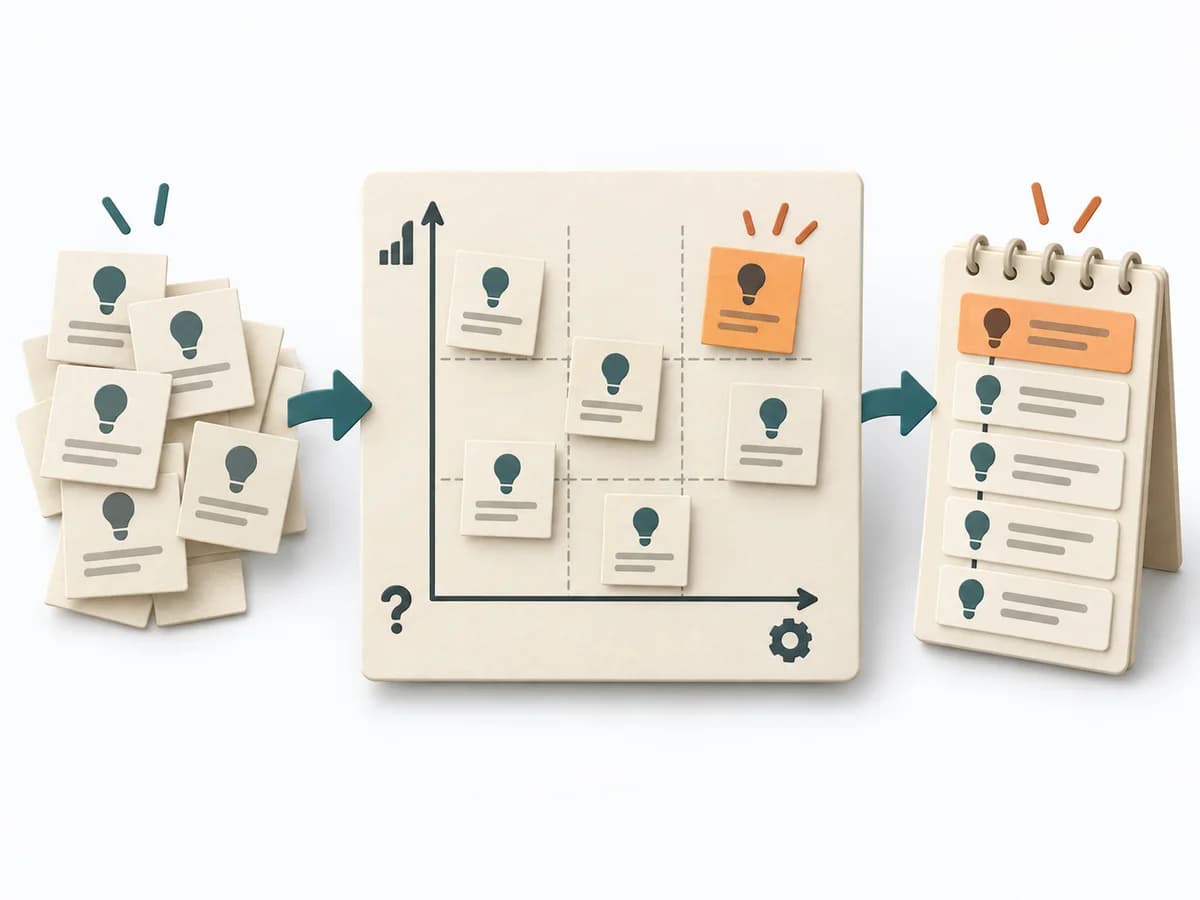 Product Discovery Hypothesis Prioritization Canvas |  Product Discovery Learning Card |
|---|---|---|---|---|
Purposedifferent | After an incident with damage or a near miss, the method creates a sober field for learning without assigning blame. It directs attention to the course of events, conditions, and effective countermeasures. | ARID examines how well developers can work with a technical design. It focuses on a part of the system that can still be revised, between the architecture overview and the detailed specification. | When many hypotheses compete for attention, it brings order to their learning sequence and importance. It separates problem, assumption, solution, and evidence. The result is captured as a prioritization canvas and a hypothesis backlog. | The Learning Card connects traceable test results to a reasoned next action while keeping the limits of the insight visible. |
Complexitydifferent | Medium | Medium | Medium | Low |
Timedifferent | 30-90 min | 2–4 h review as a planning range; preparation and evaluation additional | 60-90 min | 25-40 min |
Participantsdifferent | 3-12 | Designers, developers as users, and facilitation | 3-8 | 1-5 |
Formatdifferent | Workshop + async | Workshop + async | Workshop | Workshop + async |
Outputdifferent | Postmortem Doc, Action Items, Timeline | Prioritized development tasks, Jointly produced code or pseudocode, Observed difficulties and open design questions, Proposed design revisions | Prioritization Canvas, Hypothesis Backlog | Learning Card with evidence and next action |
Tagsno overlap | Site Reliability EngineeringIncidentLearningReliability | ArchitectureEngineeringFeedbackValidationTasks | ExperimentsPrioritizationDiscoveryHypothesis | ExperimentsValidationDiscoveryLearning |