View methods side by side.
Choose up to four methods. Add them using the search and share the comparison by copying its link.
| Criterion |  Decision Making Assumption Surfacing |  Facilitation Nominal Group Technique | 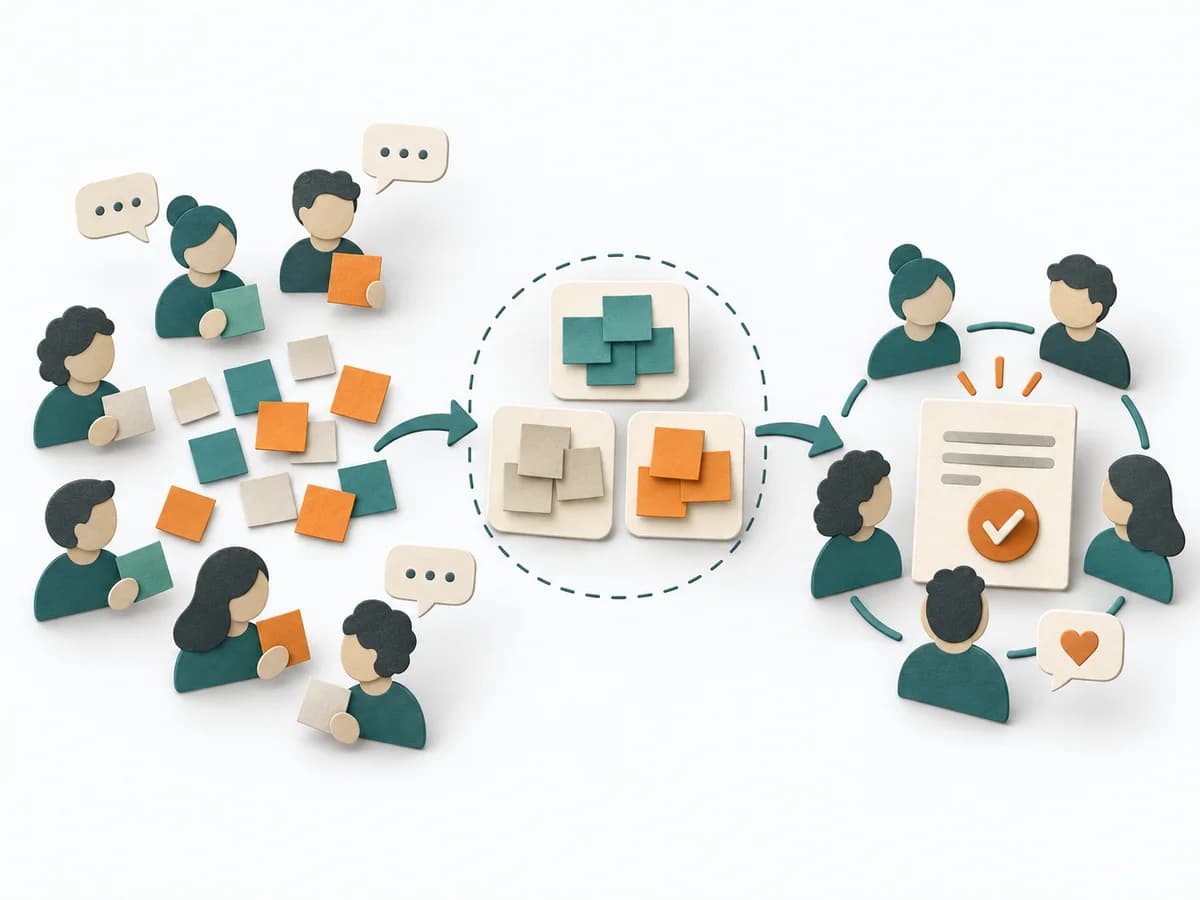 Facilitation Consensus Workshop |  Facilitation Decision Jam |
|---|---|---|---|---|
Purposedifferent | Plans often contain assumptions that were never openly stated and remain dangerous precisely because of that. Assumption Surfacing makes these silent premises visible and prioritizes which of them carry the initiative or could sink it. | When loud voices could dominate a round, Nominal Group Technique protects individual thinking time from group effects. It collects ideas separately first and only then enables shared weighting. | When a group needs a solid decision without outvoting individual factions, a Consensus Workshop creates a negotiable common ground. It makes agreement, reservations, and open tensions discussable at the same time. | When a decision is stuck, Decision Jam loosens the knot through structured separation of problem, idea, and selection. The format creates movement without jumping prematurely at the first seemingly elegant answer. |
Complexitydifferent | Low | Medium | Medium | Low |
Timedifferent | 45-90 min | 60-120 min | 1-3 h | 60-90 min |
Participantsdifferent | 2-8 | 5-12 | 5-30 | 4-10 |
Formatdifferent | Workshop + async | Workshop | Workshop | Workshop |
Outputdifferent | Assumption List, Critical Assumptions, Learning Plan | Ranked Ideas, Clarified Options, Group Priority | Consensus Clusters, Theme Titles, Priority Areas | Problem Cluster, Prioritized Challenge, Experiment |
Tagsno overlap | AssumptionsRiskDecisionDiscovery | FacilitationPrioritizationVotingInclusion | FacilitationConsensusWorkshopAlignment | FacilitationDecisionProblem solvingWorkshop |