View methods side by side.
Choose up to four methods. Add them using the search and share the comparison by copying its link.
| Criterion |  Decision Making Assumption Surfacing |  DevOps Incident Command | 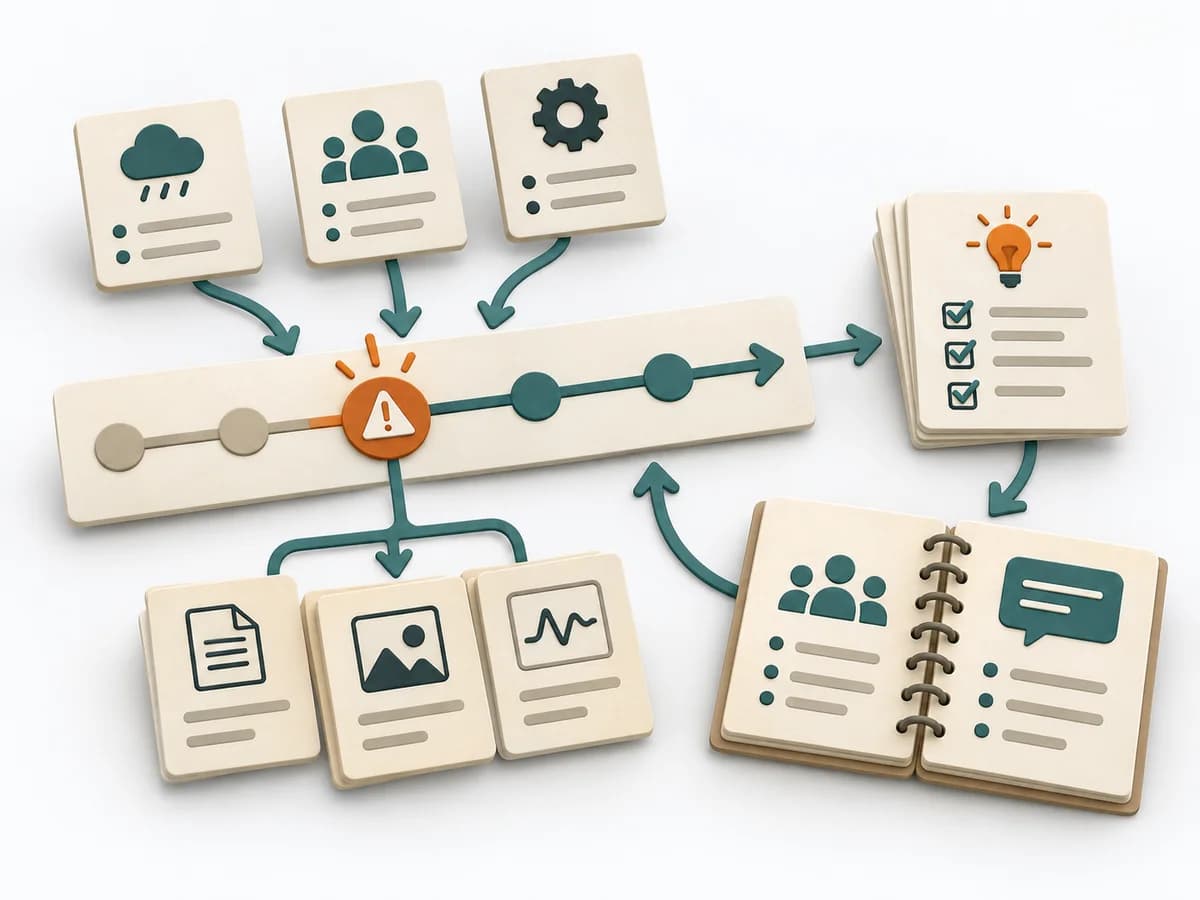 DevOps Blameless Postmortem |  Product Strategy DIBB |
|---|---|---|---|---|
Purposedifferent | Plans often contain assumptions that were never openly stated and remain dangerous precisely because of that. Assumption Surfacing makes these silent premises visible and prioritizes which of them carry the initiative or could sink it. | During an acute incident with several people involved, the method creates a clear leadership and communication structure. It reduces chaos when fast coordination and clean situational awareness are both needed at once. | After an incident with damage or a near miss, the method creates a sober field for learning without assigning blame. It directs attention to the course of events, conditions, and effective countermeasures. | DIBB helps clarify target groups, value, goals, and priorities by making the logic behind a decision explicit. It captures results as a DIBB document, belief list, bet list, and learning report. |
Complexitydifferent | Low | Medium | Medium | Low |
Timedifferent | 45-90 min | As needed | 30-90 min | 1-2 h |
Participantsdifferent | 2-8 | 4-15 | 3-12 | 2-8 |
Formatsame | Workshop + async | Workshop + async | Workshop + async | Workshop + async |
Outputdifferent | Assumption List, Critical Assumptions, Learning Plan | Incident Log, Action Tracker, Stakeholder Updates | Postmortem Doc, Action Items, Timeline | DIBB document, Belief list, Bet list, Learning report |
Tagsno overlap | AssumptionsRiskDecisionDiscovery | IncidentOperationsReliability | Site Reliability EngineeringIncidentLearningReliability | StrategyDecisionAssumptionsHypothesis |