View methods side by side.
Choose up to four methods. Add them using the search and share the comparison by copying its link.
| Criterion |  Decision Making Assumption Surfacing |  Knowledge Modeling Competency Questions |  Decision Making Force Field Analysis | 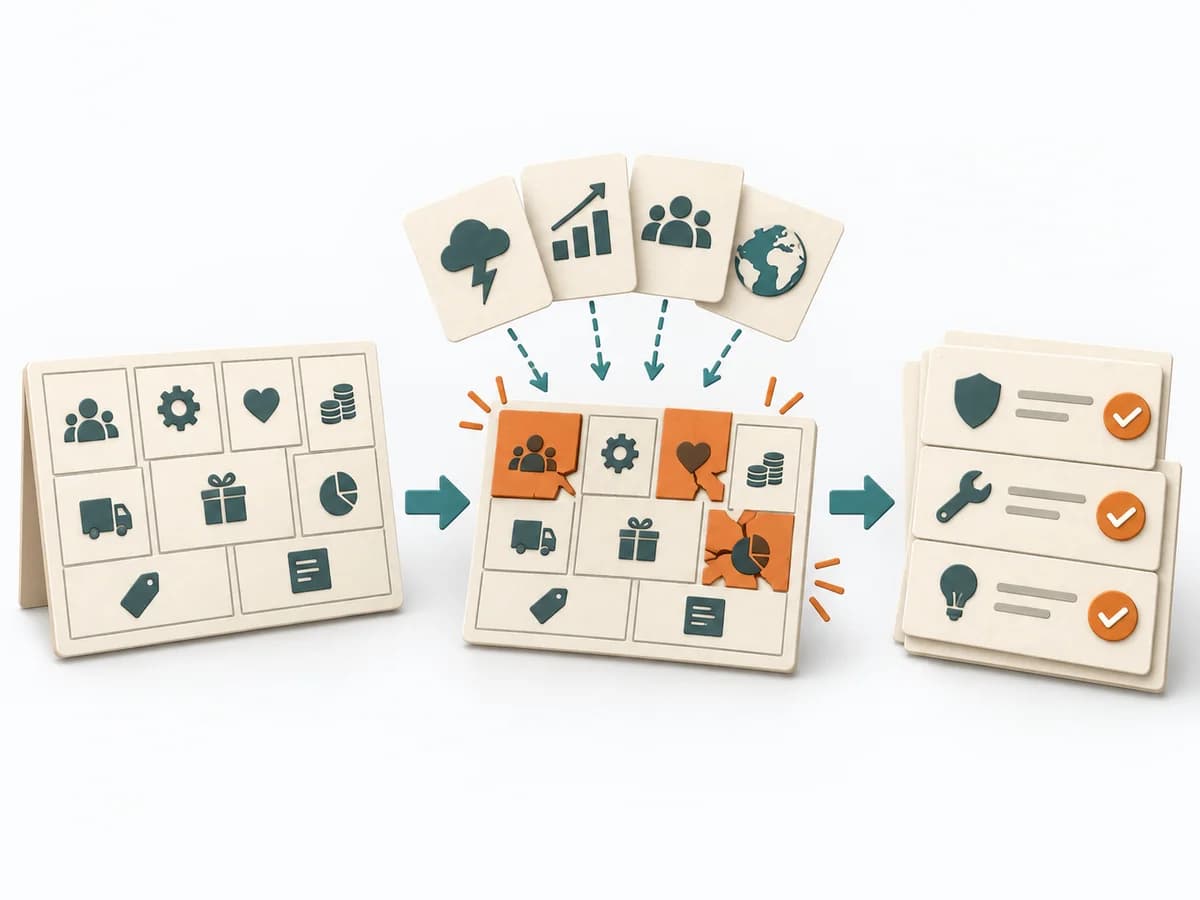 Business Strategy Business Model Stress Test |
|---|---|---|---|---|
Purposedifferent | Plans often contain assumptions that were never openly stated and remain dangerous precisely because of that. Assumption Surfacing makes these silent premises visible and prioritizes which of them carry the initiative or could sink it. | Competency Questions translate a domain model into concrete questions that it must be able to answer. The method keeps the model's scope clean and prevents pretty but useless structures. | In change initiatives, supporting and restraining forces sit at the table at the same time. Force Field Analysis makes these tensions explicit and shows where change can be pushed forward by strengthening or relieving. | A Business Model Stress Test checks how well a business model holds up under pressure and headwinds. It compares strengths, risks, market logic, and courses of action. The result is captured as a stress-test report and action plan per scenario. |
Complexitydifferent | Low | Medium | Low | High |
Timedifferent | 45-90 min | 2-4 h | 45-90 min | Half day |
Participantsdifferent | 2-8 | 2-8 | 3-12 | 3-8 |
Formatdifferent | Workshop + async | Workshop + async | Workshop | Workshop |
Outputdifferent | Assumption List, Critical Assumptions, Learning Plan | Competency Question Set, Required Concepts, Test Queries, Coverage Matrix | Force Field Map, Change Levers, Risk Notes | Stress Test Report, Action Plan per Scenario |
Tagsno overlap | AssumptionsRiskDecisionDiscovery | OntologyKnowledge graphScopeRequirementsSemantic | ChangeDecisionStrategy | StrategyBusiness modelRiskDiagnosis |