View methods side by side.
Choose up to four methods. Add them using the search and share the comparison by copying its link.
Selected:ARID (Active Reviews for Intermediate Designs)Evaporating CloudCurrent Reality TreeAssumption Mapping
| Criterion |  Architecture ARID (Active Reviews for Intermediate Designs) | 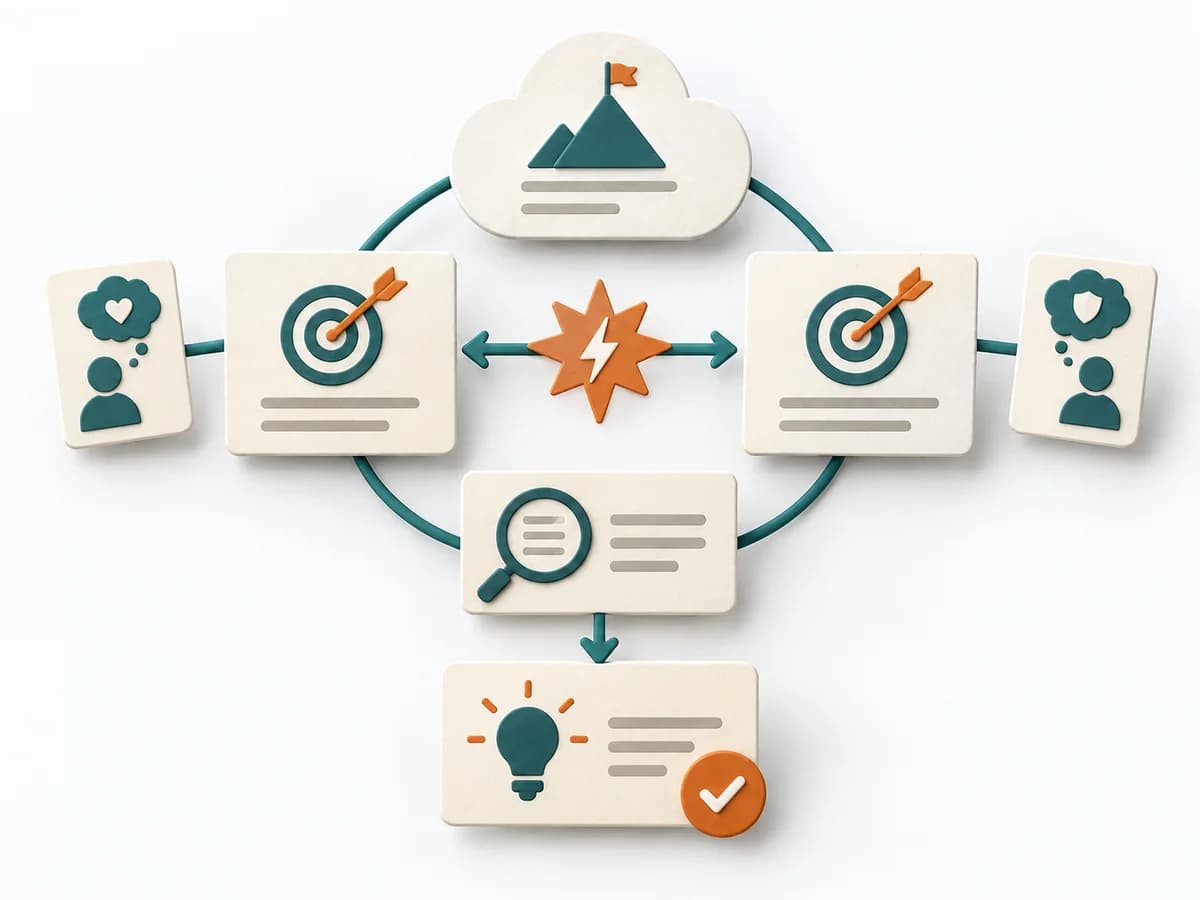 Systems Thinking Evaporating Cloud |  Systems Thinking Current Reality Tree |  Product Discovery Assumption Mapping |
|---|---|---|---|---|
Purposedifferent | ARID examines how well developers can work with a technical design. It focuses on a part of the system that can still be revised, between the architecture overview and the detailed specification. | The method makes visible why two seemingly incompatible demands arise and which assumption must be tested to resolve the conflict. | A Current Reality Tree condenses many symptoms into a few causal chains. The method makes visible which core problems drive several negative effects at once. | When assumptions still sit unordered in the room, it weighs uncertainty against leverage. It makes visible which hypotheses should be checked first. |
Complexitydifferent | Medium | Medium | High | Medium |
Timedifferent | 2–4 h review as a planning range; preparation and evaluation additional | 60-120 min | 2-6 h | 45-60 min |
Participantsdifferent | Designers, developers as users, and facilitation | 2-8 | 3-8 | 2-8 |
Formatdifferent | Workshop + async | Workshop | Workshop | Workshop + async |
Outputdifferent | Prioritized development tasks, Jointly produced code or pseudocode, Observed difficulties and open design questions, Proposed design revisions | Conflict Cloud, Assumption List, Breakthrough Ideas, Next Experiments | Current Reality Tree, Core Problems, Intervention Ideas | Assumption map, Test backlog, Risk ranking |
Tagsno overlap | ArchitectureEngineeringFeedbackValidationTasks | Theory of ConstraintsAssumptionsSystems thinking | Systems thinkingRoot causeConstraintsCausality | AssumptionsRiskExperimentsValidation |