View methods side by side.
Choose up to four methods. Add them using the search and share the comparison by copying its link.
| Criterion |  Architecture ARID (Active Reviews for Intermediate Designs) |  Decision Making Decision Tree | 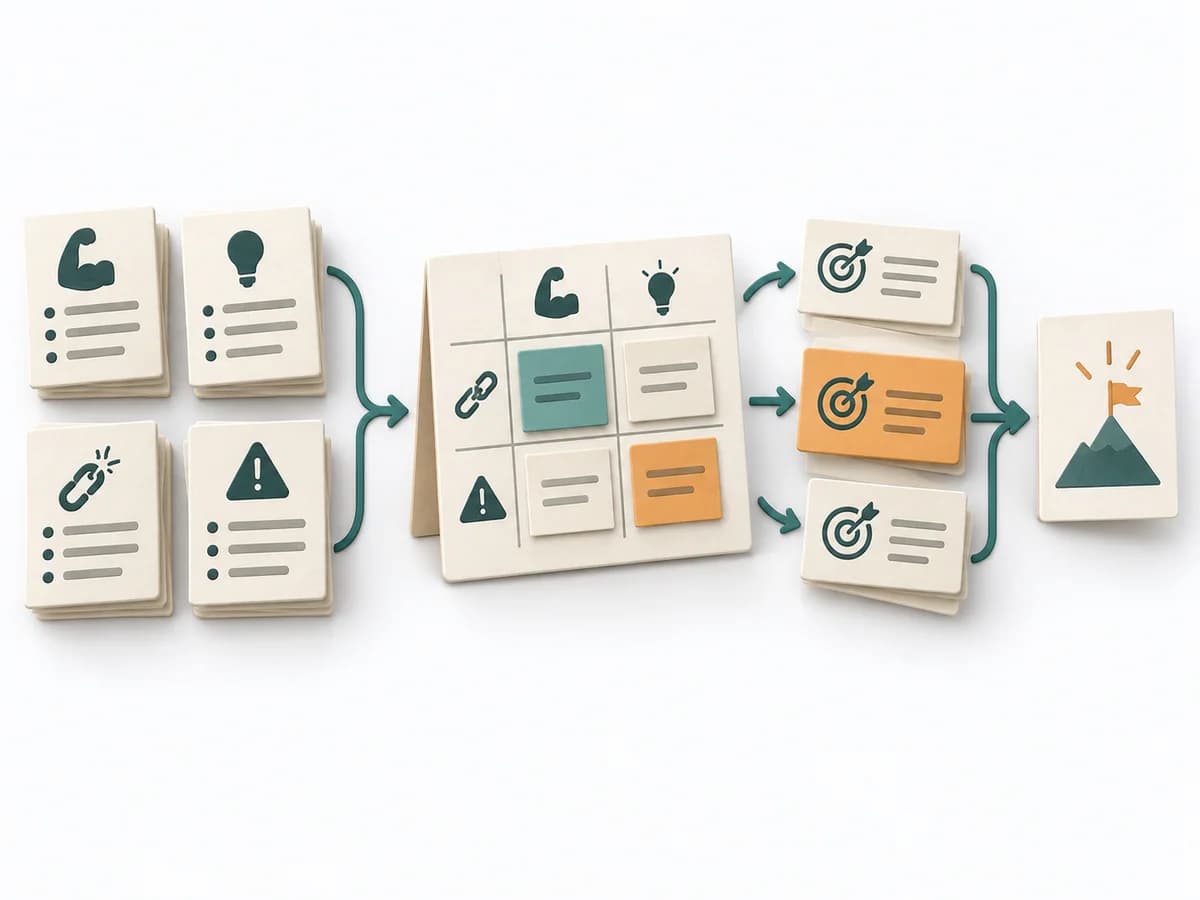 Business Strategy TOWS Matrix |  Decision Making Force Field Analysis |
|---|---|---|---|---|
Purposedifferent | ARID examines how well developers can work with a technical design. It focuses on a part of the system that can still be revised, between the architecture overview and the detailed specification. | For decisions with follow-on paths and dependencies, a linear comparison is often not enough. A Decision Tree shows how options branch under conditions and which consequences hang on each branch. | The TOWS Matrix connects internal strengths and weaknesses with external opportunities and threats into action-oriented strategies. It goes a step further than a pure stocktaking. | In change initiatives, supporting and restraining forces sit at the table at the same time. Force Field Analysis makes these tensions explicit and shows where change can be pushed forward by strengthening or relieving. |
Complexitydifferent | Medium | Medium | Medium | Low |
Timedifferent | 2–4 h review as a planning range; preparation and evaluation additional | 30-90 min | 1-2 h | 45-90 min |
Participantsdifferent | Designers, developers as users, and facilitation | 1-6 | 3-10 | 3-12 |
Formatdifferent | Workshop + async | Workshop + async | Workshop | Workshop |
Outputdifferent | Prioritized development tasks, Jointly produced code or pseudocode, Observed difficulties and open design questions, Proposed design revisions | Decision Tree, Option Map, Assumption List | TOWS Matrix, Strategic Options, Priority Actions | Force Field Map, Change Levers, Risk Notes |
Tagsno overlap | ArchitectureEngineeringFeedbackValidationTasks | DecisionTreeOptions | StrategyAnalysisOptions | ChangeDecisionStrategy |