View methods side by side.
Choose up to four methods. Add them using the search and share the comparison by copying its link.
| Criterion |  Architecture ARID (Active Reviews for Intermediate Designs) |  Decision Making Decision Tree | 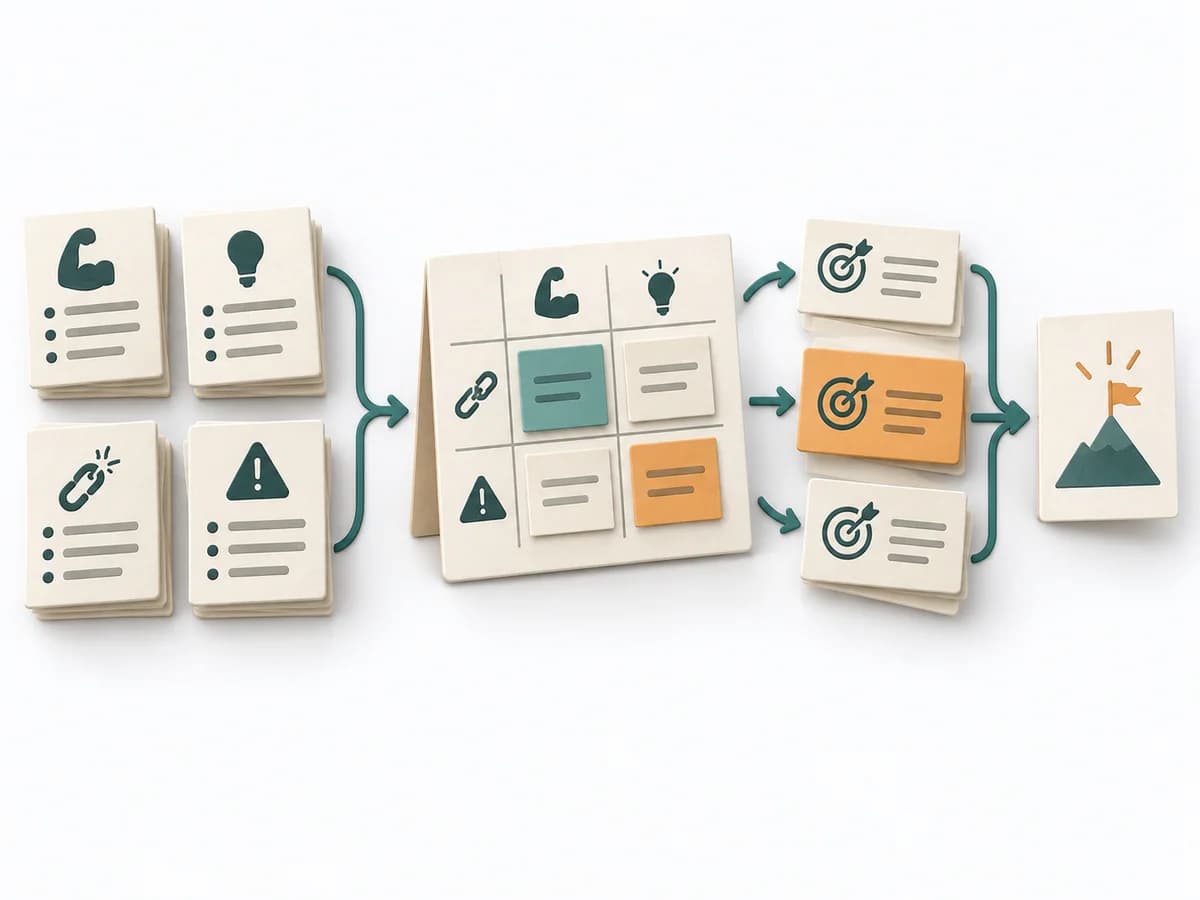 Business Strategy TOWS Matrix |  Product Strategy DIBB |
|---|---|---|---|---|
Purposedifferent | ARID examines how well developers can work with a technical design. It focuses on a part of the system that can still be revised, between the architecture overview and the detailed specification. | For decisions with follow-on paths and dependencies, a linear comparison is often not enough. A Decision Tree shows how options branch under conditions and which consequences hang on each branch. | The TOWS Matrix connects internal strengths and weaknesses with external opportunities and threats into action-oriented strategies. It goes a step further than a pure stocktaking. | DIBB helps clarify target groups, value, goals, and priorities by making the logic behind a decision explicit. It captures results as a DIBB document, belief list, bet list, and learning report. |
Complexitydifferent | Medium | Medium | Medium | Low |
Timedifferent | 2–4 h review as a planning range; preparation and evaluation additional | 30-90 min | 1-2 h | 1-2 h |
Participantsdifferent | Designers, developers as users, and facilitation | 1-6 | 3-10 | 2-8 |
Formatdifferent | Workshop + async | Workshop + async | Workshop | Workshop + async |
Outputdifferent | Prioritized development tasks, Jointly produced code or pseudocode, Observed difficulties and open design questions, Proposed design revisions | Decision Tree, Option Map, Assumption List | TOWS Matrix, Strategic Options, Priority Actions | DIBB document, Belief list, Bet list, Learning report |
Tagsno overlap | ArchitectureEngineeringFeedbackValidationTasks | DecisionTreeOptions | StrategyAnalysisOptions | StrategyDecisionAssumptionsHypothesis |