View methods side by side.
Choose up to four methods. Add them using the search and share the comparison by copying its link.
| Criterion |  Decision Making Argument Mapping |  Knowledge Modeling IBIS | 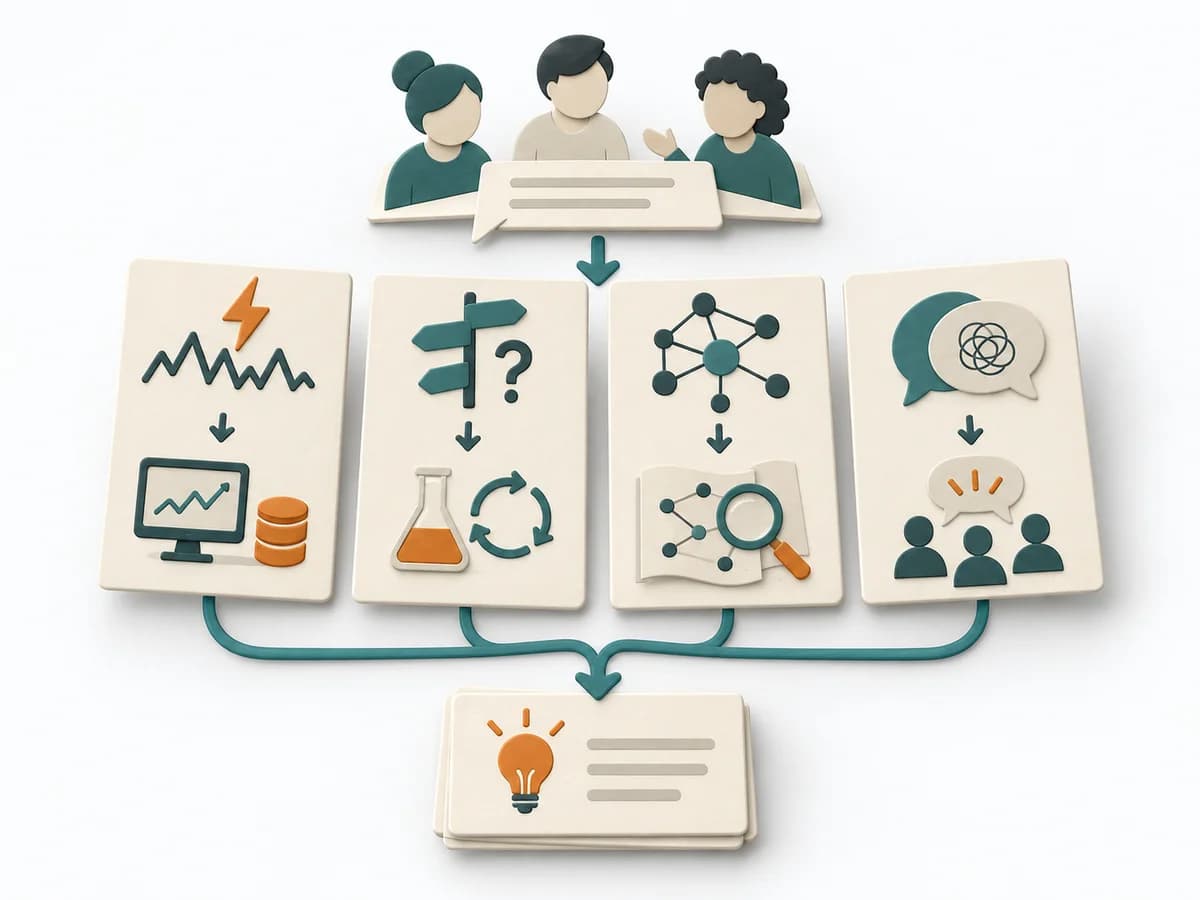 Systems Thinking VUCA Scan |  Product Strategy DIBB |
|---|---|---|---|---|
Purposedifferent | When statements, evidence, and counterarguments get mixed up, a debate quickly loses its structure. Argument Mapping breaks a thesis down into its reasoning and makes visible what it really rests on. | IBIS structures thinking about complex questions as a sequence of issues, ideas, and arguments. The method keeps discussions open without forcing them into premature consensus. | The VUCA Scan helps read difficult situations more precisely. Instead of treating unclarity as generally complicated, the method separates fast change, missing knowledge, systemic entanglement, and ambiguous interpretation. | DIBB helps clarify target groups, value, goals, and priorities by making the logic behind a decision explicit. It captures results as a DIBB document, belief list, bet list, and learning report. |
Complexitydifferent | Medium | Medium | Low | Low |
Timedifferent | 1-3 h | 1-3 h | 30-90 min | 1-2 h |
Participantsdifferent | 1-8 | 2-8 | 1-10 | 2-8 |
Formatsame | Workshop + async | Workshop + async | Workshop + async | Workshop + async |
Outputdifferent | Argument Map, Evidence Gaps, Decision Rationale | Issue Map, Positions, Argument Notes | VUCA Map, Response Options, Signal and Learning Plan | DIBB document, Belief list, Bet list, Learning report |
Tagsno overlap | SensemakingDecisionRationale | RationaleKnowledgeDecision | SensemakingUncertaintyComplexityStrategyForesight | StrategyDecisionAssumptionsHypothesis |