View methods side by side.
Choose up to four methods. Add them using the search and share the comparison by copying its link.
| Criterion | 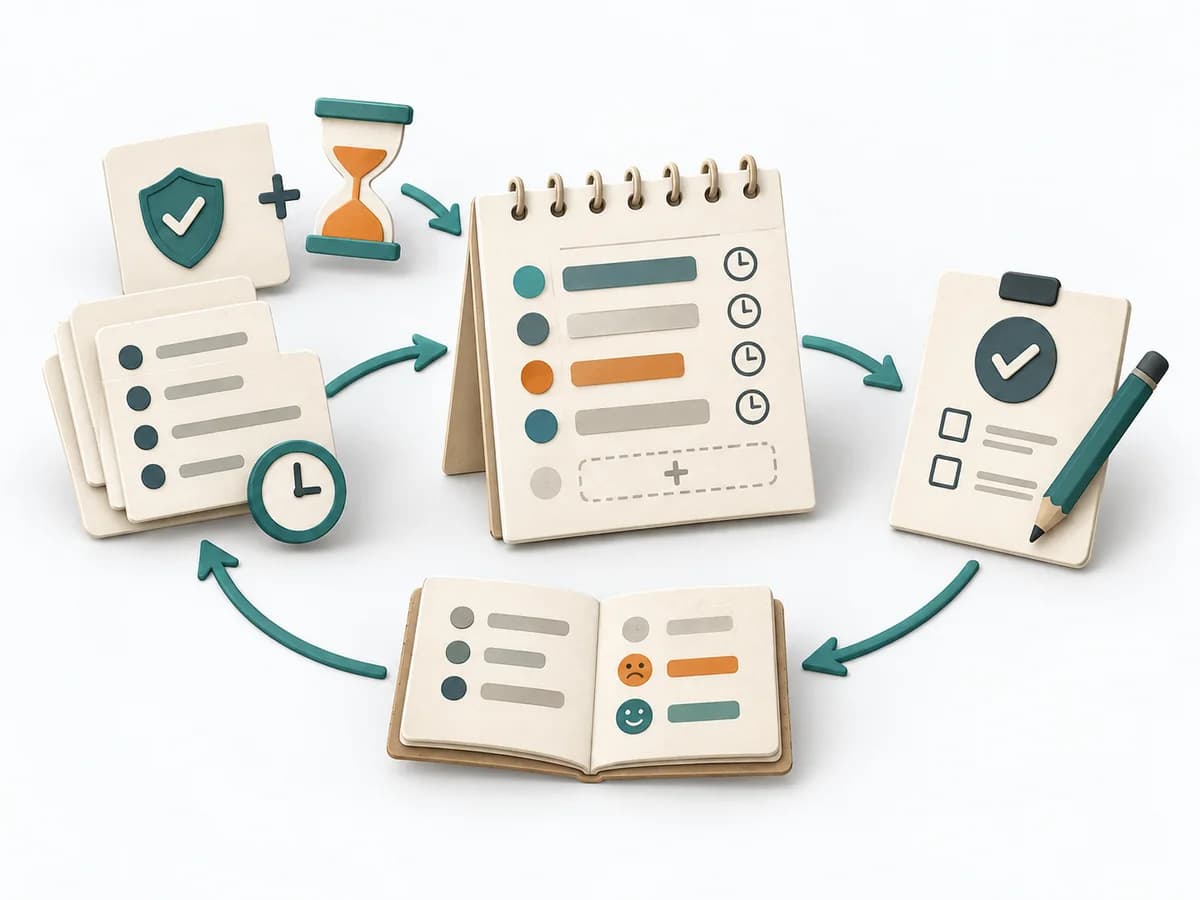 Operations ALPEN Method |  Product Strategy DIBB |  Product Discovery Experiment Canvas |  Product Discovery Assumption Mapping |
|---|---|---|---|---|
Purposedifferent | With an overloaded day full of too many tasks, a realistic picture of the day emerges. The method connects estimating, deciding, and buffer thinking so planning fits available energy and time. | DIBB helps clarify target groups, value, goals, and priorities by making the logic behind a decision explicit. It captures results as a DIBB document, belief list, bet list, and learning report. | When experiments become unreadable after the fact, it arranges hypothesis, signal, and learning goal on a single canvas. It separates problem, assumption, solution, and evidence. The result is captured as a Completed Experiment Canvas and a Success Metric. | When assumptions still sit unordered in the room, it weighs uncertainty against leverage. It makes visible which hypotheses should be checked first. |
Complexitydifferent | Low | Low | Low | Medium |
Timedifferent | 10-20 min daily | 1-2 h | 30-60 min | 45-60 min |
Participantsdifferent | 1 | 2-8 | 1-5 | 2-8 |
Formatdifferent | Async | Workshop + async | Workshop + async | Workshop + async |
Outputdifferent | Daily Plan, Time Estimates, Review Notes | DIBB document, Belief list, Bet list, Learning report | Completed Experiment Canvas, Success Metric | Assumption map, Test backlog, Risk ranking |
Tagsno overlap | PlanningTime managementProductivityOperations | StrategyDecisionAssumptionsHypothesis | ExperimentsValidationDiscoveryHypothesis | AssumptionsRiskExperimentsValidation |