View methods side by side.
Choose up to four methods. Add them using the search and share the comparison by copying its link.
| Criterion | 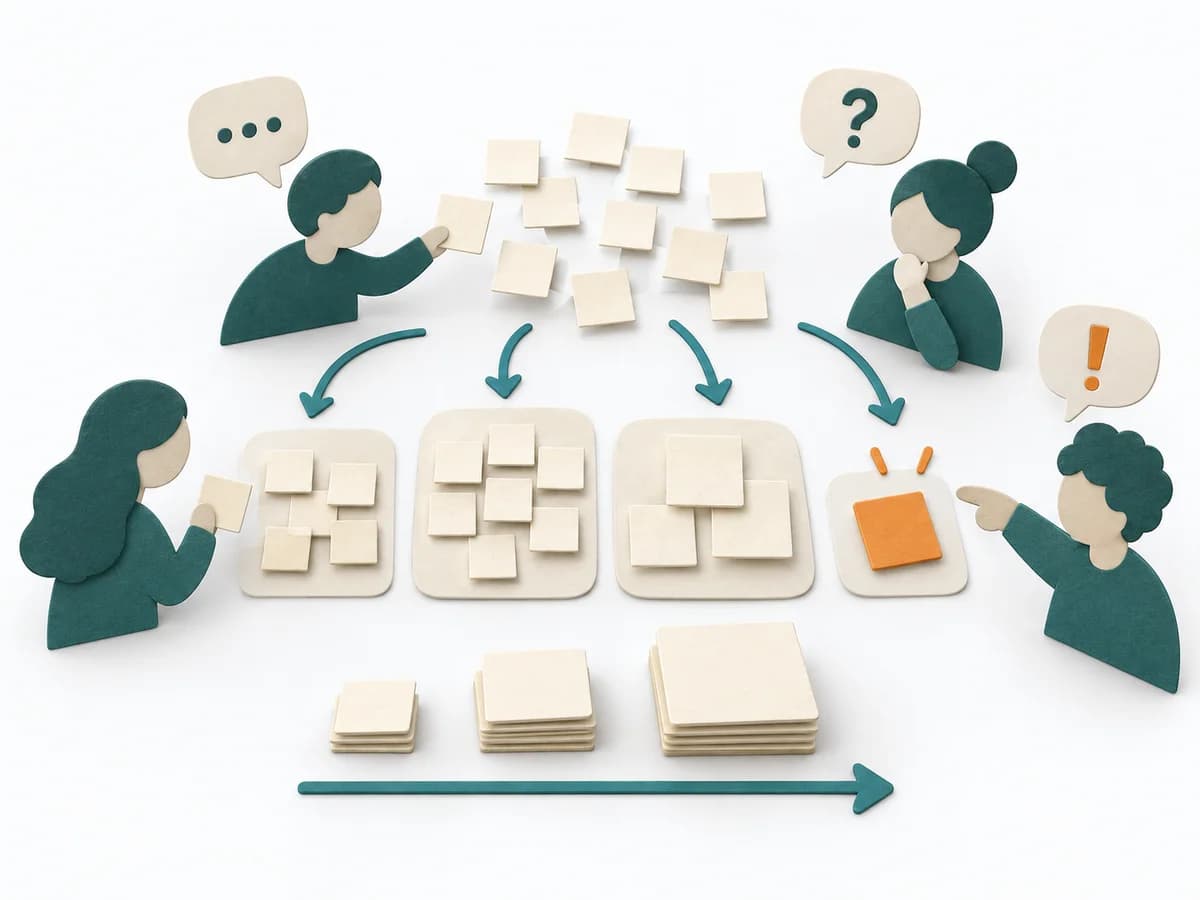 Agile Affinity Estimation |  Agile Sprint Retrospective |  Operations After-Action Review |  Agile Planning Poker |
|---|---|---|---|---|
Purposedifferent | When many tasks need to be classified quickly, it sorts them by perceived effort and similarity. It reduces the effort of fine-grained estimation for large volumes. | When a sprint is over and friction shouldn't simply be carried forward, it opens the view onto collaboration and patterns. It creates space to see causes and changes together. | After missions or project phases with unclear outcomes, the method makes visible what actually happened and what can be learned from it. It separates course, effect, and causes so experience turns into solid improvement. | When estimates within the team diverge too much, it puts differing expectations on a common test bench. It separates rough complexity from unspoken assumptions. |
Complexitydifferent | Medium | Low | Low | Low |
Timedifferent | 30-90 min | Up to 3 hours for a one-month Sprint; shorter Sprints are usually shorter | 20-45 min | 2-5 min je Item |
Participantsdifferent | 3-12 | Scrum Team | 3-12 | 3-9 |
Formatdifferent | Workshop | Workshop | Workshop + async | Workshop + async |
Outputdifferent | Affinity Size Map, Grouped Estimates, Unclear Items | Improvement actions, Team agreements | Lessons learned, Action items, Event summary | Relative Estimates, Assumption Notes, Split Candidates |
Tagsno overlap | EstimationBacklogRelative sizing | RetrospectiveImprovementLearning | LearningOperationsImprovement | EstimationAgileRelative sizingTeam |