View methods side by side.
Choose up to four methods. Add them using the search and share the comparison by copying its link.
| Criterion |  Agile Affinity Estimation |  Growth Hooked Model | 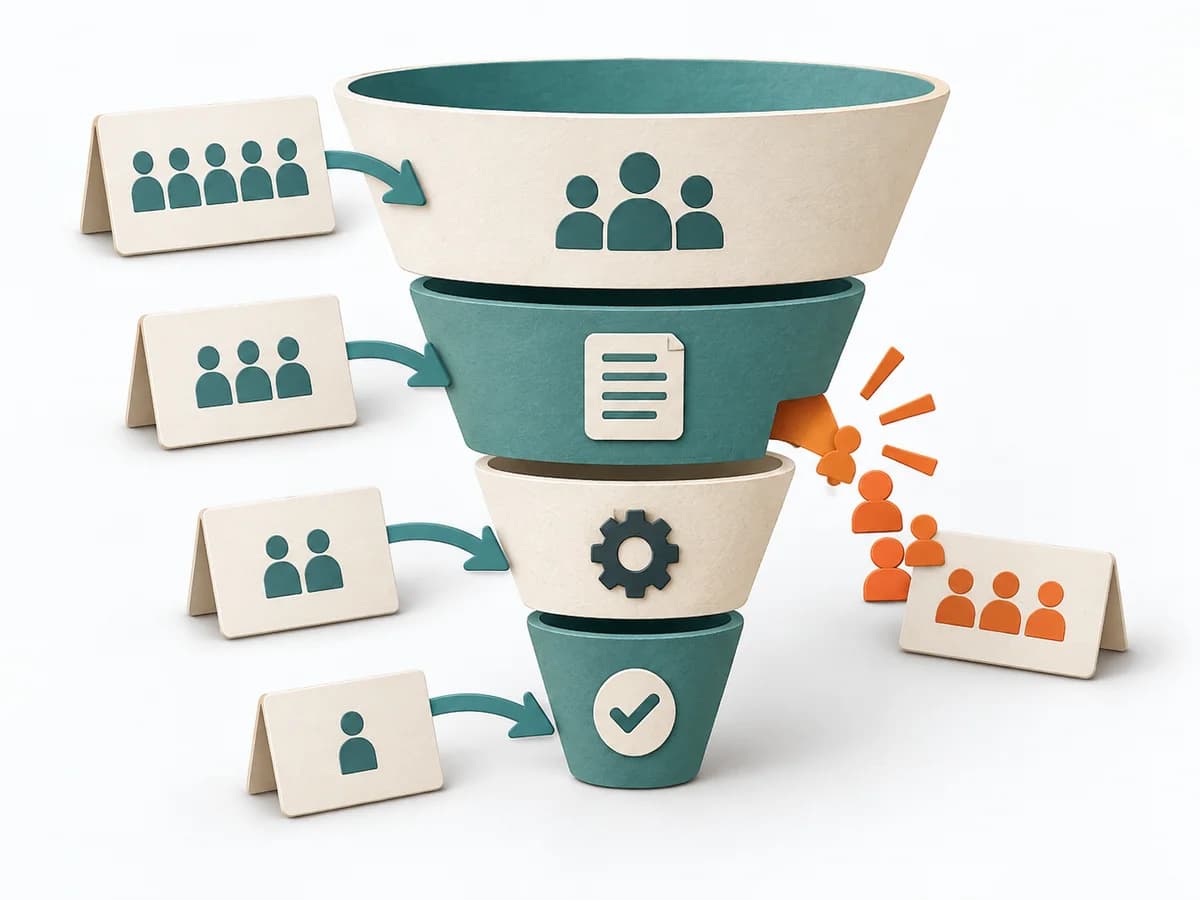 Growth Funnel Analysis |  Growth Flywheel |
|---|---|---|---|---|
Purposedifferent | When many tasks need to be classified quickly, it sorts them by perceived effort and similarity. It reduces the effort of fine-grained estimation for large volumes. | The Hooked Model helps clarify engagement loops, user behavior, and experiments. It makes repeat behavior measurable and captures the result as a hooked loop, trigger map, and reward design. | When many visitors or users drop off along the way, the reason behind the number often stays hidden. Funnel Analysis exposes these transitions and makes visible exactly where the path collapses. | Growth often breaks down where a reinforcing mechanism builds up too much friction. A Flywheel shows the cycle of value, repetition, and reinforcement meant to sustain growth. |
Complexitysame | Medium | Medium | Medium | Medium |
Timedifferent | 30-90 min | Multiple workshops over several weeks | 1-3 h | 60-120 min |
Participantsdifferent | 3-12 | 2-8 | 1-5 | 3-8 |
Formatdifferent | Workshop | Workshop + async | Async | Workshop |
Outputdifferent | Affinity Size Map, Grouped Estimates, Unclear Items | Hooked loop, Trigger map, Reward design, Ethics check | Funnel report, Drop-off analysis, Optimization hypotheses | Flywheel Map, Friction Points, Growth Levers, Experiment Backlog |
Tagsno overlap | EstimationBacklogRelative sizing | GrowthBehaviorRetention | AnalyticsConversionGrowth | GrowthRetentionConversion |