View methods side by side.
Choose up to four methods. Add them using the search and share the comparison by copying its link.
| Criterion | 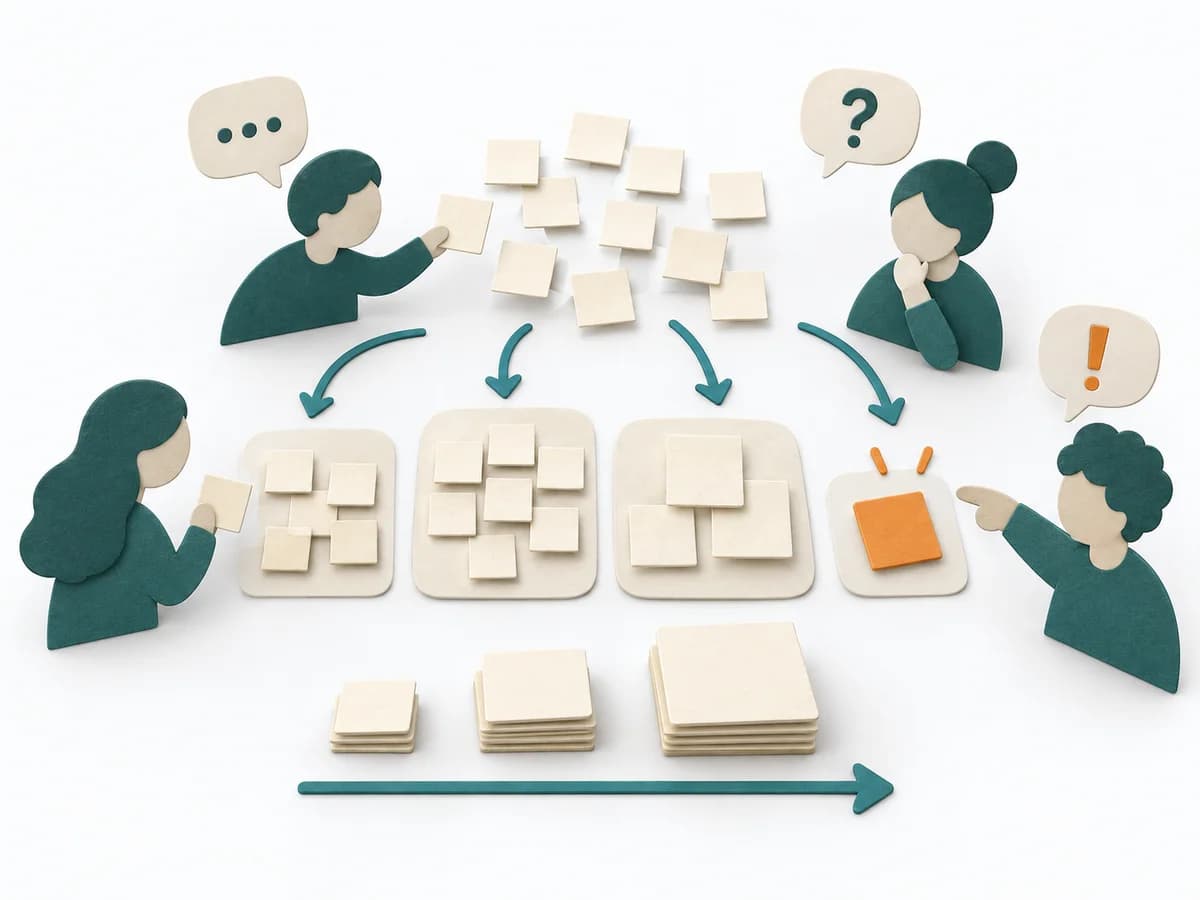 Agile Affinity Estimation |  Facilitation Alignment Mapping |  Facilitation Dot Voting |  Facilitation Nominal Group Technique |
|---|---|---|---|---|
Purposedifferent | When many tasks need to be classified quickly, it sorts them by perceived effort and similarity. It reduces the effort of fine-grained estimation for large volumes. | When several people work toward one goal but hold different mental maps, Alignment Mapping makes the discrepancies visible. It arranges goals, assumptions, and priorities so shared direction becomes verifiable. | When a workshop has produced too many options and the group needs to condense quickly, dot voting makes preferences visible in a short time. It bundles individual votes into a solid signal for the next selection. | When loud voices could dominate a round, Nominal Group Technique protects individual thinking time from group effects. It collects ideas separately first and only then enables shared weighting. |
Complexitydifferent | Medium | Medium | Low | Medium |
Timedifferent | 30-90 min | 1-2 h | 5-15 min | 60-120 min |
Participantsdifferent | 3-12 | 4-12 | 3-20 | 5-12 |
Formatsame | Workshop | Workshop | Workshop | Workshop |
Outputdifferent | Affinity Size Map, Grouped Estimates, Unclear Items | Alignment Map, Open Issues, Decision Questions | Ranked list, Consensus signal, Shortlist | Ranked Ideas, Clarified Options, Group Priority |
Tagsno overlap | EstimationBacklogRelative sizing | AlignmentStakeholdersStrategyFacilitation | FacilitationVotingConsensusPrioritization | FacilitationPrioritizationVotingInclusion |