Plan my session
Plan a concrete work block with agenda, roles, preparation, and a copyable result artifact.
Session: Round Robin Brainstorming
The plan translates the method into a concrete facilitated work block. Your inputs flow directly into the session brief and work artifact.
Method session with 4-10. The plan uses the existing method logic and the runsheet.
RunsheetUse the session for shared understanding. Contributions are collected visibly, assumptions are aligned, and open differences remain traceable in the artifact.
The session works directly toward Idea List. After the session, the artifact should be shareable, reviewable, or reusable.
- 1
Phase 1: Challenge and rules
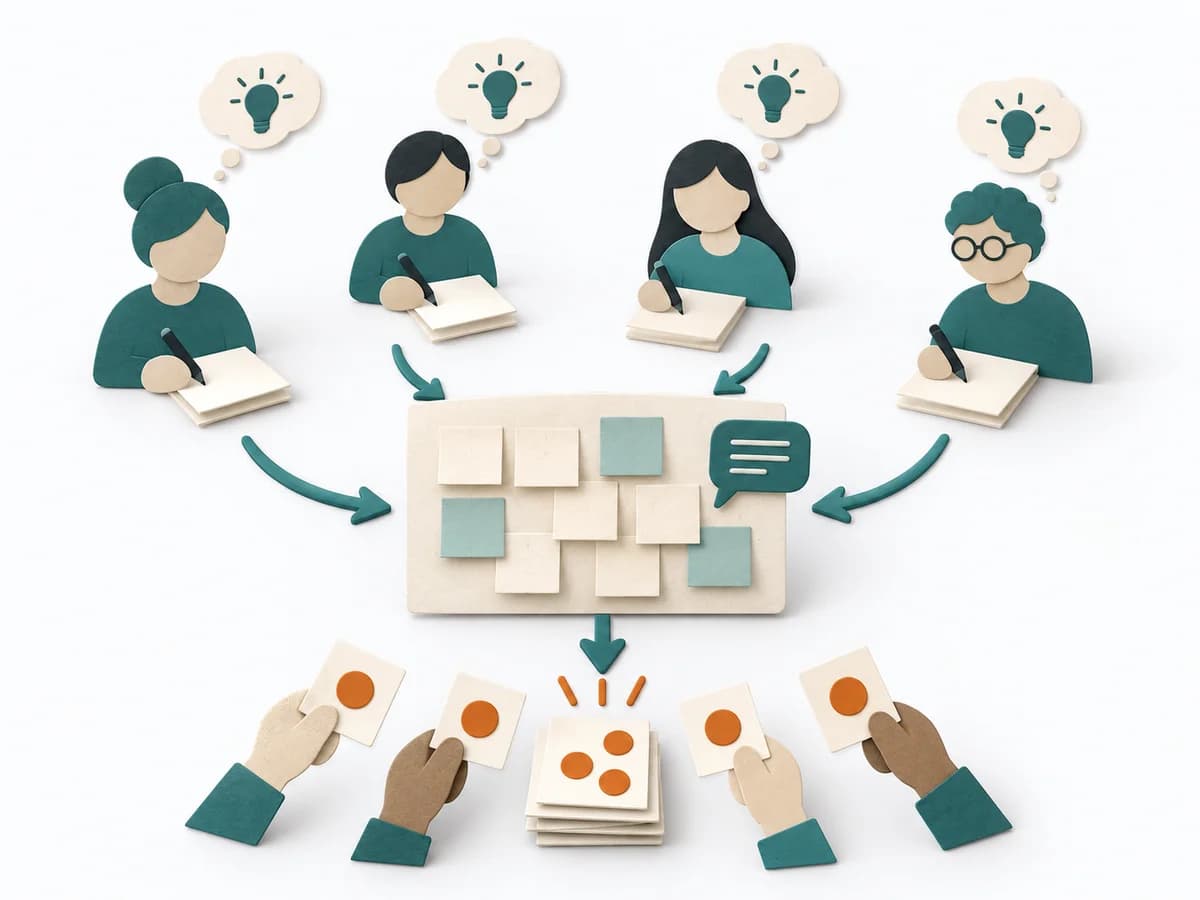
5 minRead challenge aloud, clarify understanding questions. Announce order. Rule: one idea per round, timer 60 s, pass without explanation allowed, building on previous ideas explicitly encouraged. Hint: Clarify understanding questions now, not during Round Robin. Otherwise rhythm stalls and energy evaporates.
FacilitatorIdea List - 2
Phase 2: Round Robin
15-25 minRound-robin one idea per person spoken or written, at least three rounds. Scribe or participants stick ideas to wall immediately. No evaluation, no discussion between contributions. Hint: If someone passes, continue order immediately, no pressure. Building on previous ideas often produces the most interesting contributions.
FacilitatorCluster - 3
Phase 3: Clustering
5-10 minSort ideas together into 3-6 clusters. Name clusters. Merge duplicates. Hint: Clusters are discussion anchors, not final categories. Whoever clusters loudest dominates here too; facilitator balances participation.
FacilitatorShortlist - 4
Phase 4: Shortlist
5-10 minDot voting (2-3 dots per person) on ideas or clusters. Note top 3-5 as shortlist with owner and next step. Hint: If an idea from exactly one person gets votes, hear their rationale. Such contributions are often the innovation and otherwise disappear.
OwnerIdea List - 5
Publish artifact
10 minCheck the artifact for completeness, define location, set version or status, and name review recipients.
OwnerIdea List
Session Brief
For invitations, boards, tickets, PR descriptions, or workshop notes.
session-brief.md
Session Brief: Round Robin Brainstorming
Goal
Artifact: Idea List
Working Question
Which ideas emerge when every person in the group contributes evenly and without dominance?
Context
Challenge as one sentence; existing idea lists to avoid repetition; participant order (set in advance, not spontaneous).
Setup
- Format: Method session
- Duration: 20-45 min
- Mode: Workshop
- Participants: One facilitator who enforces sequence and prevents duplicate contributions; four to ten equal participants; one scribe who categorizes ideas (optional).
- Owner: One facilitator who enforces sequence and prevents duplicate contributions
- Participation mode: Team round, shared work and alignment
- Outcome logic: Finish artifact
Participation Logic
Use the session for shared understanding. Contributions are collected visibly, assumptions are aligned, and open differences remain traceable in the artifact.
Outcome Logic
The session works directly toward Idea List. After the session, the artifact should be shareable, reviewable, or reusable.
Input
Whiteboard or Miro board with visible challenge at top and list for ideas; sticky notes or digital cards; timer; visible participant order.
Preparation
Write challenge at top. Number participants in fixed order. State rule: one idea per person per round, no jumping ahead, pass allowed. Timer 30-60 s per contribution.
Agenda
-
Phase 1: Challenge and rules (5 min) Owner: Facilitator Action: Read challenge aloud, clarify understanding questions. Announce order. Rule: one idea per round, timer 60 s, pass without explanation allowed, building on previous ideas explicitly encouraged. Hint: Clarify understanding questions now, not during Round Robin. Otherwise rhythm stalls and energy evaporates. Output: Idea List
-
Phase 2: Round Robin (15-25 min) Owner: Facilitator Action: Round-robin one idea per person spoken or written, at least three rounds. Scribe or participants stick ideas to wall immediately. No evaluation, no discussion between contributions. Hint: If someone passes, continue order immediately, no pressure. Building on previous ideas often produces the most interesting contributions. Output: Cluster
-
Phase 3: Clustering (5-10 min) Owner: Facilitator Action: Sort ideas together into 3-6 clusters. Name clusters. Merge duplicates. Hint: Clusters are discussion anchors, not final categories. Whoever clusters loudest dominates here too; facilitator balances participation. Output: Shortlist
-
Phase 4: Shortlist (5-10 min) Owner: Owner Action: Dot voting (2-3 dots per person) on ideas or clusters. Note top 3-5 as shortlist with owner and next step. Hint: If an idea from exactly one person gets votes, hear their rationale. Such contributions are often the innovation and otherwise disappear. Output: Idea List
-
Publish artifact (10 min) Owner: Owner Action: Check the artifact for completeness, define location, set version or status, and name review recipients. Output: Idea List
Closeout
- Update result artifact: Idea List
- Define location, version, and review recipients.
- Define owner, next step, and review date.
Work artifact
Pre-filled starting point based on the matching template.
work-artifact.md
Idea List: Round Robin Brainstorming
Working Question
Which ideas emerge when every person in the group contributes evenly and without dominance?
Context
Challenge as one sentence; existing idea lists to avoid repetition; participant order (set in advance, not spontaneous).
Participants
- Owner: One facilitator who enforces sequence and prevents duplicate contributions
- Participants: One facilitator who enforces sequence and prevents duplicate contributions; four to ten equal participants; one scribe who categorizes ideas (optional).
Input
Whiteboard or Miro board with visible challenge at top and list for ideas; sticky notes or digital cards; timer; visible participant order.
Template
Round Robin Brainstorming Working Template
Goal
Collect ideas in turns so every participant contributes to the same prompt.
Context
What challenge should the group explore, and how much time is available?
Input
- Challenge statement:
- Participants:
- Rules or timebox:
- Reference material:
Working area
- Round 1 ideas:
- Round 2 ideas:
- Round 3 ideas:
- Clusters:
- Selection notes:
Output artifacts
- Idea list:
- Cluster map:
- Shortlist:
Open questions
- ...
Decision / next step
Owner, date, and success signal.
Completion Check
- Idea List is complete enough for review:
- Location:
- Version / status:
- Review by:
- Next step:
Next Step
- Review result
- Mark open questions
- Schedule review or decision
Round Robin Brainstorming Working Template
View templateCompact working template for Round Robin Brainstorming with ordered rounds, idea capture, and shortlist.markdown
round-robin-brainstorming-working-template.md
Compact working template for Round Robin Brainstorming with ordered rounds, idea capture, and shortlist.
Round Robin Brainstorming Working Template
Goal
Collect ideas in turns so every participant contributes to the same prompt.
Context
What challenge should the group explore, and how much time is available?
Input
- Challenge statement:
- Participants:
- Rules or timebox:
- Reference material:
Working area
- Round 1 ideas:
- Round 2 ideas:
- Round 3 ideas:
- Clusters:
- Selection notes:
Output artifacts
- Idea list:
- Cluster map:
- Shortlist:
Open questions
- ...
Decision / next step
Owner, date, and success signal.
- Working question, owner, and target artifact are visible.
- The result fits Idea List.
- One entry per session with date, challenge and participant list. Do not overwrite results from multiple sessions on same challenge; create v2 referencing previous clusters.
- Open questions are noted as follow-ups.
- The next review or decision point is scheduled.