Complete firstShared context
Period and goal are set.
Without a frame, contributions are hard to compare.
A practical method guide: clarify prerequisites and materials, understand the complete process, and look up outputs, pitfalls, and stop criteria.
What needs to be finished first
Period and goal are set.
What needs to be ready before start
Board, Stickies, Timer
The facilitator holds the hypothetical frame; the sponsor provides goal and boundaries; participants collect reasons independently; the scribe records risks, signals, and owners.
Collect the decision, goal, success criteria, assumptions, dependencies, and assumed failure point beforehand.
45 minutes
Show the scenario sentence. Collect risks silently first, then cluster causes, signals, effects, and mitigations.
The one question this method answers
Which plausible reasons could make this initiative fail at the assumed point, and how will we detect or reduce them?
Phases with goal, actions, output and pitfall
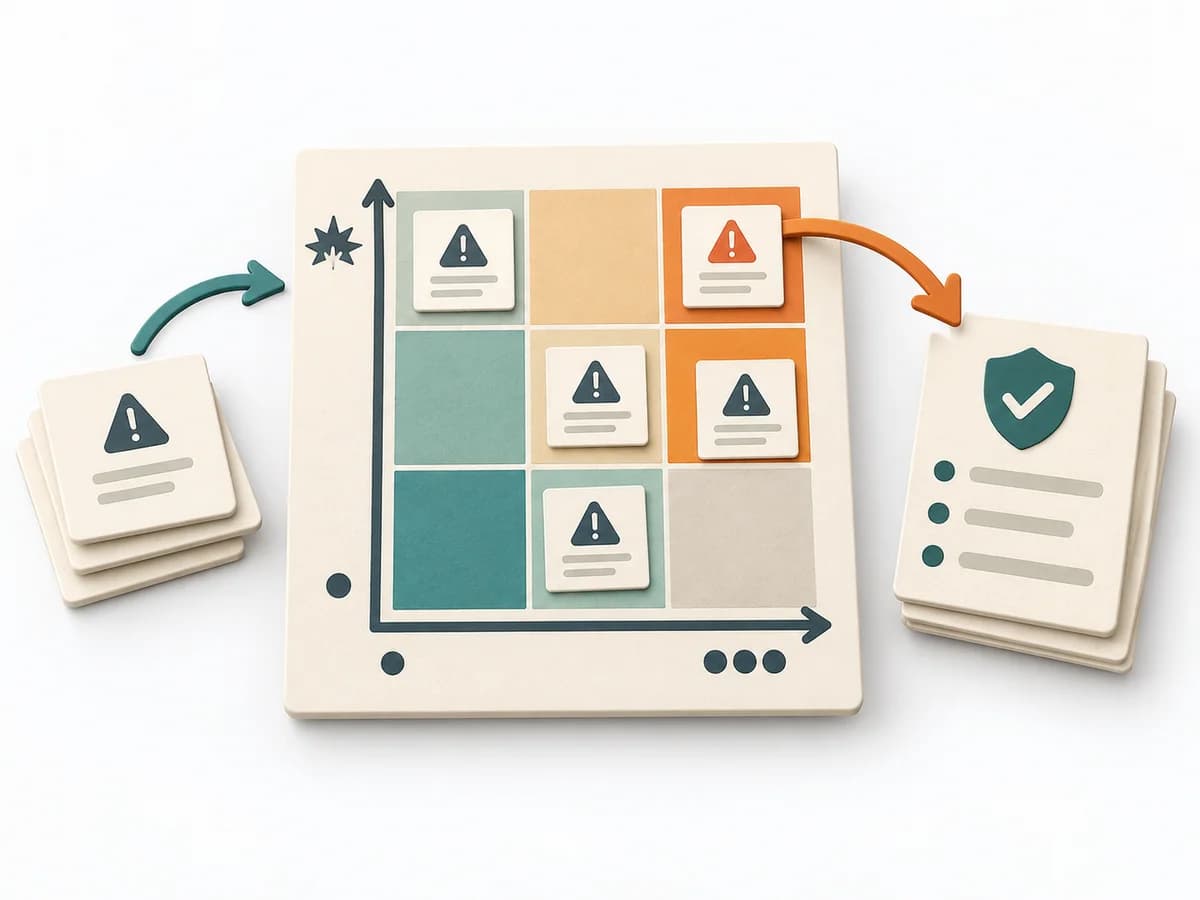
A hypothetical failure makes concrete risks, signals, and fitting mitigations visible.
Fictional example
Structured board with a blank workspace and fictional example view.
Fictional: late inventory sync
Returns sync late; double bookings increase.
Fictional: two double bookings per week
Leading signal for inconsistent availability.
Fictional: sync spike
Sam checks the sync before the pilot; manual confirmation is the contingency.
Frame

Goal
Define the initiative, success, and the assumed failure point.
Inputs for this step
Actions
Output
Context, goal, horizon
Context, goal, horizon
Quality check
Is the step concrete, safe, and actionable?
Pitfall
The discussion stays generic or blames people. Return to observable work, effects, and the next check.
Timing: 10–20 minutes
Assume
Goal
Imagine the group after failure and state the hypothetical frame.
Inputs for this step
Actions
Output
Hypothetical outcome
Hypothetical outcome
Quality check
Is the step concrete, safe, and actionable?
Pitfall
The discussion stays generic or blames people. Return to observable work, effects, and the next check.
Timing: 10–20 minutes
Surface
Goal
First collect concrete reasons, cascades, and leading signals silently.
Inputs for this step
Actions
Output
Risks and signals
Risks and signals
Quality check
Is the step concrete, safe, and actionable?
Pitfall
The discussion stays generic or blames people. Return to observable work, effects, and the next check.
Timing: 10–20 minutes
Act
Goal
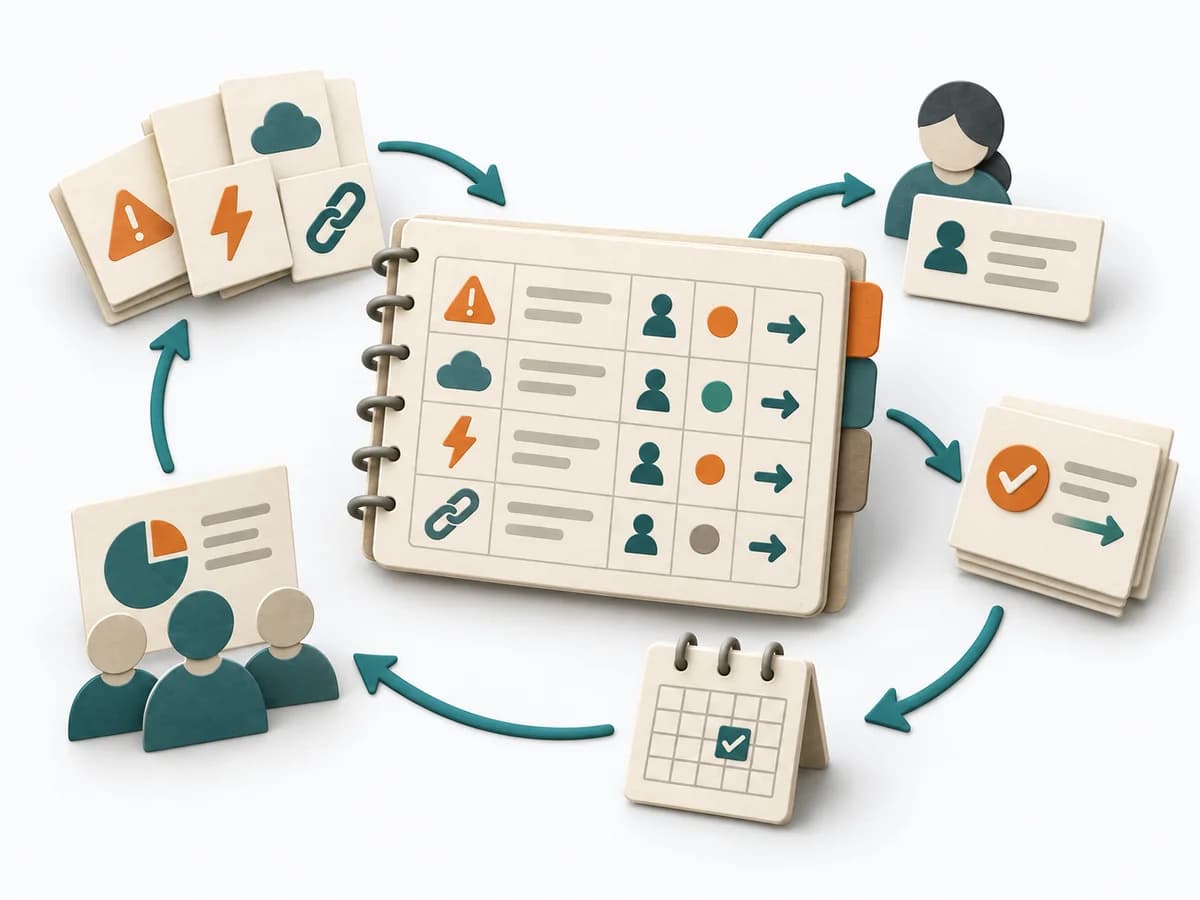
Prioritize actionable risks and link prevention, monitoring, contingency, owner, and review date.
Inputs for this step
Actions
Output
Mitigation plan
Mitigation plan
Quality check
Is the step concrete, safe, and actionable?
Pitfall
The discussion stays generic or blames people. Return to observable work, effects, and the next check.
Timing: 10–20 minutes
Follow-up
Goal
Prepare a clear follow-up review.
Inputs for this step
Actions
Output
Agreed follow-up plan
Action · owner · review date · signal · record location
Quality check
Are owner, review date and effect signal clearly agreed?
Pitfall
The pre-mortem is left unchanged after the workshop. Anchor a concrete review date and visible status maintenance.
Timing: 5–10 minutes to agree follow-up
What comes out at the end
Sketch: what the artifact looks like
Preventive risk artifact with hypothetical failure, independent reasons, risk chains, leading signals, prevention, monitoring, contingency, owner, and review date.
Keep date, period, and owner on the artifact.
Plan purpose, period, and the next work block.
To be confirmed
To be confirmed
Whole flow Time: In one session
Complete this worksheet on paper or in your own document during the work.
...
...
...
Stay hypothetical ...
How to Run Pre-Mortem Exercises | Atlassian
Expected artifact: Context, goal, horizon
Context, goal, horizon
Entry:
...
Expected artifact: Hypothetical outcome
Hypothetical outcome
Entry:
...
Expected artifact: Risks and signals
Risks and signals
Entry:
...
Expected artifact: Mitigation plan
Mitigation plan
Entry:
...
Expected artifact: Agreed follow-up plan
Action · owner · review date · signal · record location
Entry:
...
...
Method guide: https://methodatlas.meierhoff-systems.de/en/methods/pre-mortem/run-sheet
Concrete filled scenario, fictional example
Fictional example for orientation. Counts and timings describe this case and are not universal requirements.
Concrete filled scenario, fictional example
Scenario: Three months after launch, online reservations fail.
Risk: Inventory data syncs late after returns. Signal: More than two unresolved double bookings per week. Prevention: Run a sync spike before the pilot, owner: Sam. Contingency: Confirm affected devices manually. Review: Before pilot approval.
Recognize symptoms and steer against them
Quick overview, the full text is in the matching phase in the flow
The discussion stays generic or blames people.
Return to observable work, effects, and the next check.
The discussion stays generic or blames people.
Return to observable work, effects, and the next check.
The discussion stays generic or blames people.
Return to observable work, effects, and the next check.
The discussion stays generic or blames people.
Return to observable work, effects, and the next check.
The pre-mortem is left unchanged after the workshop.
Anchor a concrete review date and visible status maintenance.
When to pause, resolve prerequisites, or choose another approach
Go to the profile for purpose, similar methods, and sources or continue to the next method in the catalog.