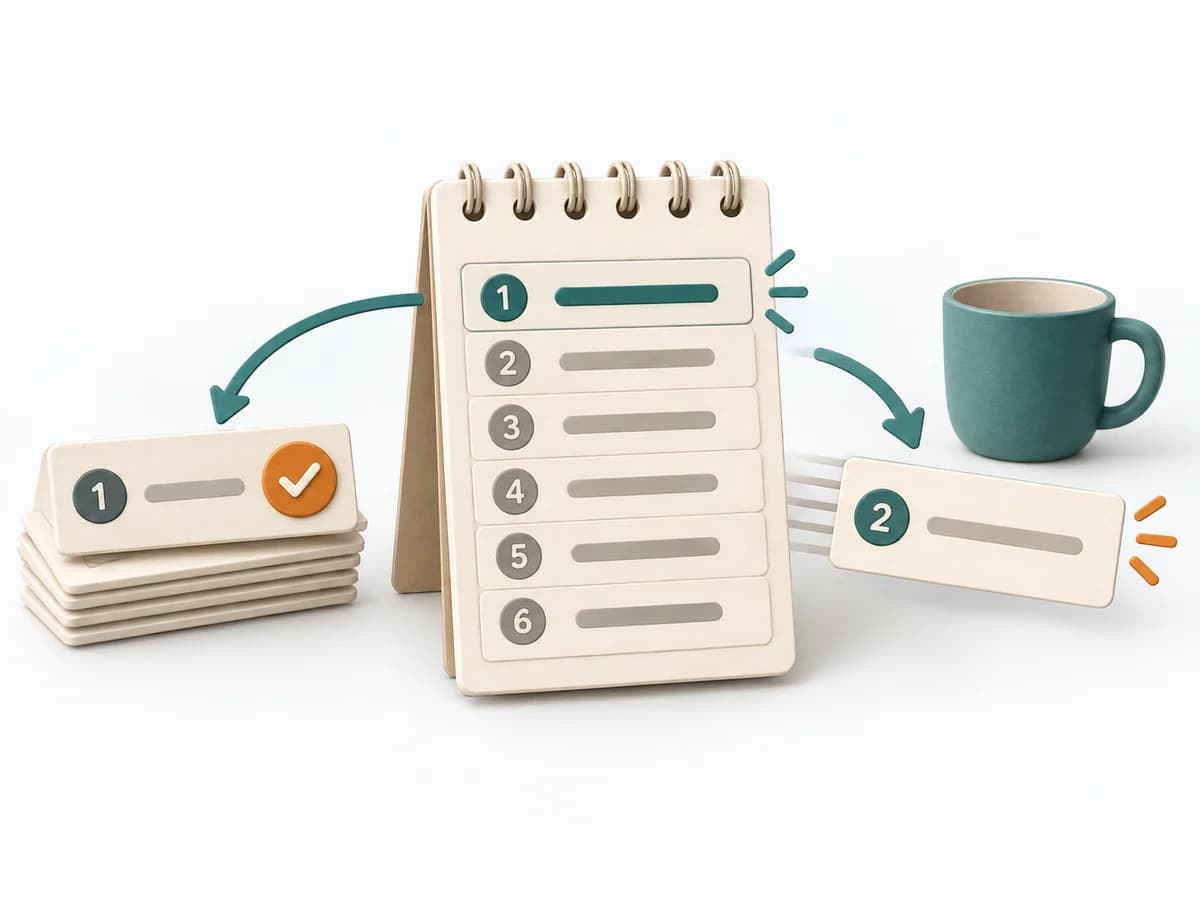
Complete firstControllable focus time
An interval can be largely protected from task switching.
If continuous availability is required, clarify coverage first.
A practical method guide: clarify prerequisites and materials, understand the complete process, and look up outputs, pitfalls, and stop criteria.
What needs to be finished first
An interval can be largely protected from task switching.
What needs to be ready before start
Timer, today’s task list, activity inventory and interruption notes.
One working person; agree availability and genuine emergencies with colleagues beforehand.
Review next tasks, expected effort in intervals and non-negotiable appointments.
25 minutes of focus + 5-minute break; about 15–30 minutes of rest after four intervals.
Reduce notifications, open material, set the timer and prepare an interruption list.
The one question this method answers
Which concrete task will I work on during the next uninterrupted interval?
Phases with goal, actions, output and pitfall
The Pomodoro Technique combines task selection, focused work intervals, breaks, and interruption management. A common starting pattern is 25 minutes of work and a five-minute break, with a longer break after four intervals. The comparison of estimated and actual intervals supports planning.
Fictional example
Interval record with task, estimated effort, completed intervals, interruptions and revised estimate.
Which concrete outcome is planned in how many intervals?
Add three follow-up questions to an interview guide; two intervals estimated.
Which intervals were completed and which abandoned?
Two complete 25-minute intervals; one abandoned start due to an urgent support incident.
What distracted you and how will it be handled next time?
Captured two reminders; clarify support cover before the next focus block.
Which short or long break is due?
Five minutes after each completed interval; a set of four has not yet been reached.
What estimate or work protection changes next time?
Guide completed; two intervals was realistic. Schedule the next block outside support duty.
All situations and people are fictional.
Choose

Goal
Selected task and estimate
Inputs for this step
Actions
Output
Selected task and estimate
Estimates support learning, not performance quotas.
Quality check
Is the concrete work for this interval clear?
Pitfall
A vague project objective stands in for an executable task. Name a small outcome and the next concrete action.
Timing: 2–5 minutes
Focus
Goal
Completed work interval
Inputs for this step
Actions
Output
Completed work interval
An abandoned interval is not a completed Pomodoro.
Quality check
Was the interval completed without switching tasks?
Pitfall
The person responds to every message but still counts the interval as complete. Record the interruption and restart a genuinely abandoned Pomodoro.
Timing: 25 minutes
Break
Goal
Recovery and recorded interval
Inputs for this step
Actions
Output
Recovery and recorded interval
Breaks are part of the method.
Quality check
Was the break free from further task work?
Pitfall
Breaks are skipped or filled with message processing. Protect recovery time before starting another work interval.
Timing: 5 minutes; 15–30 after four
Learn
Goal
Revised effort estimate
Inputs for this step
Actions
Output
Revised effort estimate
Review effort together with interruption patterns.
Quality check
Do actual effort and interruptions inform the next plan?
Pitfall
Timers are started repeatedly without reviewing progress or causes of interruption. Review outcomes, effort and interruptions briefly each day.
Timing: 2–5 minutes
What comes out at the end
Sketch: what the artifact looks like
Interval record with task, estimated effort, completed intervals, interruptions and revised estimate.
Count completed intervals accurately and use the record to refine future estimates.
Organize focused work in protected intervals with real breaks and a learning record.
To be confirmed
To be confirmed
Plan the practice Time: 25 minutes of focus + 5-minute break; about 15–30 minutes of rest after four intervals.
Complete this worksheet on paper or in your own document during the work.
Which concrete outcome is planned in how many intervals?
...
Which intervals were completed and which abandoned?
...
What distracted you and how will it be handled next time?
...
Which short or long break is due?
...
What estimate or work protection changes next time?
...
Enter your own information; connect open commitments to a next action.
Francesco Cirillo · Pomodoro Technique
Expected artifact: Selected task and estimate
Estimates support learning, not performance quotas.
Entry:
...
Expected artifact: Completed work interval
An abandoned interval is not a completed Pomodoro.
Entry:
...
Expected artifact: Recovery and recorded interval
Breaks are part of the method.
Entry:
...
Expected artifact: Revised effort estimate
Review effort together with interruption patterns.
Entry:
...
...
Method guide: https://methodatlas.meierhoff-systems.de/en/methods/pomodoro-technique/run-sheet
Concrete filled scenario, fictional example
Fictional example for orientation. Counts and timings describe this case and are not universal requirements.
Concrete filled scenario, fictional example
Task and estimate: Add three follow-up questions to an interview guide; two intervals estimated.
Focus record: Two complete 25-minute intervals; one abandoned start due to an urgent support incident.
Interruptions: Captured two reminders; clarify support cover before the next focus block.
Breaks: Five minutes after each completed interval; a set of four has not yet been reached.
Learning: Guide completed; two intervals was realistic. Schedule the next block outside support duty.
Recognize symptoms and steer against them
Quick overview, the full text is in the matching phase in the flow
A vague project objective stands in for an executable task.
Name a small outcome and the next concrete action.
The person responds to every message but still counts the interval as complete.
Record the interruption and restart a genuinely abandoned Pomodoro.
Breaks are skipped or filled with message processing.
Protect recovery time before starting another work interval.
Timers are started repeatedly without reviewing progress or causes of interruption.
Review outcomes, effort and interruptions briefly each day.
When to pause, resolve prerequisites, or choose another approach
Go to the profile for purpose, similar methods, and sources or continue to the next method in the catalog.