Plan my session
Plan a concrete work block with agenda, roles, preparation, and a copyable result artifact.
Session: NoEstimates
The plan translates the method into a concrete facilitated work block. Your inputs flow directly into the session brief and work artifact.
Method session with 2-12. The plan uses the existing method logic and the runsheet.
RunsheetUse the session for shared understanding. Contributions are collected visibly, assumptions are aligned, and open differences remain traceable in the artifact.
The session works directly toward Throughput Data. After the session, the artifact should be shareable, reviewable, or reusable.
- 1
Phase 1: Define planning question
10 minState clearly which decision estimation should support: release date, budget, or scope cut. For each question, check whether flow data is sufficient. Hint: Without a concrete question, NoEstimates becomes dogmatic. Some questions still require explicit estimation (for example unknown investments). Review honesty per case.
FacilitatorThroughput Data - 2
Phase 2: Tighten slicing
20-30 minReview current items for size suitability (cycle time less than 5 days). Document slicing rules, for example: "an item is small if a developer can complete it in three days." Hint: Without small slicing, throughput mixes apples and oranges. If 30% of items are over five days cycle time, fix slicing before forecasting.
FacilitatorFlow Forecast - 3
Phase 3: Collect throughput data
15 minCount completed items per week and collect at least 6-12 weeks of data. Include cycle-time distribution and mark anomalies (holidays, outages). Hint: The data window must match the question. Use 12 weeks for quarterly forecast, 4-6 weeks for sprint forecast. Account for seasonal effects.
FacilitatorSlicing Rules - 4
Phase 4: Generate and communicate forecast
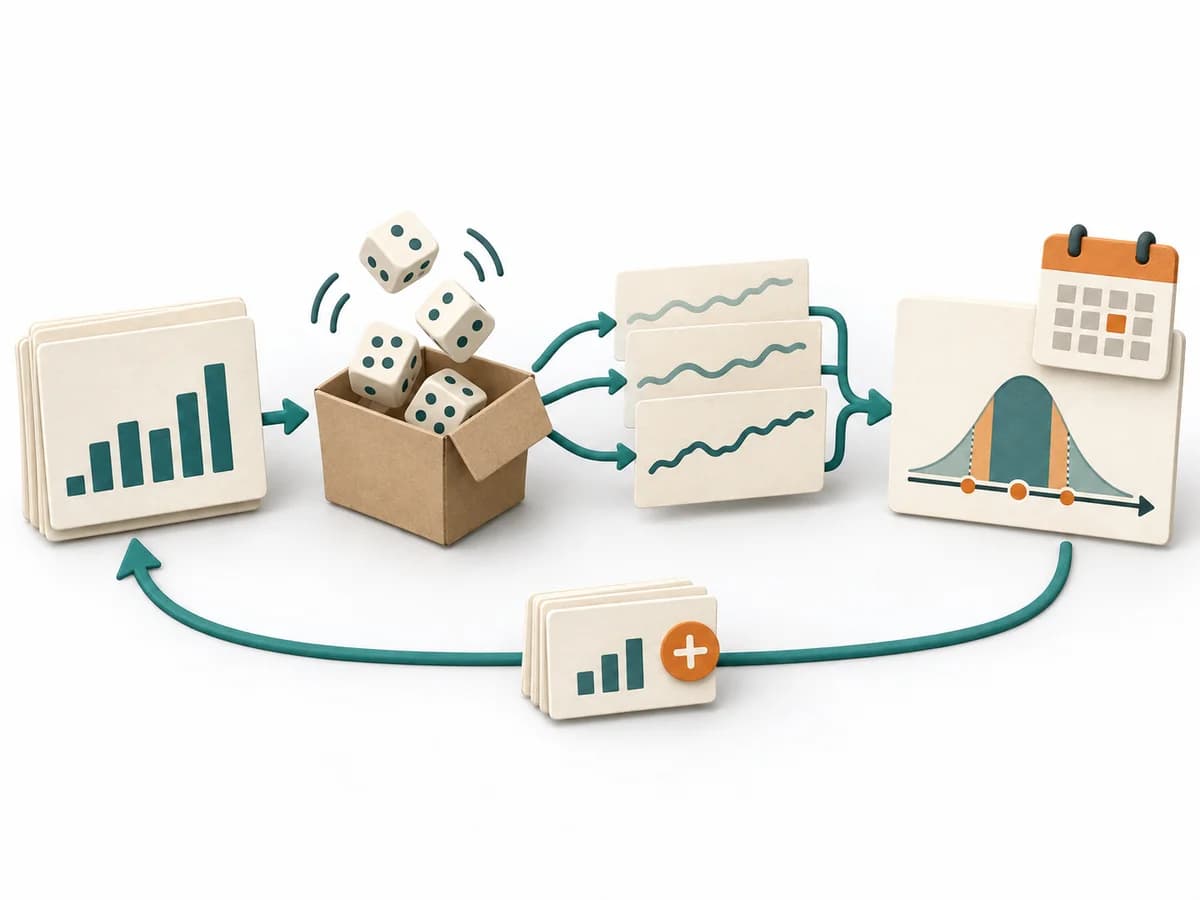
15-30 minRun Monte Carlo forecast for planning question. Calculate percentiles (50%, 70%, 85%, 95%). Communicate a range: "85% chance of completion in five weeks." Hint: Update forecasts weekly. When the system changes (new engineer, migration), discard old data windows.
OwnerThroughput Data - 5
Publish artifact
10 minCheck the artifact for completeness, define location, set version or status, and name review recipients.
OwnerThroughput Data
Session Brief
For invitations, boards, tickets, PR descriptions, or workshop notes.
session-brief.md
Session Brief: NoEstimates
Goal
Artifact: Throughput Data
Working Question
Which planning decision do we need to make, and which flow data or slicing rules answer it more cheaply than an estimation ritual?
Context
Throughput data (items per week) for last 6-12 weeks; cycle-time distribution; current WIP; slicing rules; known planning questions (release date, budget, scope).
Setup
- Format: Method session
- Duration: Ongoing, setup 30-60 min, forecast 15-30 min
- Mode: Workshop or async
- Participants: A flow master or tech lead who maintains data and communicates forecasts; the delivery team; a product owner for slicing and prioritization; optional coach for methodology change.
- Owner: A flow master or tech lead who maintains data and communicates forecasts
- Participation mode: Team round, shared work and alignment
- Outcome logic: Finish artifact
Participation Logic
Use the session for shared understanding. Contributions are collected visibly, assumptions are aligned, and open differences remain traceable in the artifact.
Outcome Logic
The session works directly toward Throughput Data. After the session, the artifact should be shareable, reviewable, or reusable.
Input
Flow dashboard with throughput and cycle time (Jira, Linear, Azure DevOps, or external tools such as Actionable Agile); backlog with sliced items; forecast tool or Monte Carlo simulator; list of typical planning questions.
Preparation
Export throughput data as a dataset. Configure forecast tool (Monte Carlo with 1,000+ simulations). Define a "small story" rule. Identify existing estimation rituals to replace.
Agenda
-
Phase 1: Define planning question (10 min) Owner: Facilitator Action: State clearly which decision estimation should support: release date, budget, or scope cut. For each question, check whether flow data is sufficient. Hint: Without a concrete question, NoEstimates becomes dogmatic. Some questions still require explicit estimation (for example unknown investments). Review honesty per case. Output: Throughput Data
-
Phase 2: Tighten slicing (20-30 min) Owner: Facilitator Action: Review current items for size suitability (cycle time less than 5 days). Document slicing rules, for example: "an item is small if a developer can complete it in three days." Hint: Without small slicing, throughput mixes apples and oranges. If 30% of items are over five days cycle time, fix slicing before forecasting. Output: Flow Forecast
-
Phase 3: Collect throughput data (15 min) Owner: Facilitator Action: Count completed items per week and collect at least 6-12 weeks of data. Include cycle-time distribution and mark anomalies (holidays, outages). Hint: The data window must match the question. Use 12 weeks for quarterly forecast, 4-6 weeks for sprint forecast. Account for seasonal effects. Output: Slicing Rules
-
Phase 4: Generate and communicate forecast (15-30 min) Owner: Owner Action: Run Monte Carlo forecast for planning question. Calculate percentiles (50%, 70%, 85%, 95%). Communicate a range: "85% chance of completion in five weeks." Hint: Update forecasts weekly. When the system changes (new engineer, migration), discard old data windows. Output: Throughput Data
-
Publish artifact (10 min) Owner: Owner Action: Check the artifact for completeness, define location, set version or status, and name review recipients. Output: Throughput Data
Closeout
- Update result artifact: Throughput Data
- Define location, version, and review recipients.
- Define owner, next step, and review date.
Work artifact
Pre-filled starting point based on the matching template.
work-artifact.md
Throughput Data: NoEstimates
Working Question
Which planning decision do we need to make, and which flow data or slicing rules answer it more cheaply than an estimation ritual?
Context
Throughput data (items per week) for last 6-12 weeks; cycle-time distribution; current WIP; slicing rules; known planning questions (release date, budget, scope).
Participants
- Owner: A flow master or tech lead who maintains data and communicates forecasts
- Participants: A flow master or tech lead who maintains data and communicates forecasts; the delivery team; a product owner for slicing and prioritization; optional coach for methodology change.
Input
Flow dashboard with throughput and cycle time (Jira, Linear, Azure DevOps, or external tools such as Actionable Agile); backlog with sliced items; forecast tool or Monte Carlo simulator; list of typical planning questions.
Template
NoEstimates Working Template
Goal
Approach that reduces explicit effort estimation and instead uses small items, throughput, and forecasting.
Context
When and for what do we use this method?
Input
Which data, observations, decisions, or materials are available?
Execution
Short notes along the runsheet.
Output artifacts
- Throughput Data:
- Flow Forecast:
- Slicing Rules:
Assumptions and open questions
- ...
Decision / Next step
Owner, date, and success signal.
Completion Check
- Throughput Data is complete enough for review:
- Location:
- Version / status:
- Review by:
- Next step:
Next Step
- Review result
- Mark open questions
- Schedule review or decision
NoEstimates Working Template
View templateCompact working template for NoEstimates with context, input, output artifacts, and next step.markdown
no-estimates-working-template.md
Compact working template for NoEstimates with context, input, output artifacts, and next step.
NoEstimates Working Template
Goal
Approach that reduces explicit effort estimation and instead uses small items, throughput, and forecasting.
Context
When and for what do we use this method?
Input
Which data, observations, decisions, or materials are available?
Execution
Short notes along the runsheet.
Output artifacts
- Throughput Data:
- Flow Forecast:
- Slicing Rules:
Assumptions and open questions
- ...
Decision / Next step
Owner, date, and success signal.
- Working question, owner, and target artifact are visible.
- The result fits Throughput Data.
- Maintain throughput data as a time series (for example, sheet with date, completed items). Archive forecasts per planning question with date and keep old ones. Version slicing rules in the team wiki.
- Open questions are noted as follow-ups.
- The next review or decision point is scheduled.