methodatlas
Session Builder

Plan my session

Plan a concrete work block with agenda, roles, preparation, and a copyable result artifact.

Method session2-6 hWorkshopFMEA Table

Session: Failure Mode and Effects Analysis

The plan translates the method into a concrete facilitated work block. Your inputs flow directly into the session brief and work artifact.

Derived automatically

Method session with 3-10. The plan uses the existing method logic and the runsheet.

Runsheet
Participation logic
Team round, shared work and alignment

Use the session for shared understanding. Contributions are collected visibly, assumptions are aligned, and open differences remain traceable in the artifact.

Outcome logic
Finish artifact

The session works directly toward FMEA Table. After the session, the artifact should be shareable, reviewable, or reusable.

  1. 1

    Phase 1: Scope and functions

    20-30 min

    Define the scope of the FMEA (for example "order processing from order entry to shipping confirmation"). List the functions per process step. Mark interfaces explicitly. Hint: If functions are too broad, failure modes become unclear. Formulate clearly what each function produces and under which condition.

    FacilitatorFMEA Table
  2. 2

    Phase 2: Collect failure modes

    30-60 min

    Ask for each function: how can this function fail, be done incorrectly, or be only partially completed? Capture at least two failure modes per function. Also include unlikely modes. Hint: Participants who collect only the ordinary modes miss rare but critical ones. In safety-critical processes, completeness is more important than efficiency.

    FacilitatorRisk Priority
  3. 3

    Phase 3: Effects and causes

    45-90 min

    Describe the effect of each failure mode (what happens for customer or system), add one or more causes, and document current controls (tests, checks, reviews). Hint: Multiple causes can exist per failure mode. Keep them as separate rows, otherwise risk scoring becomes distorted.

    FacilitatorMitigation Actions
  4. 4

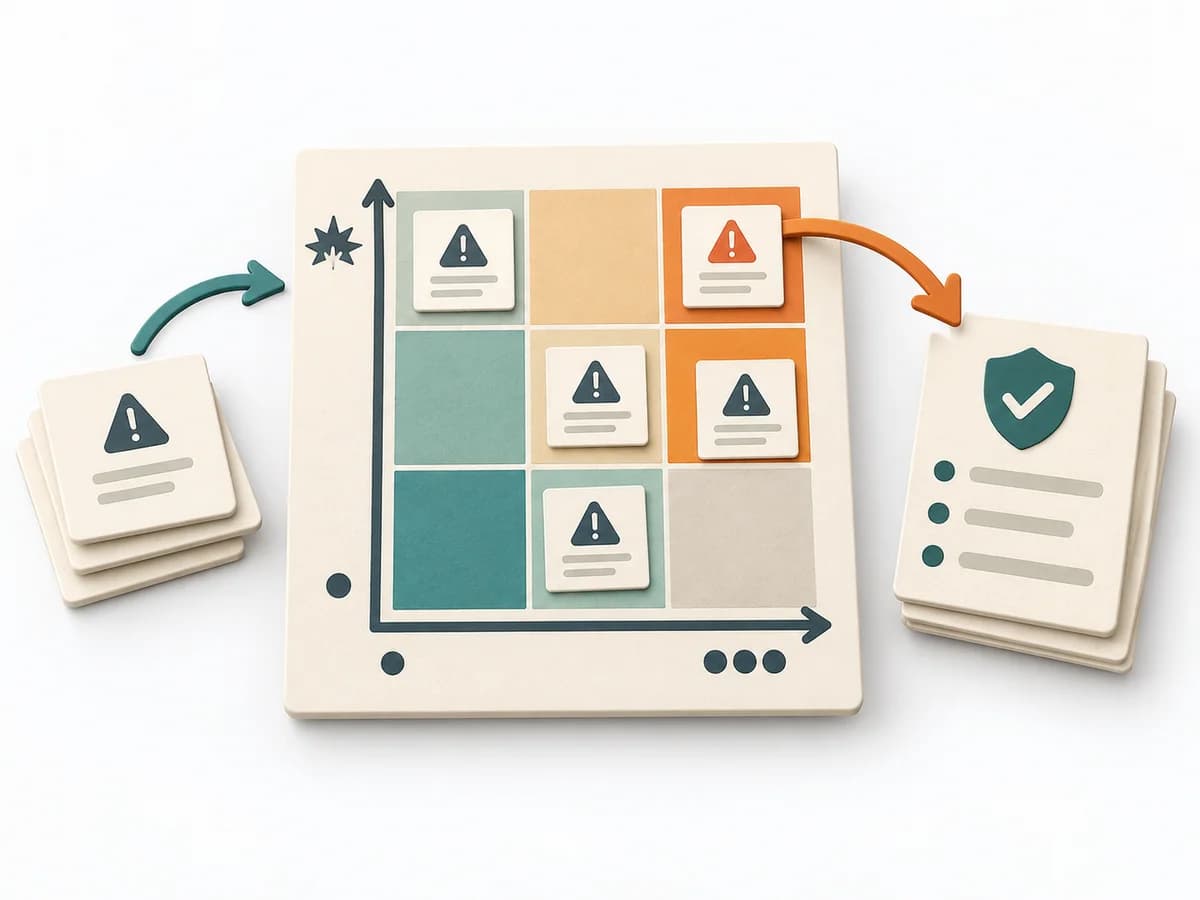
    Phase 4: Rate risks (S, O, D, RPN)

    30-45 min

    For each row, rate S, O, and D on the agreed scale (typically 1-10). Calculate RPN = S x O x D. Flag top rows above the threshold. Hint: S and O are often agreed, D is often contested. If someone leaves current control empty, they cannot score D honestly.

    FacilitatorFMEA Table
  5. 5

    Phase 5: Actions and owners

    30-45 min

    Define action, owner, and date for each top row. Categorize action by effect (elimination, reduction, detection). Estimate follow-up RPN to verify effectiveness. Hint: Not every top row needs an action; some risks can be consciously accepted. Document acceptance with rationale, do not skip it silently.

    OwnerRisk Priority
  6. 6

    Publish artifact

    10 min

    Check the artifact for completeness, define location, set version or status, and name review recipients.

    OwnerFMEA Table
Usable artifact

Session Brief

For invitations, boards, tickets, PR descriptions, or workshop notes.

session-brief.md

Session Brief: Failure Mode and Effects Analysis

Goal

Artifact: FMEA Table

Working Question

Which failure modes in the process have enough risk to require preventive or detective actions before deployment?

Context

Scope (product, process, or system); process diagram; previous incidents and complaints; binding S/O/D scales; threshold for "critical" (for example RPN over 100).

Setup

  • Format: Method session
  • Duration: 2-6 h
  • Mode: Workshop
  • Participants: A facilitator with FMEA experience; three to ten participants with knowledge of all process sections; a quality lead who calibrates scales; and a scribe for the table.
  • Owner: A facilitator with FMEA experience
  • Participation mode: Team round, shared work and alignment
  • Outcome logic: Finish artifact

Participation Logic

Use the session for shared understanding. Contributions are collected visibly, assumptions are aligned, and open differences remain traceable in the artifact.

Outcome Logic

The session works directly toward FMEA Table. After the session, the artifact should be shareable, reviewable, or reusable.

Input

FMEA table with columns for function, failure mode, effect, severity (S), cause, occurrence (O), current control, detection (D), RPN, action, owner, date; shared document or spreadsheet; process diagram as a reference.

Preparation

Prepare the table, fix scope and scales at the top. Pre-create one row group per function. Add an example row as a writing template. Rule: risk scoring only after complete description, not in parallel.

Agenda

  1. Phase 1: Scope and functions (20-30 min) Owner: Facilitator Action: Define the scope of the FMEA (for example "order processing from order entry to shipping confirmation"). List the functions per process step. Mark interfaces explicitly. Hint: If functions are too broad, failure modes become unclear. Formulate clearly what each function produces and under which condition. Output: FMEA Table

  2. Phase 2: Collect failure modes (30-60 min) Owner: Facilitator Action: Ask for each function: how can this function fail, be done incorrectly, or be only partially completed? Capture at least two failure modes per function. Also include unlikely modes. Hint: Participants who collect only the ordinary modes miss rare but critical ones. In safety-critical processes, completeness is more important than efficiency. Output: Risk Priority

  3. Phase 3: Effects and causes (45-90 min) Owner: Facilitator Action: Describe the effect of each failure mode (what happens for customer or system), add one or more causes, and document current controls (tests, checks, reviews). Hint: Multiple causes can exist per failure mode. Keep them as separate rows, otherwise risk scoring becomes distorted. Output: Mitigation Actions

  4. Phase 4: Rate risks (S, O, D, RPN) (30-45 min) Owner: Facilitator Action: For each row, rate S, O, and D on the agreed scale (typically 1-10). Calculate RPN = S x O x D. Flag top rows above the threshold. Hint: S and O are often agreed, D is often contested. If someone leaves current control empty, they cannot score D honestly. Output: FMEA Table

  5. Phase 5: Actions and owners (30-45 min) Owner: Owner Action: Define action, owner, and date for each top row. Categorize action by effect (elimination, reduction, detection). Estimate follow-up RPN to verify effectiveness. Hint: Not every top row needs an action; some risks can be consciously accepted. Document acceptance with rationale, do not skip it silently. Output: Risk Priority

  6. Publish artifact (10 min) Owner: Owner Action: Check the artifact for completeness, define location, set version or status, and name review recipients. Output: FMEA Table

Closeout

  • Update result artifact: FMEA Table
  • Define location, version, and review recipients.
  • Define owner, next step, and review date.
Usable artifact

Work artifact

Pre-filled starting point based on the matching template.

work-artifact.md

FMEA Table: Failure Mode and Effects Analysis

Working Question

Which failure modes in the process have enough risk to require preventive or detective actions before deployment?

Context

Scope (product, process, or system); process diagram; previous incidents and complaints; binding S/O/D scales; threshold for "critical" (for example RPN over 100).

Participants

  • Owner: A facilitator with FMEA experience
  • Participants: A facilitator with FMEA experience; three to ten participants with knowledge of all process sections; a quality lead who calibrates scales; and a scribe for the table.

Input

FMEA table with columns for function, failure mode, effect, severity (S), cause, occurrence (O), current control, detection (D), RPN, action, owner, date; shared document or spreadsheet; process diagram as a reference.

Template

Failure Mode and Effects Analysis Working Template

Goal

Analyzes possible failure modes, effects, causes, and priorities for countermeasures.

Context

When and for what do we use this method?

Input

Which data, observations, decisions, or materials are available?

Execution

Short notes along the runsheet.

Output artifacts

  • FMEA Table:
  • Risk Priority:
  • Mitigation Actions:

Assumptions and open questions

  • ...

Decision / Next step

Owner, date, and success signal.

Completion Check

  • FMEA Table is complete enough for review:
  • Location:
  • Version / status:
  • Review by:
  • Next step:

Next Step

  • Review result
  • Mark open questions
  • Schedule review or decision
Template base

Failure Mode and Effects Analysis Working Template

View templateCompact working template for Failure Mode and Effects Analysis with context, input, output artifacts, and next step.
markdown

fmea-working-template.md

Compact working template for Failure Mode and Effects Analysis with context, input, output artifacts, and next step.

Failure Mode and Effects Analysis Working Template

Goal

Analyzes possible failure modes, effects, causes, and priorities for countermeasures.

Context

When and for what do we use this method?

Input

Which data, observations, decisions, or materials are available?

Execution

Short notes along the runsheet.

Output artifacts

  • FMEA Table:
  • Risk Priority:
  • Mitigation Actions:

Assumptions and open questions

  • ...

Decision / Next step

Owner, date, and success signal.

Ready to use when
  • Working question, owner, and target artifact are visible.
  • The result fits FMEA Table.
  • Separate FMEA version per scope with date. For process changes, create a delta FMEA, do not overwrite. Review action status regularly and recalculate RPN after implementation.
  • Open questions are noted as follow-ups.
  • The next review or decision point is scheduled.