Complete firstFunctions and scales
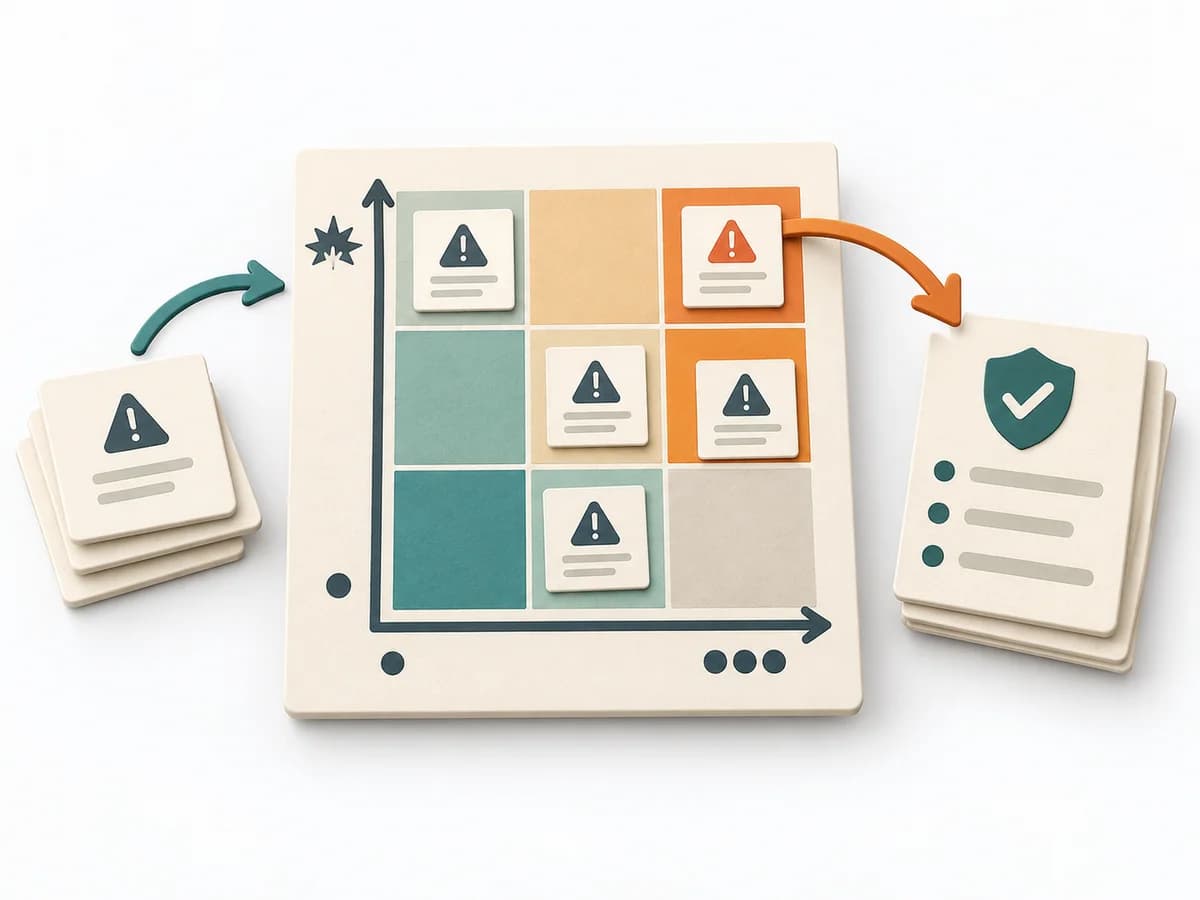
Functions, effects and organisation-specific S/O/D scales are jointly understood.
Example ratings are not an approved industry scale.
A practical method guide: clarify prerequisites and materials, understand the complete process, and look up outputs, pitfalls, and stop criteria.
What needs to be finished first
Functions, effects and organisation-specific S/O/D scales are jointly understood.
What needs to be ready before start
FMEA table, function flow, failure data and anchored S/O/D rating scales.
Cross-functional team covering design, operations, quality and affected users.
Define scope, functions and agreed rating rules; prepare existing controls and failure data.
Multiple work sessions; verify actions after implementation
Create one row per failure chain; display rating legend and current controls, keeping planned actions separate.
The one question this method answers
How can a function fail, what effects follow and which actions demonstrably reduce risk?
Phases with goal, actions, output and pitfall
FMEA proactively examines functions for failure modes, effects and causes. Existing prevention and detection controls are assessed; prioritised improvements are implemented and then reassessed.
Fictional example
FMEA proactively examines functions for failure modes, effects and causes. Existing prevention and detection controls are assessed; prioritised improvements are implemented and then reassessed.
| Failure chain | Function | Failure mode | Effect | Cause | Current controls | S | O | D | RPN | Action / owner | Evidence / residual rating |
|---|---|---|---|---|---|---|---|---|---|---|---|
| 1Enter function, failure chain, current controls and justified ratings; distinguish actions and evidence. | Send confirmation | No confirmation | Participants unsure of status | Transient sending failure without retry | Prevention: none. Detection: log entry without alert. | 6 | 4 | 7 | 168 | Jan by Friday: add queue retry and alert. | Fictionally after test and operational observation: S6/O2/D3 = 36; severity unchanged. |
Fictional teaching ratings, scale 1–10: higher is worse. S6 significant service disruption; O4 occasional, O2 rare; D7 weak detection, D3 reliable alerting in tests. 6 × 4 × 7 = 168; after verified action 6 × 2 × 3 = 36.
Functions

Goal
Failure chains
Inputs for this step
Actions
Output
Failure chains
Are failure mode and effect distinct?
Quality check
Are failure mode and effect distinct?
Pitfall
Everything is bundled as technical failure. Name loss of function and concrete effect separately.
Timing: 20–40 minutes
Controls
Goal
Control picture
Inputs for this step
Actions
Output
Control picture
Do controls exist and work today?
Quality check
Do controls exist and work today?
Pitfall
Planned controls already lower initial ratings. Assess the baseline before actions.
Timing: 20–40 minutes
Rating
Goal
Reasoned priority
Inputs for this step
Actions
Output
Reasoned priority
Does high D mean poor detection?
Quality check
Does high D mean poor detection?
Pitfall
RPN is treated as a precise probability. State ordinal scoring and data uncertainty.
Timing: 20–40 minutes
Actions
Goal
Action plan
Inputs for this step
Actions
Output
Action plan
Does the action change a specific risk driver?
Quality check
Does the action change a specific risk driver?
Pitfall
An extra check is assumed to lower S. Rate detection effects under D; retain S when effects are unchanged.
Timing: 15–30 minutes
Effectiveness
Goal
Verified residual state
Inputs for this step
Actions
Output
Verified residual state
Is reassessment based on evidence?
Quality check
Is reassessment based on evidence?
Pitfall
New low scores replace evidence of effectiveness. Require tests or operating data; keep residual scoring open until then.
Timing: 15–30 minutes
What comes out at the end
Sketch: what the artifact looks like
FMEA matrix with function, failure mode, effect, cause, controls, S/O/D, RPN and actions with effectiveness evidence.
Record date and scope; retain the previous version and reason when changing it.
Define scope, functions and agreed rating rules; prepare existing controls and failure data.
To be confirmed
To be confirmed
Complete cycle Time: Multiple work sessions; verify actions after implementation
Complete this worksheet on paper or in your own document during the work.
| Failure chain | Function | Failure mode | Effect | Cause | Current controls | S | O | D | RPN | Action / owner | Evidence / residual rating |
|---|---|---|---|---|---|---|---|---|---|---|---|
| 1 |
Define your own rating anchors first. S = severity, O = occurrence, D = poor detectability; RPN = S × O × D. Examine high severity separately; no universal RPN acceptance threshold. Reassess only after effectiveness evidence.
Expected artifact: Failure chains
Are failure mode and effect distinct?
Entry:
...
Expected artifact: Control picture
Do controls exist and work today?
Entry:
...
Expected artifact: Reasoned priority
Does high D mean poor detection?
Entry:
...
Expected artifact: Action plan
Does the action change a specific risk driver?
Entry:
...
Expected artifact: Verified residual state
Is reassessment based on evidence?
Entry:
...
...
Method guide: https://methodatlas.meierhoff-systems.de/en/methods/fmea/run-sheet
Concrete filled scenario, fictional example
Fictional example for orientation. Counts and timings describe this case and are not universal requirements.
Concrete filled scenario, fictional example
Function and scale: Fictional: send course confirmation. Teaching scale 1–10, higher = worse; S6 substantial service disruption, O4 occasional, D7 weak detection before customer contact.
Failure chain and controls: Mode: no confirmation. Effect: participants do not know their status. Cause: transient sending failure without retry. Control: simple log entry, no active alert.
Initial assessment: S6 × O4 × D7 = 168. The product supports prioritisation but does not replace examining each factor.
Action: Jan adds queue retries and missing-confirmation alerts by Friday; test with simulated sending failure.
Reassessment: Fictionally after a passed failure test and operational observation: S6 unchanged, O2, D3; RPN 36. In real use, reassess only after evidence.
Recognize symptoms and steer against them
Quick overview, the full text is in the matching phase in the flow
Everything is bundled as technical failure.
Name loss of function and concrete effect separately.
Planned controls already lower initial ratings.
Assess the baseline before actions.
RPN is treated as a precise probability.
State ordinal scoring and data uncertainty.
An extra check is assumed to lower S.
Rate detection effects under D; retain S when effects are unchanged.
New low scores replace evidence of effectiveness.
Require tests or operating data; keep residual scoring open until then.
When to pause, resolve prerequisites, or choose another approach
Go to the profile for purpose, similar methods, and sources or continue to the next method in the catalog.