Complete firstActionable task
The task is important and its next steps are within your influence.
Unpleasantness alone does not establish priority.
A practical method guide: clarify prerequisites and materials, understand the complete process, and look up outputs, pitfalls, and stop criteria.
What needs to be finished first
The task is important and its next steps are within your influence.
What needs to be ready before start
Short priority list, required materials, protected calendar block and completion criterion.
Person doing the work; a named contact if support is needed.
Review important commitments and consequences; select a task that can actually be started and meaningfully advanced today.
5–10 minutes selection; work duration follows the task
Prepare work materials where the first focus block happens; close messages and display the completion criterion.
The one question this method answers
Which important postponed task deserves my undivided attention first today?
Phases with goal, actions, output and pitfall
Brian Tracy’s focus principle puts an important, often postponed task ahead of readily available minor tasks. A clear completion condition and protected early work block make starting concrete.
Fictional example
Brian Tracy’s focus principle puts an important, often postponed task ahead of readily available minor tasks. A clear completion condition and protected early work block make starting concrete.
Which postponed task has the greatest relevant consequences?
Fictional: an overdue customer proposal blocks a decision for next week.
What achievable outcome marks completion today?
Scope and three pricing items are detailed enough for Lea to review.
How does work start, what must be ready and what is closed?
Open needs notes and calculation, create the proposal outline, close email.
When is the first suitable protected period and how are interruptions handled?
09:00–10:30 reserved; enquiries go to the agreed backup until then.
What was achieved and which next step is needed?
Draft complete; Lea reviews by 14:00. One unresolved volume value is visibly marked as an assumption.
All example details are fictional and illustrate the application.
Prioritise impact
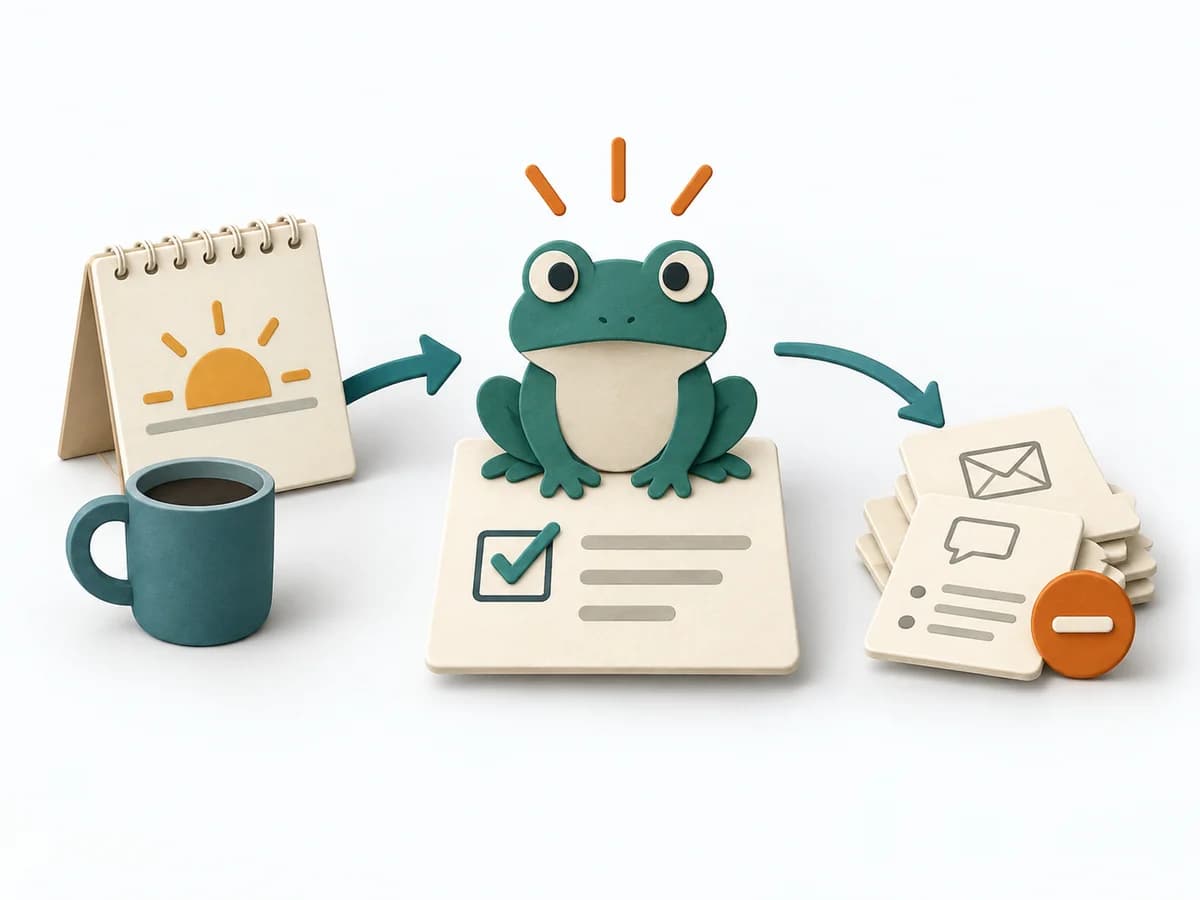
Goal
Selected frog
Inputs for this step
Actions
Output
Selected frog
Is the task important rather than merely unpleasant?
Quality check
Is the task important rather than merely unpleasant?
Pitfall
A tedious small task displaces the central commitment. Rank by consequences of postponement.
Timing: 2–5 minutes
Prepare start and finish
Goal
Ready-to-start task
Inputs for this step
Actions
Output
Ready-to-start task
Do I know how to start without more planning?
Quality check
Do I know how to start without more planning?
Pitfall
Finish the project is the entire task description. State a verifiable partial result with a clear boundary.
Timing: 3–5 minutes
Work with focus first
Goal
Progress on the important outcome
Inputs for this step
Actions
Output
Progress on the important outcome
Is the selected outcome progressing?
Quality check
Is the selected outcome progressing?
Pitfall
Many small tasks are done quickly before starting. Note the distraction and return to the first action.
Timing: 25–90 minutes
Outcome and continuation
Goal
Progress note and next entry point
Inputs for this step
Actions
Output
Progress note and next entry point
Is remaining work deliberately handled rather than silently delayed?
Quality check
Is remaining work deliberately handled rather than silently delayed?
Pitfall
The same huge frog remains open every day. Reduce scope, resolve the blocker or reconsider priority.
Timing: 2–5 minutes
What comes out at the end
Sketch: what the artifact looks like
One prioritised frog with visible outcome, prepared starting point, focus block and progress note.
Record date and scope; retain the previous version and reason when changing it.
Review important commitments and consequences; select a task that can actually be started and meaningfully advanced today.
To be confirmed
To be confirmed
Complete cycle Time: 5–10 minutes selection; work duration follows the task
Complete this worksheet on paper or in your own document during the work.
Which postponed task has the greatest relevant consequences?
...
What achievable outcome marks completion today?
...
How does work start, what must be ready and what is closed?
...
When is the first suitable protected period and how are interruptions handled?
...
What was achieved and which next step is needed?
...
Answer the prompts with your own information. Explicitly mark unknowns and assumptions.
Brian Tracy: Eat That Frog Report
Expected artifact: Selected frog
Is the task important rather than merely unpleasant?
Entry:
...
Expected artifact: Ready-to-start task
Do I know how to start without more planning?
Entry:
...
Expected artifact: Progress on the important outcome
Is the selected outcome progressing?
Entry:
...
Expected artifact: Progress note and next entry point
Is remaining work deliberately handled rather than silently delayed?
Entry:
...
...
Method guide: https://methodatlas.meierhoff-systems.de/en/methods/eat-the-frog/run-sheet
Concrete filled scenario, fictional example
Fictional example for orientation. Counts and timings describe this case and are not universal requirements.
Concrete filled scenario, fictional example
Important task: Fictional: an overdue customer proposal blocks a decision for next week.
Completion criterion: Scope and three pricing items are detailed enough for Lea to review.
First action and preparation: Open needs notes and calculation, create the proposal outline, close email.
Focus block: 09:00–10:30 reserved; enquiries go to the agreed backup until then.
Outcome and remainder: Draft complete; Lea reviews by 14:00. One unresolved volume value is visibly marked as an assumption.
Recognize symptoms and steer against them
Quick overview, the full text is in the matching phase in the flow
A tedious small task displaces the central commitment.
Rank by consequences of postponement.
Finish the project is the entire task description.
State a verifiable partial result with a clear boundary.
Many small tasks are done quickly before starting.
Note the distraction and return to the first action.
The same huge frog remains open every day.
Reduce scope, resolve the blocker or reconsider priority.
When to pause, resolve prerequisites, or choose another approach
Go to the profile for purpose, similar methods, and sources or continue to the next method in the catalog.