View methods side by side.
Choose up to four methods. Add them using the search and share the comparison by copying its link.
| Criterion |  Agile WSJF | 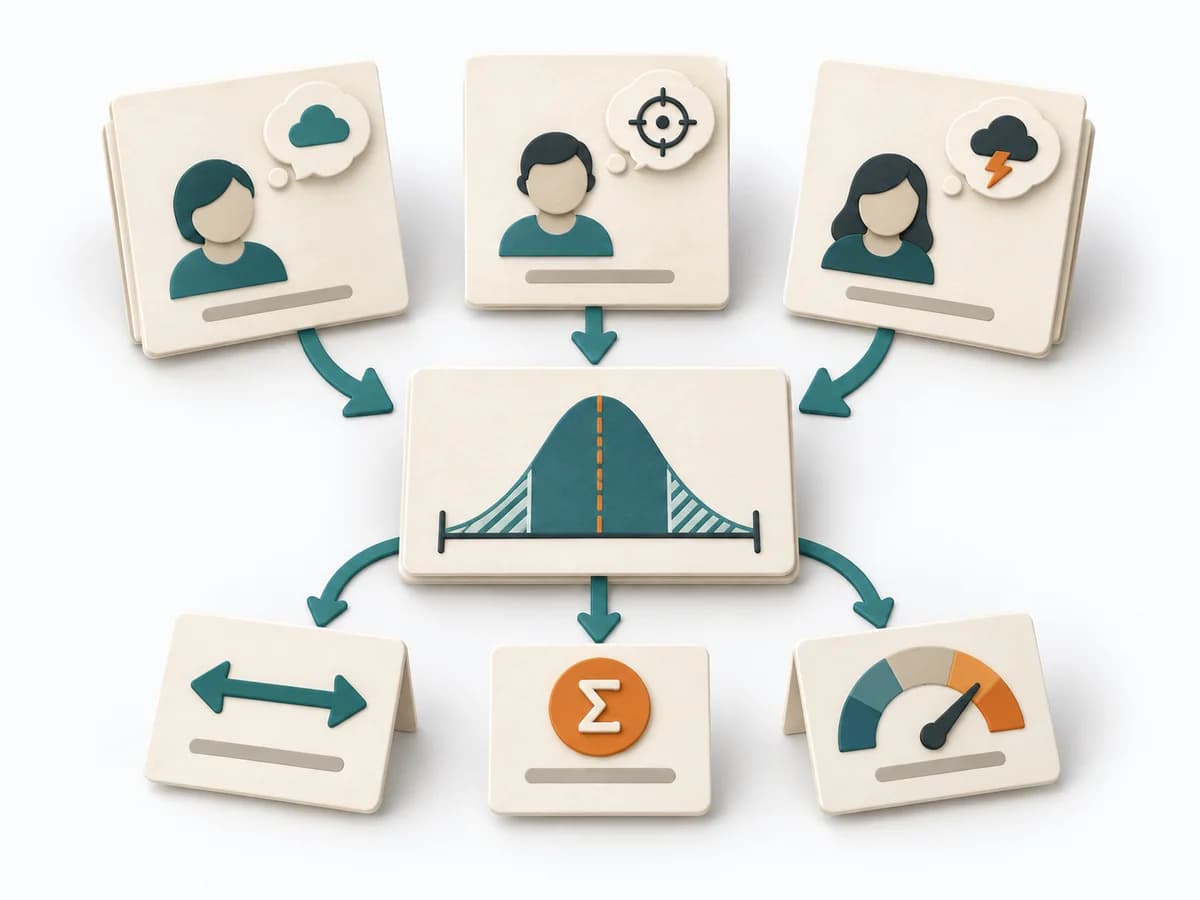 Decision Making Three-Point Estimation |  Product Strategy DIBB |  Decision Making Force Field Analysis |
|---|---|---|---|---|
Purposedifferent | When many tasks compete for the same capacity, it orders work by economic impact. It makes time lost, benefit, and effort comparable together. | A single estimate for effort, time, or risk often looks too smooth for the real uncertainty behind it. It separates options, evaluation criteria, and open risks. The result is captured as a Three-Point Estimate, Risk Range, and Assumption Notes. | DIBB helps clarify target groups, value, goals, and priorities by making the logic behind a decision explicit. It captures results as a DIBB document, belief list, bet list, and learning report. | In change initiatives, supporting and restraining forces sit at the table at the same time. Force Field Analysis makes these tensions explicit and shows where change can be pushed forward by strengthening or relieving. |
Complexitydifferent | High | Medium | Low | Low |
Timedifferent | 45-90 min | 10-30 min je Item | 1-2 h | 45-90 min |
Participantsdifferent | 3-10 | 1-8 | 2-8 | 3-12 |
Formatdifferent | Workshop | Workshop + async | Workshop + async | Workshop |
Outputdifferent | Ranked Backlog, Cost-of-Delay Assumptions | Three-Point Estimate, Risk Range, Assumption Notes | DIBB document, Belief list, Bet list, Learning report | Force Field Map, Change Levers, Risk Notes |
Tagsno overlap | LeanEconomicsSequencePrioritization | EstimationUncertaintyForecasting | StrategyDecisionAssumptionsHypothesis | ChangeDecisionStrategy |