View methods side by side.
Choose up to four methods. Add them using the search and share the comparison by copying its link.
| Criterion |  Agile WSJF |  Growth Hooked Model | 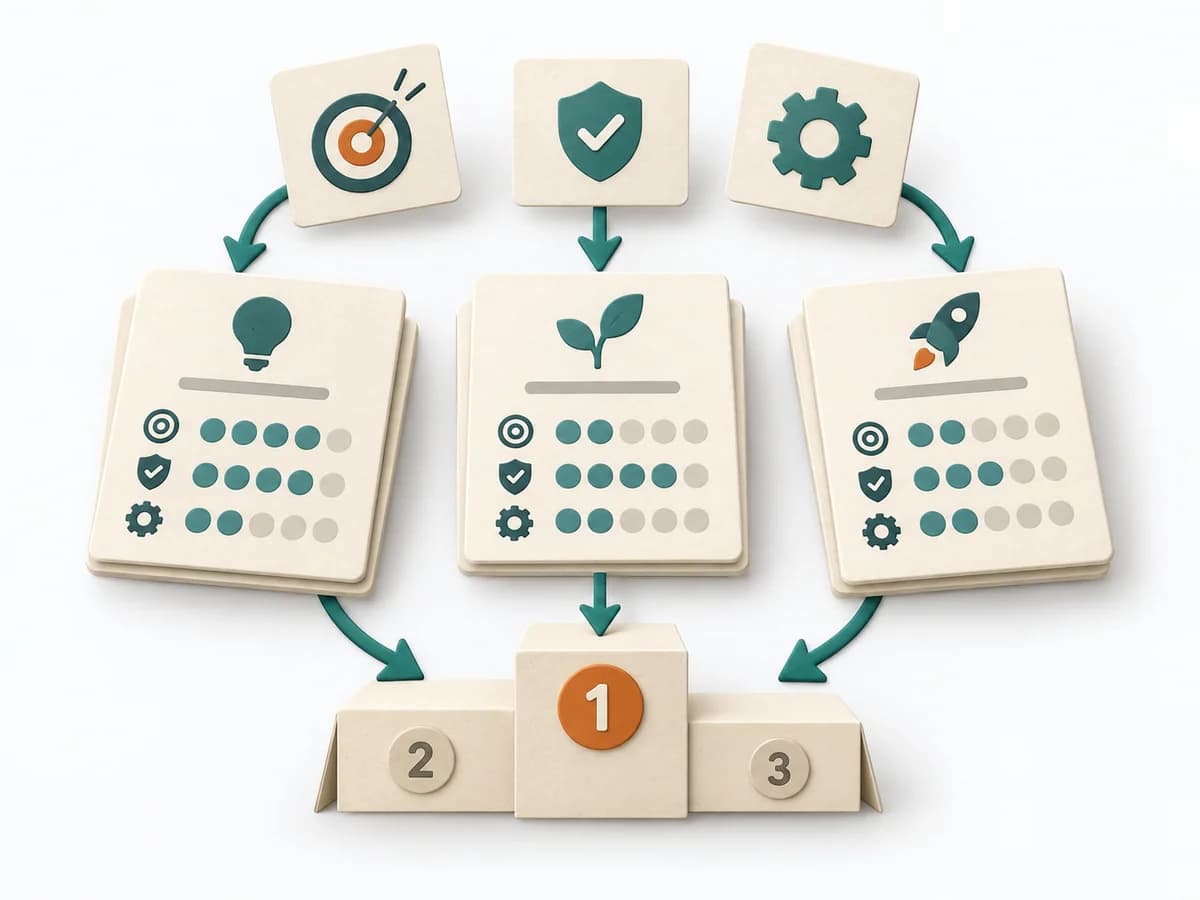 Product Strategy ICE Scoring |  Growth Flywheel |
|---|---|---|---|---|
Purposedifferent | When many tasks compete for the same capacity, it orders work by economic impact. It makes time lost, benefit, and effort comparable together. | The Hooked Model helps clarify engagement loops, user behavior, and experiments. It makes repeat behavior measurable and captures the result as a hooked loop, trigger map, and reward design. | When ideas need sorting quickly, it condenses impact, confidence, and effort into one compact score. It connects customer value, product logic, and decision priorities. The result is captured as an ICE table and top-ideas list. | Growth often breaks down where a reinforcing mechanism builds up too much friction. A Flywheel shows the cycle of value, repetition, and reinforcement meant to sustain growth. |
Complexitydifferent | High | Medium | Low | Medium |
Timedifferent | 45-90 min | Multiple workshops over several weeks | 30-60 min | 60-120 min |
Participantsdifferent | 3-10 | 2-8 | 2-8 | 3-8 |
Formatdifferent | Workshop | Workshop + async | Workshop + async | Workshop |
Outputdifferent | Ranked Backlog, Cost-of-Delay Assumptions | Hooked loop, Trigger map, Reward design, Ethics check | ICE Table, Top Idea List | Flywheel Map, Friction Points, Growth Levers, Experiment Backlog |
Tagsno overlap | LeanEconomicsSequencePrioritization | GrowthBehaviorRetention | PrioritizationScoringGrowthDecision | GrowthRetentionConversion |