View methods side by side.
Choose up to four methods. Add them using the search and share the comparison by copying its link.
| Criterion |  UX Research Usability Testing | 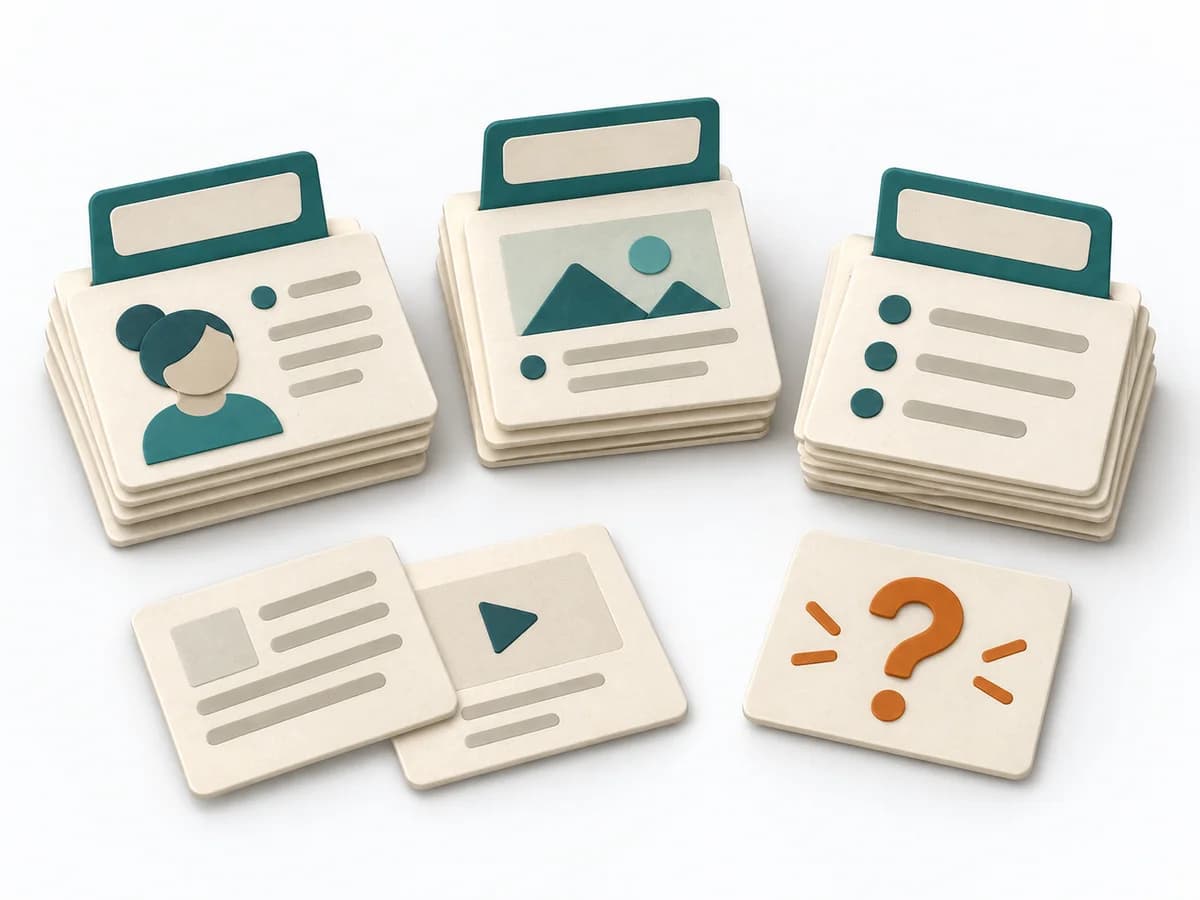 UX Research Card Sorting |  Product Discovery Assumption Mapping | 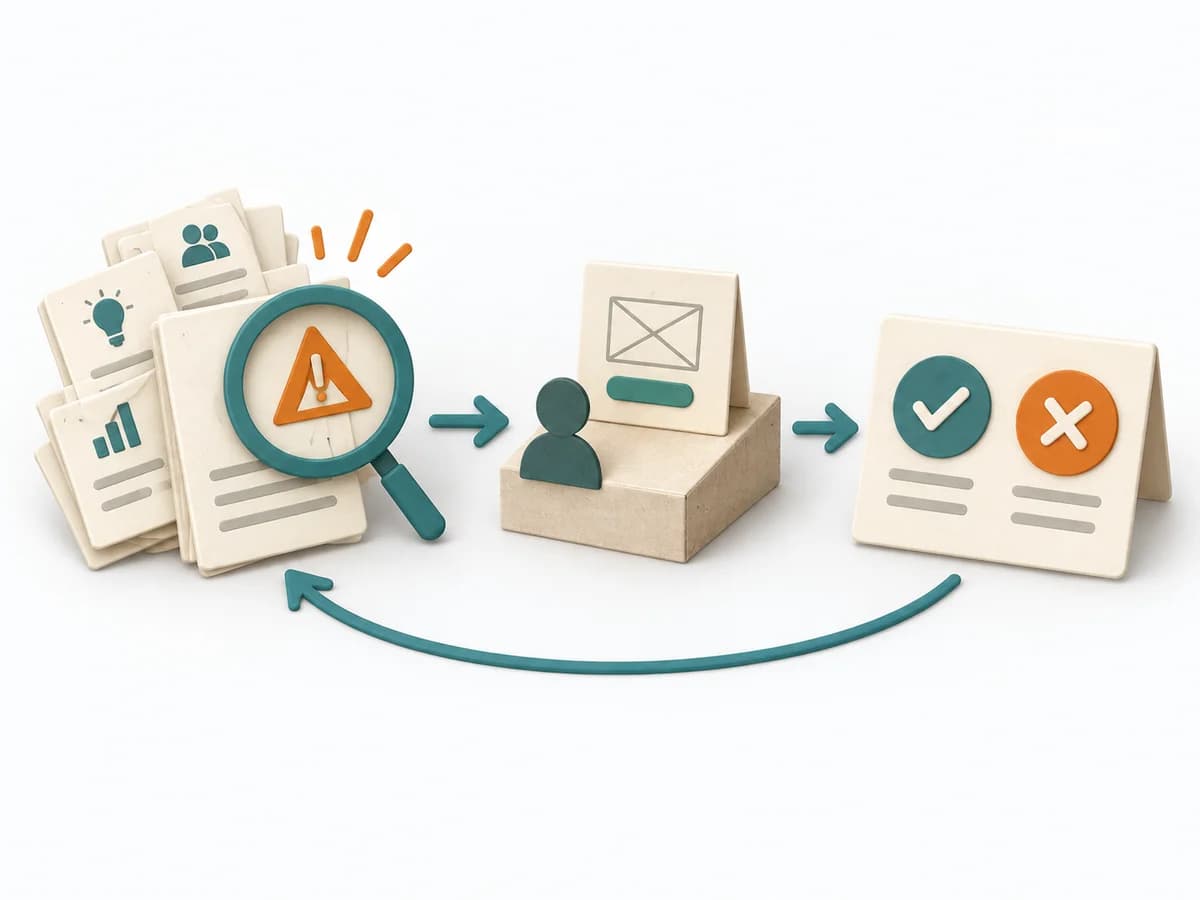 Product Discovery Riskiest Assumption Test |
|---|---|---|---|---|
Purposedifferent | When a product is built but people get stuck on tasks, usability testing shows the friction at concrete points. Observed use instead of self-report makes visible where orientation, understanding, or interaction breaks down. | When content only makes sense internally and users can't find the structure again, card sorting exposes their mental order. Terms, groups, and naming are then aligned with the target group's expectations. | When assumptions still sit unordered in the room, it weighs uncertainty against leverage. It makes visible which hypotheses should be checked first. | When an idea hinges on one critical unknown, it prioritizes testing that exact piece of uncertainty first. It separates problem, assumption, solution, and evidence. The result is captured as a prioritized list of assumptions, a test plan, and a result report. |
Complexitydifferent | Medium | Low | Medium | Medium |
Timedifferent | 1-2 h je Session | 20-45 min | 45-60 min | 1-2 Wochen pro Iteration |
Participantsdifferent | Based on research question | Based on research question | 2-8 | 2-6 |
Formatsame | Workshop + async | Workshop + async | Workshop + async | Workshop + async |
Outputdifferent | Usability Issues, Severity List, Recommendations | Content groups, Label set, IA hypotheses | Assumption map, Test backlog, Risk ranking | Prioritized Assumption List, Test Plan, Results Report |
Tagsno overlap | ValidationUXPrototype | Information architectureNavigationStructure | AssumptionsRiskExperimentsValidation | ExperimentsValidationDiscoveryAssumptions |