View methods side by side.
Choose up to four methods. Add them using the search and share the comparison by copying its link.
| Criterion | 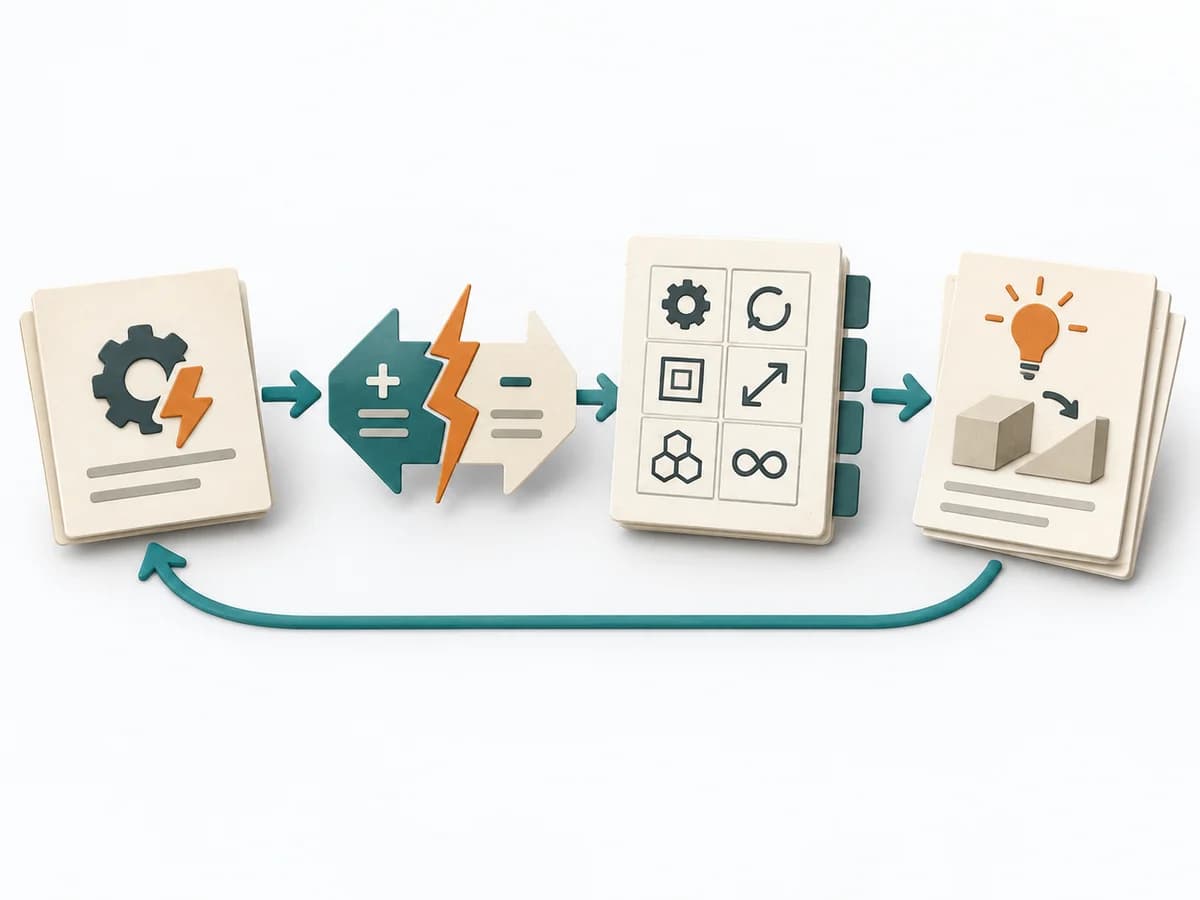 Innovation TRIZ |  Knowledge Modeling IBIS |  Knowledge Modeling Concept Mapping |  Innovation Contradiction Analysis |
|---|---|---|---|---|
Purposedifferent | For technical contradictions or trade-offs, the method looks for solutions that resolve opposing requirements at the same time. It translates limits into an explicit picture of conflict that becomes workable. This produces not just compromises but more elegant principles. | IBIS structures thinking about complex questions as a sequence of issues, ideas, and arguments. The method keeps discussions open without forcing them into premature consensus. | Concept Mapping arranges terms and relationships in a network that makes subject-matter connections tangible. It fits when a topic needs to be understood structurally rather than linearly. | When a system should improve while another measure suffers as a result, the method makes the underlying conflict precisely formulable. It separates the desired effect from its side effect. This makes solutions possible that address the contradiction deliberately instead of half-heartedly. |
Complexitydifferent | High | Medium | Medium | Medium |
Timedifferent | 1-4 h | 1-3 h | 1-2 h | 60-120 min |
Participantsdifferent | 2-8 | 2-8 | 1-8 | 2-8 |
Formatdifferent | Workshop + async | Workshop + async | Workshop + async | Workshop |
Outputdifferent | Contradiction Statement, Inventive Principles, Solution Concepts | Issue Map, Positions, Argument Notes | Concept Map, Relationship Labels, Knowledge Gaps | Contradiction Statement, Abstraction Notes, Solution Principles, Concept Ideas |
Tagsno overlap | InnovationProblem solvingContradictionsCreativity | RationaleKnowledgeDecision | KnowledgeConceptsMappingSensemaking | ContradictionsInnovationProblem solving |