View methods side by side.
Choose up to four methods. Add them using the search and share the comparison by copying its link.
Selected:Tree TestingStakeholder Salience ModelLASR (Lightweight Approach for Software Reviews)Alignment Mapping
| Criterion | 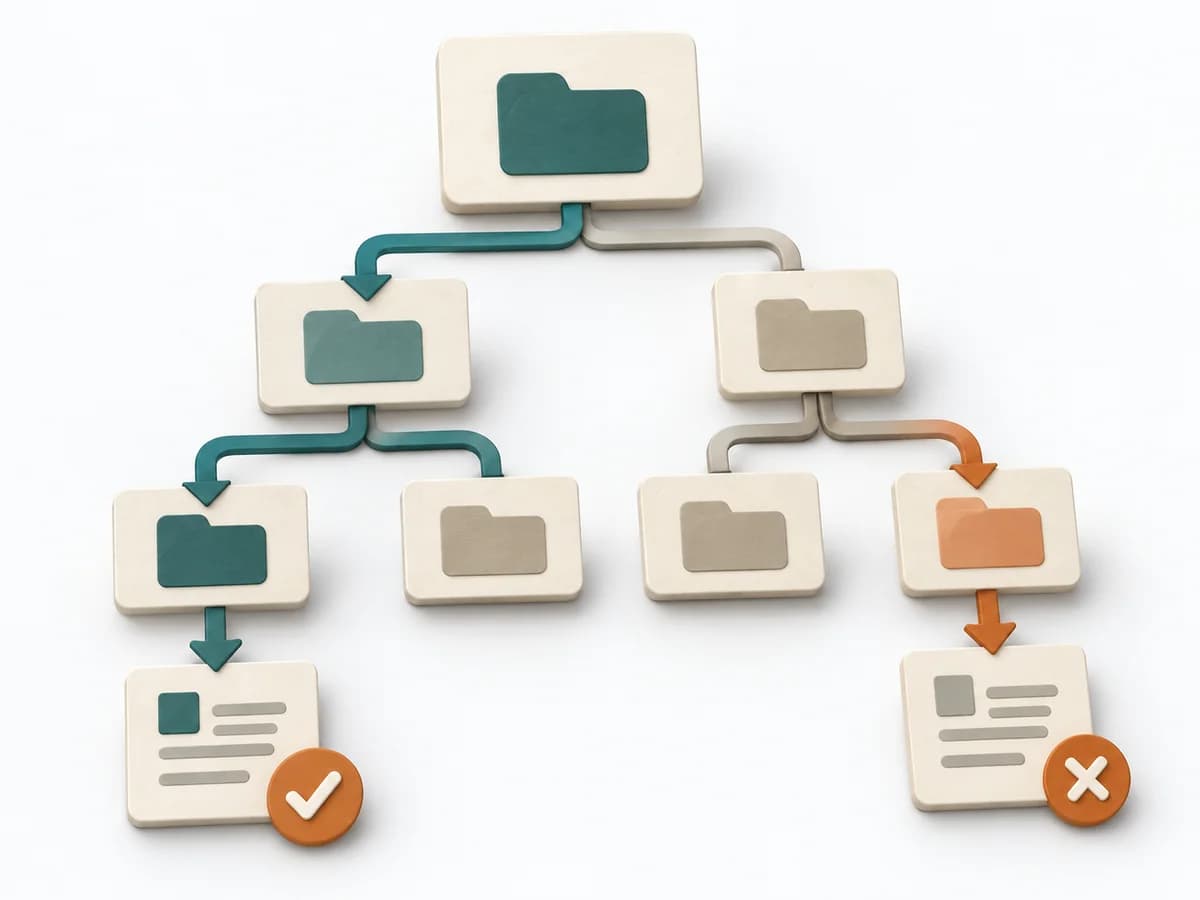 UX Research Tree Testing |  Facilitation Stakeholder Salience Model |  Architecture LASR (Lightweight Approach for Software Reviews) |  Facilitation Alignment Mapping |
|---|---|---|---|---|
Purposedifferent | When a navigation exists but search paths still fail, tree testing checks findability without visual distraction. The method shows whether labels, levels, and paths really lead to the intended destination. | When stakeholders appear to matter very differently, the Stakeholder Salience Model rates their actual priority through power, legitimacy, and urgency. It turns individual contributions into a visible selection. The result is captured as a Salience diagram and a class-based strategy. | LASR helps development teams identify where their software falls short of important quality goals and which improvements to consider. A small group with existing system knowledge can make an initial assessment and investigate open questions in more detail. | When several people work toward one goal but hold different mental maps, Alignment Mapping makes the discrepancies visible. It arranges goals, assumptions, and priorities so shared direction becomes verifiable. |
Complexitysame | Medium | Medium | Medium | Medium |
Timedifferent | 1-2 Tage | 60-90 min | 3–4 h for initial assessment; preparation and deeper analysis additional | 1-2 h |
Participantsdifferent | Based on research question | 3-6 | 1 or a small team; particularly suitable for 3–4 people | 4-12 |
Formatdifferent | Async | Workshop | Workshop + async | Workshop |
Outputdifferent | Findability Metrics, Path Analysis, Revised IA | Salience Diagram, Strategy per Class | Lean Mission Statement describing the software’s purpose, Prioritized quality goals and evaluation criteria, Risks and estimated gaps against quality goals, More closely examined findings and open checks | Alignment Map, Open Issues, Decision Questions |
Tagsno overlap | Information architectureNavigationFindability | StakeholdersFacilitationAlignmentGovernance | ArchitectureQualityRiskAssessmentLean | AlignmentStakeholdersStrategyFacilitation |