View methods side by side.
Choose up to four methods. Add them using the search and share the comparison by copying its link.
| Criterion | 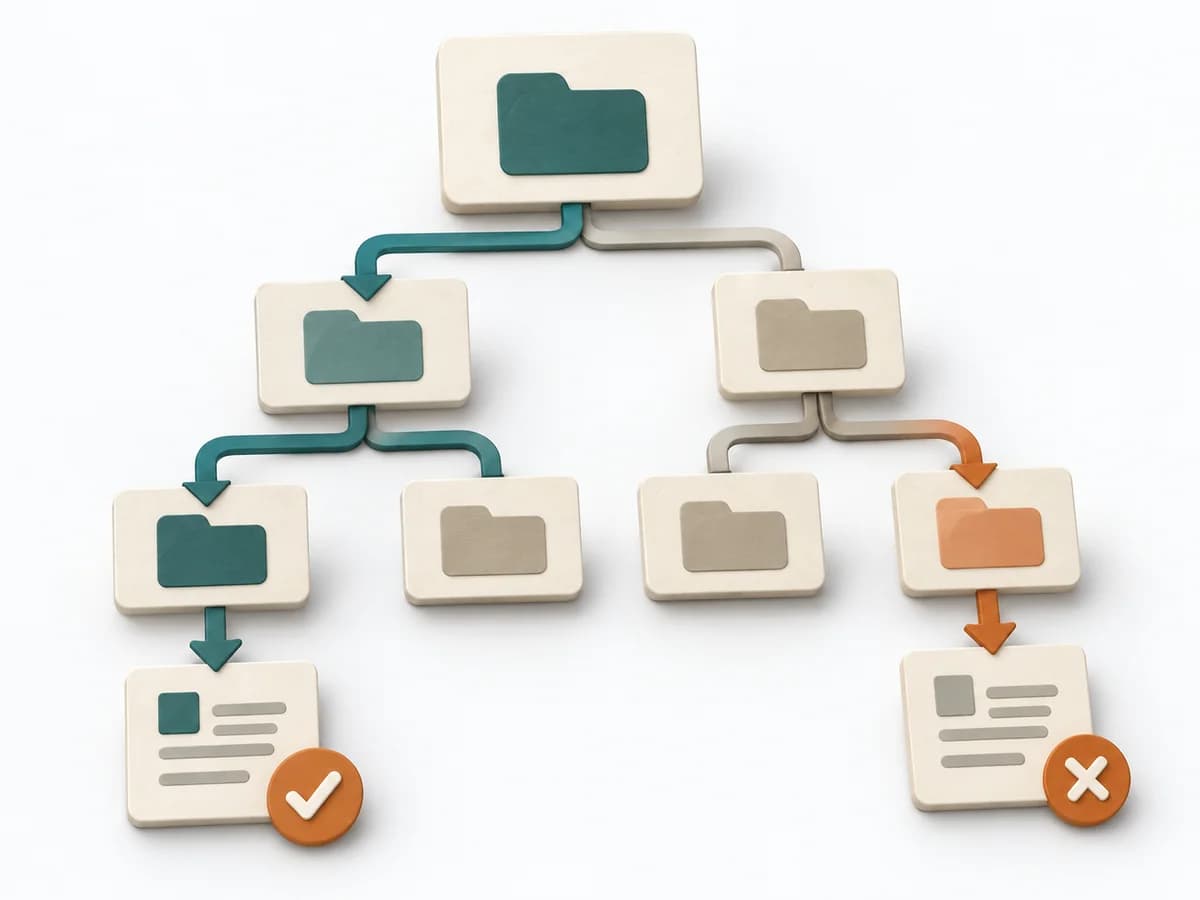 UX Research Tree Testing |  Business Strategy GAP Analysis |  UX Research Card Sorting |  Business Strategy Scenario Planning |
|---|---|---|---|---|
Purposedifferent | When a navigation exists but search paths still fail, tree testing checks findability without visual distraction. The method shows whether labels, levels, and paths really lead to the intended destination. | GAP Analysis compares the current state with a target picture and makes the distance manageable. It becomes useful when, ahead of new initiatives, it must become clear which capabilities, processes, or resources are missing. | When content only makes sense internally and users can't find the structure again, card sorting exposes their mental order. Terms, groups, and naming are then aligned with the target group's expectations. | Scenario Planning opens the view to several plausible futures instead of a single forecast. The method protects strategies from depending on too narrow an expected path. |
Complexitydifferent | Medium | Medium | Low | High |
Timedifferent | 1-2 Tage | 1-3 h | 20-45 min | 0.5-2 Tage |
Participantsdifferent | Based on research question | 2-8 | Based on research question | 4-12 |
Formatdifferent | Async | Workshop + async | Workshop + async | Workshop |
Outputdifferent | Findability Metrics, Path Analysis, Revised IA | Gap Matrix, Action Plan, Risk Notes | Content groups, Label set, IA hypotheses | Scenario Set, Strategic Implications, Robust Options |
Tagsno overlap | Information architectureNavigationFindability | StrategyAnalysisPlanning | Information architectureNavigationStructure | StrategyUncertaintyPlanning |