View methods side by side.
Choose up to four methods. Add them using the search and share the comparison by copying its link.
| Criterion | 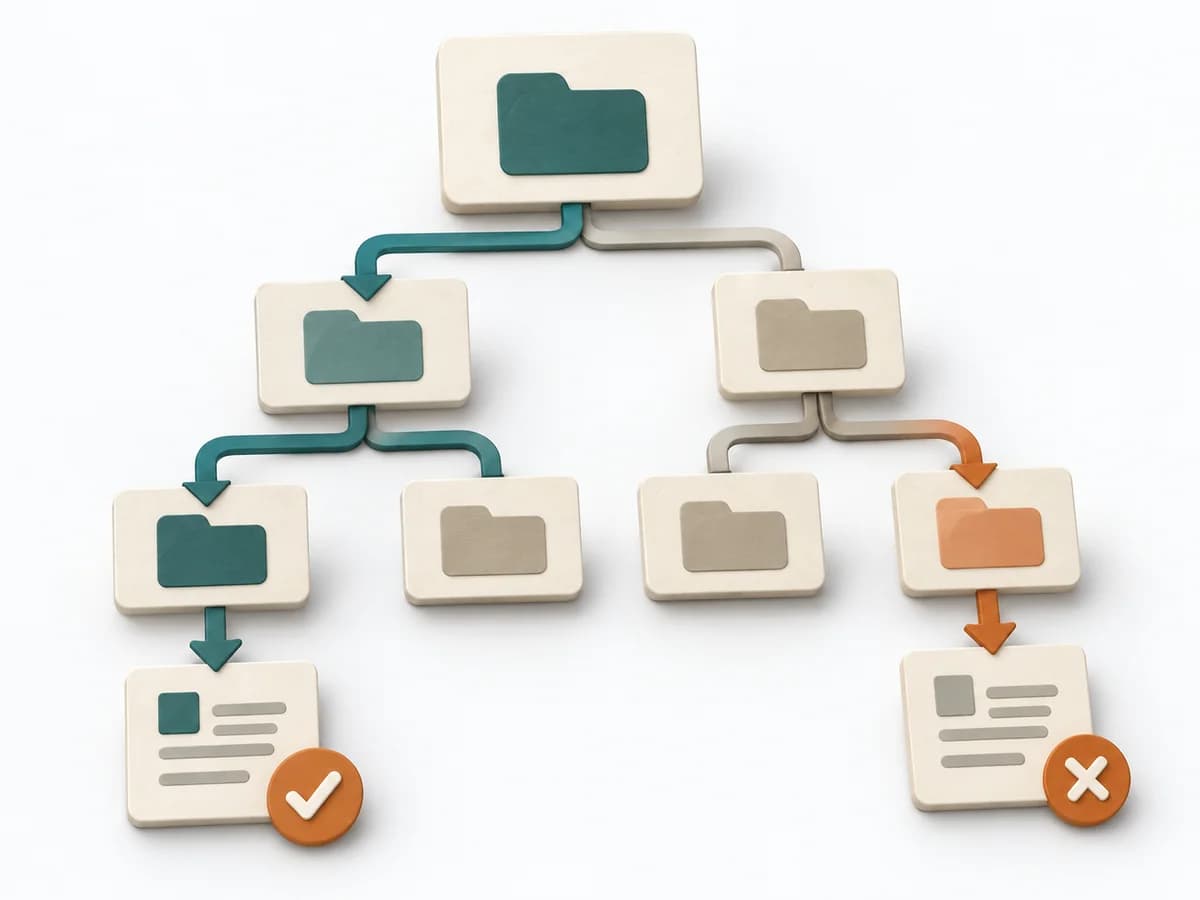 UX Research Tree Testing |  UX Research Card Sorting |  Decision Making OODA Loop |  Product Strategy DIBB |
|---|---|---|---|---|
Purposedifferent | When a navigation exists but search paths still fail, tree testing checks findability without visual distraction. The method shows whether labels, levels, and paths really lead to the intended destination. | When content only makes sense internally and users can't find the structure again, card sorting exposes their mental order. Terms, groups, and naming are then aligned with the target group's expectations. | In dynamic situations, decisions become outdated faster than they can be prepared. The OODA Loop holds observing, orienting, deciding, and acting together as a recurring rhythm so reaction does not slide into inertia. | DIBB helps clarify target groups, value, goals, and priorities by making the logic behind a decision explicit. It captures results as a DIBB document, belief list, bet list, and learning report. |
Complexitydifferent | Medium | Low | Medium | Low |
Timedifferent | 1-2 Tage | 20-45 min | 15-60 min je Zyklus | 1-2 h |
Participantsdifferent | Based on research question | Based on research question | 1-8 | 2-8 |
Formatdifferent | Async | Workshop + async | Workshop + async | Workshop + async |
Outputdifferent | Findability Metrics, Path Analysis, Revised IA | Content groups, Label set, IA hypotheses | Situation Assessment, Decision Loop, Action Updates | DIBB document, Belief list, Bet list, Learning report |
Tagsno overlap | Information architectureNavigationFindability | Information architectureNavigationStructure | DecisionChangeLearningStrategy | StrategyDecisionAssumptionsHypothesis |