View methods side by side.
Choose up to four methods. Add them using the search and share the comparison by copying its link.
| Criterion | 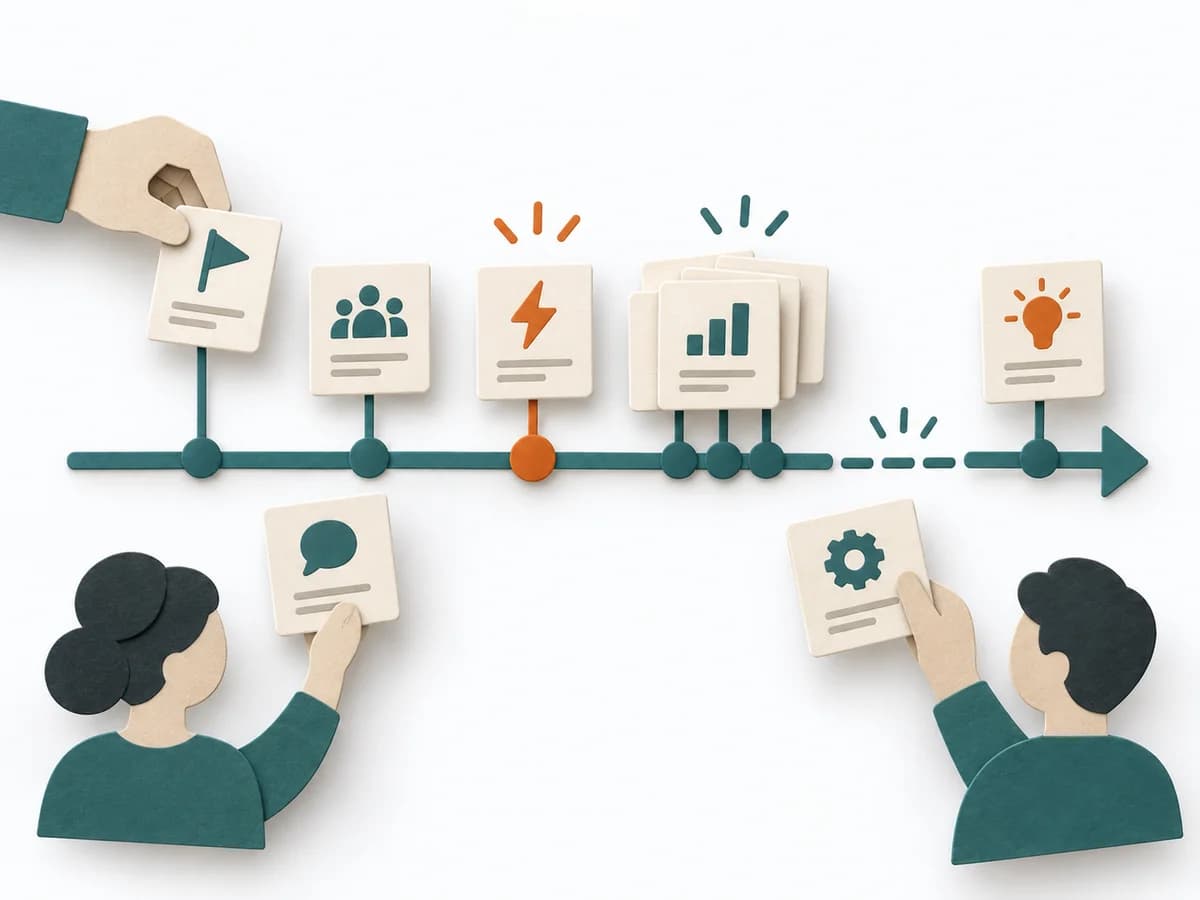 Facilitation Timeline |  Domain Modeling EventStorming |  UX Research Affinity Diagramming |  Facilitation Consensus Workshop |
|---|---|---|---|---|
Purposedifferent | When a project, incident, or change process is only remembered in fragments, Timeline brings the sequence back into a readable form. It makes turning points, precursors, and after-effects recognizable over the course of time. | When a domain consists of many events, rules, and states, it creates a shared modeling space for the team. It bundles language, flows, and boundaries before domain knowledge fragments into siloed views. | When research notes, feedback, or observations sit unconnected side by side, affinity diagramming sorts the raw material into solid themes. Many individual points turn into patterns that make decisions and opportunities clearer. | When a group needs a solid decision without outvoting individual factions, a Consensus Workshop creates a negotiable common ground. It makes agreement, reservations, and open tensions discussable at the same time. |
Complexitydifferent | Low | Medium | Low | Medium |
Timedifferent | 30-90 min | 2-8 h | 45–90 min | 1-3 h |
Participantsdifferent | 2-12 | 5-12 | 3-10 | 5-30 |
Formatdifferent | Workshop + async | Workshop | Workshop | Workshop |
Outputdifferent | Timeline, Milestones, Insight Notes | Event Timeline, Ubiquitous Language, Boundaries, Open Questions | Theme clusters, Insight statements, Opportunity areas | Consensus Clusters, Theme Titles, Priority Areas |
Tagsno overlap | TimelineFacilitationSequence | Domain-Driven DesignEventsDiscoveryWorkshop | SynthesisQualitativeRoot cause | FacilitationConsensusWorkshopAlignment |