View methods side by side.
Choose up to four methods. Add them using the search and share the comparison by copying its link.
| Criterion |  UX Research Surveys |  Facilitation Dot Voting |  Facilitation Nominal Group Technique | 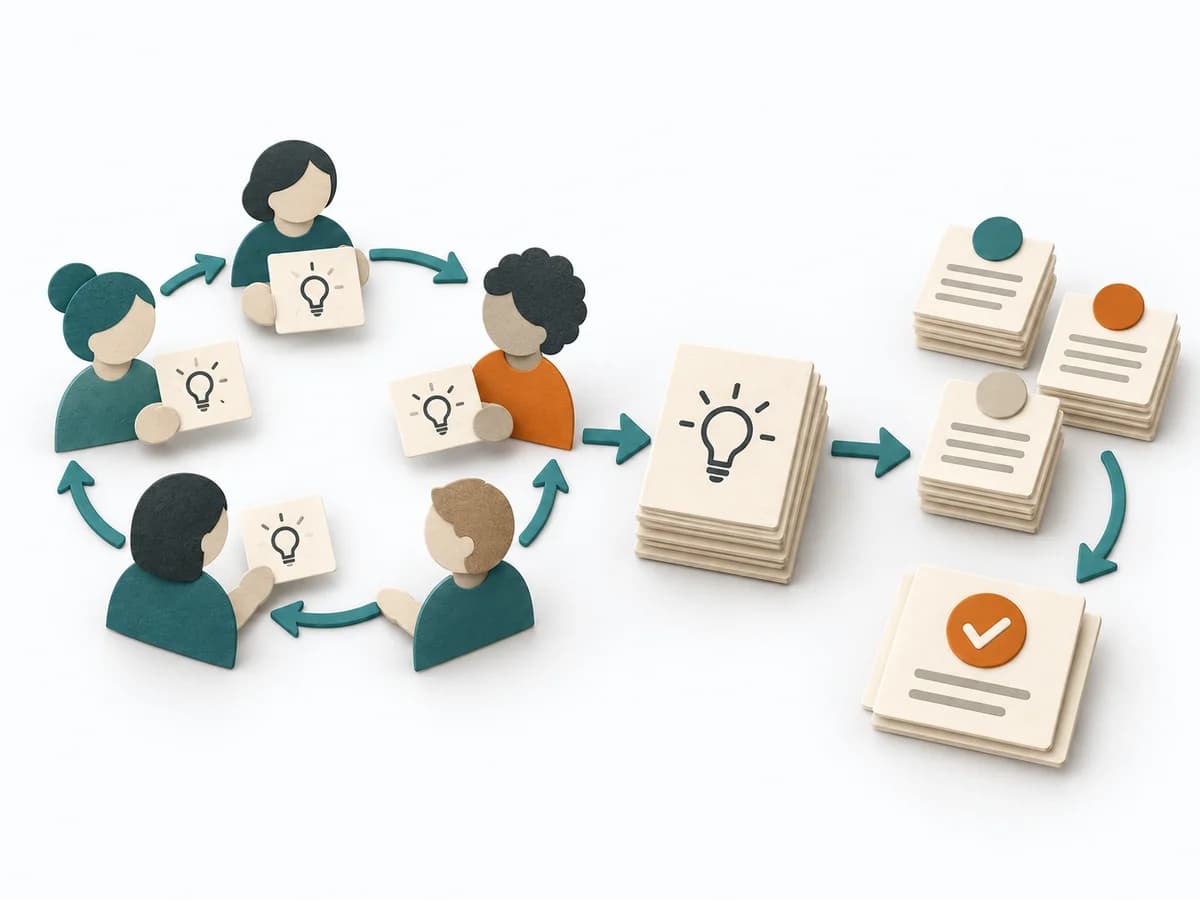 Innovation Round Robin Brainstorming |
|---|---|---|---|---|
Purposedifferent | When a topic needs to be validated broadly and many people can answer the same question, surveys gather structured feedback in a scalable form. Answers become comparable and segmentable instead of remaining merely anecdotal. | When a workshop has produced too many options and the group needs to condense quickly, dot voting makes preferences visible in a short time. It bundles individual votes into a solid signal for the next selection. | When loud voices could dominate a round, Nominal Group Technique protects individual thinking time from group effects. It collects ideas separately first and only then enables shared weighting. | With unevenly distributed speaking time, the method brings every person into the contribution one after another. It prevents early voices from setting the direction while still producing a shared idea space. This makes participation plannable and the team's diversity visible. |
Complexitydifferent | Medium | Low | Medium | Low |
Timedifferent | 3-14 Tage | 5-15 min | 60-120 min | 20-45 min |
Participantsdifferent | 50+ | 3-20 | 5-12 | 4-10 |
Formatdifferent | Async | Workshop | Workshop | Workshop |
Outputdifferent | Survey Results, Charts, Segment Insights | Ranked list, Consensus signal, Shortlist | Ranked Ideas, Clarified Options, Group Priority | Idea List, Cluster, Shortlist |
Tagsno overlap | QuantitativeResearchValidation | FacilitationVotingConsensusPrioritization | FacilitationPrioritizationVotingInclusion | BrainstormingIdeationFacilitationInclusionCreativity |