View methods side by side.
Choose up to four methods. Add them using the search and share the comparison by copying its link.
| Criterion |  Business Strategy Strategy Map |  Decision Making Assumption Surfacing | 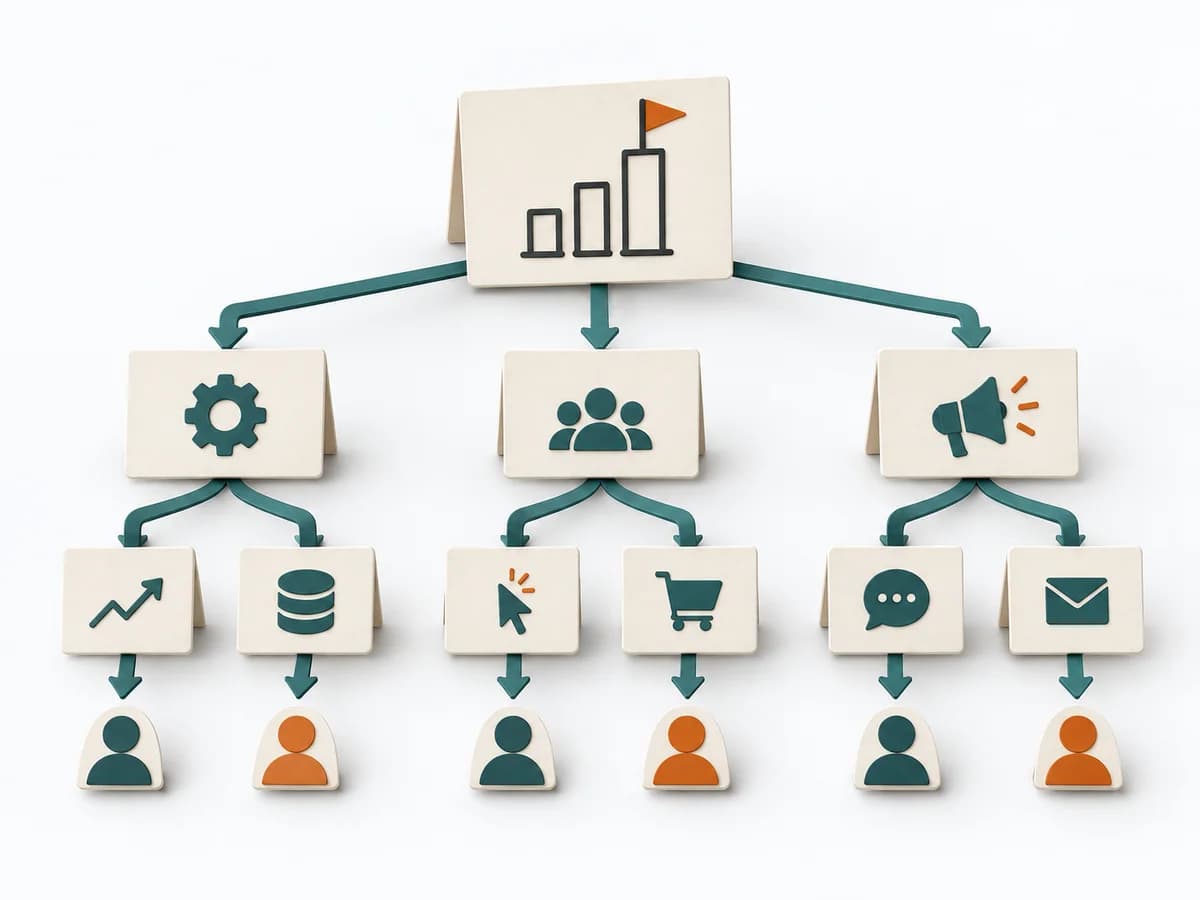 Product Strategy KPI Tree |  Product Strategy DIBB |
|---|---|---|---|---|
Purposedifferent | A Strategy Map translates strategy into a few connected objectives across perspectives such as finance, customers, processes, and learning. This makes visible which capabilities and activities are meant to drive which results. | Plans often contain assumptions that were never openly stated and remain dangerous precisely because of that. Assumption Surfacing makes these silent premises visible and prioritizes which of them carry the initiative or could sink it. | When metrics across the organization drift apart, it arranges drivers and effects under one shared logic. It connects customer value, product logic, and decision priorities. The result is captured as a KPI tree and owner list. | DIBB helps clarify target groups, value, goals, and priorities by making the logic behind a decision explicit. It captures results as a DIBB document, belief list, bet list, and learning report. |
Complexitydifferent | Medium | Low | Medium | Low |
Timedifferent | 2-4 h workshop plus review | 45-90 min | 90-180 min initial, dann laufend | 1-2 h |
Participantsdifferent | 4-10 | 2-8 | 3-8 | 2-8 |
Formatdifferent | Workshop | Workshop + async | Workshop + async | Workshop + async |
Outputdifferent | Strategy Map, Objective Set, Cause-Effect Hypotheses | Assumption List, Critical Assumptions, Learning Plan | KPI Tree, Owner List | DIBB document, Belief list, Bet list, Learning report |
Tagsno overlap | AlignmentExecutionGoalsCausality | AssumptionsRiskDecisionDiscovery | MetricsStrategyAlignmentMeasurement | StrategyDecisionAssumptionsHypothesis |