View methods side by side.
Choose up to four methods. Add them using the search and share the comparison by copying its link.
Selected:Strategic, Tactical and Operational PlanningPirate Metrics AARRRSmoke TestAssumption Mapping
| Criterion | 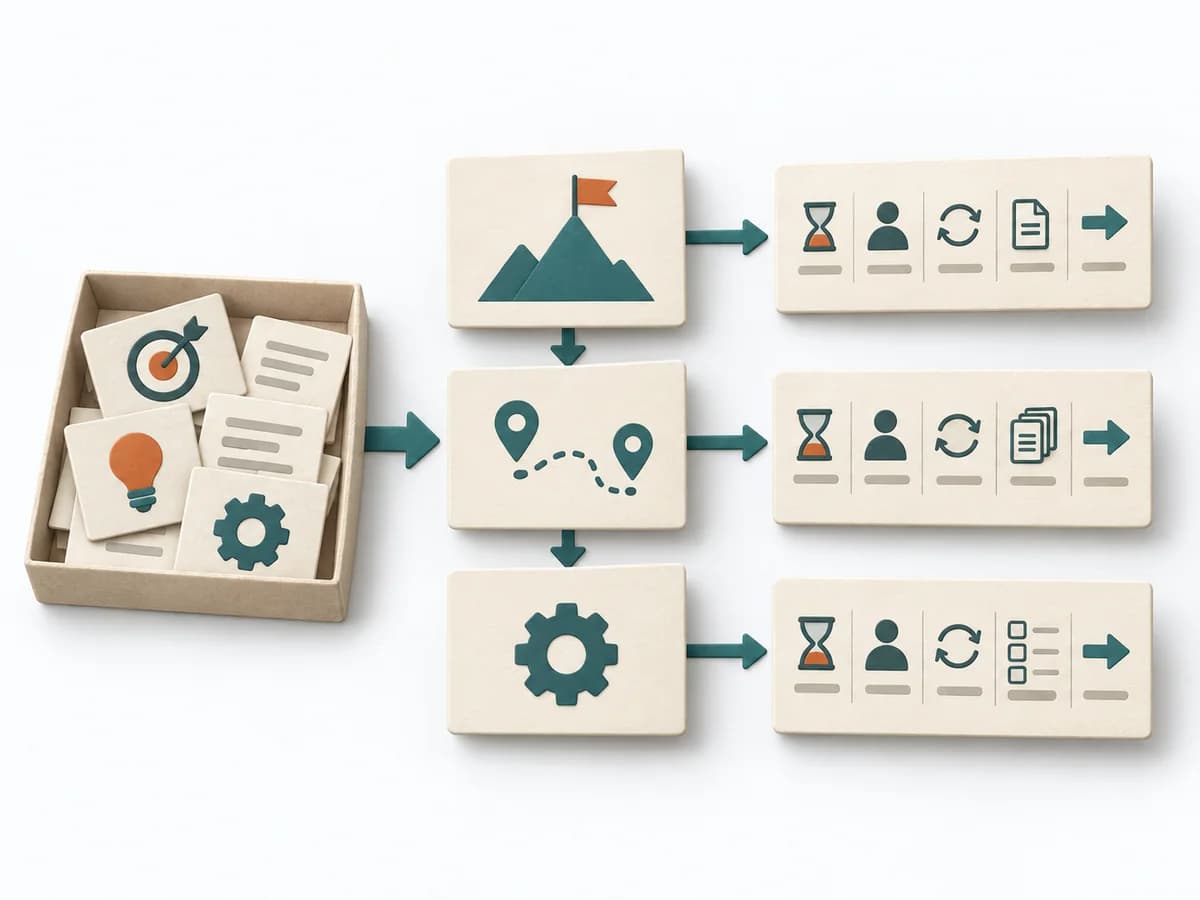 Business Strategy Strategic, Tactical and Operational Planning |  Growth Pirate Metrics AARRR |  Product Discovery Smoke Test |  Product Discovery Assumption Mapping |
|---|---|---|---|---|
Purposedifferent | It places decisions and artifacts at the right level. Strategic planning clarifies direction, tactical planning translates it into programs, and operational planning steers concrete processes. | For products with complex usage paths, overall growth alone is too coarse to reveal bottlenecks. Pirate Metrics breaks the relationship with the product into consecutive stages and shows where the funnel actually leaks. | When demand only needs to be roughly verified, it tests interest with minimal effort. It measures whether people would take a next step at all. | When assumptions still sit unordered in the room, it weighs uncertainty against leverage. It makes visible which hypotheses should be checked first. |
Complexitydifferent | Medium | Medium | Low | Medium |
Timedifferent | 90-180 min | 1-2 h Setup, laufend | 1-5 Tage | 45-60 min |
Participantsdifferent | 4-12 | 2-8 | Nutzertraffic | 2-8 |
Formatdifferent | Workshop | Workshop + async | Async | Workshop + async |
Outputdifferent | Planning Levels Map, Cadence Model, Planning Artifact Inventory | AARRR funnel, Metric baseline, Experiment backlog | Interest Metrics, Conversion Signal, Learning Note | Assumption map, Test backlog, Risk ranking |
Tagsno overlap | CadenceGovernanceExecution | GrowthMetricsExperiments | ValidationExperimentsDemandGrowth | AssumptionsRiskExperimentsValidation |