View methods side by side.
Choose up to four methods. Add them using the search and share the comparison by copying its link.
| Criterion |  Facilitation Six Thinking Hats | 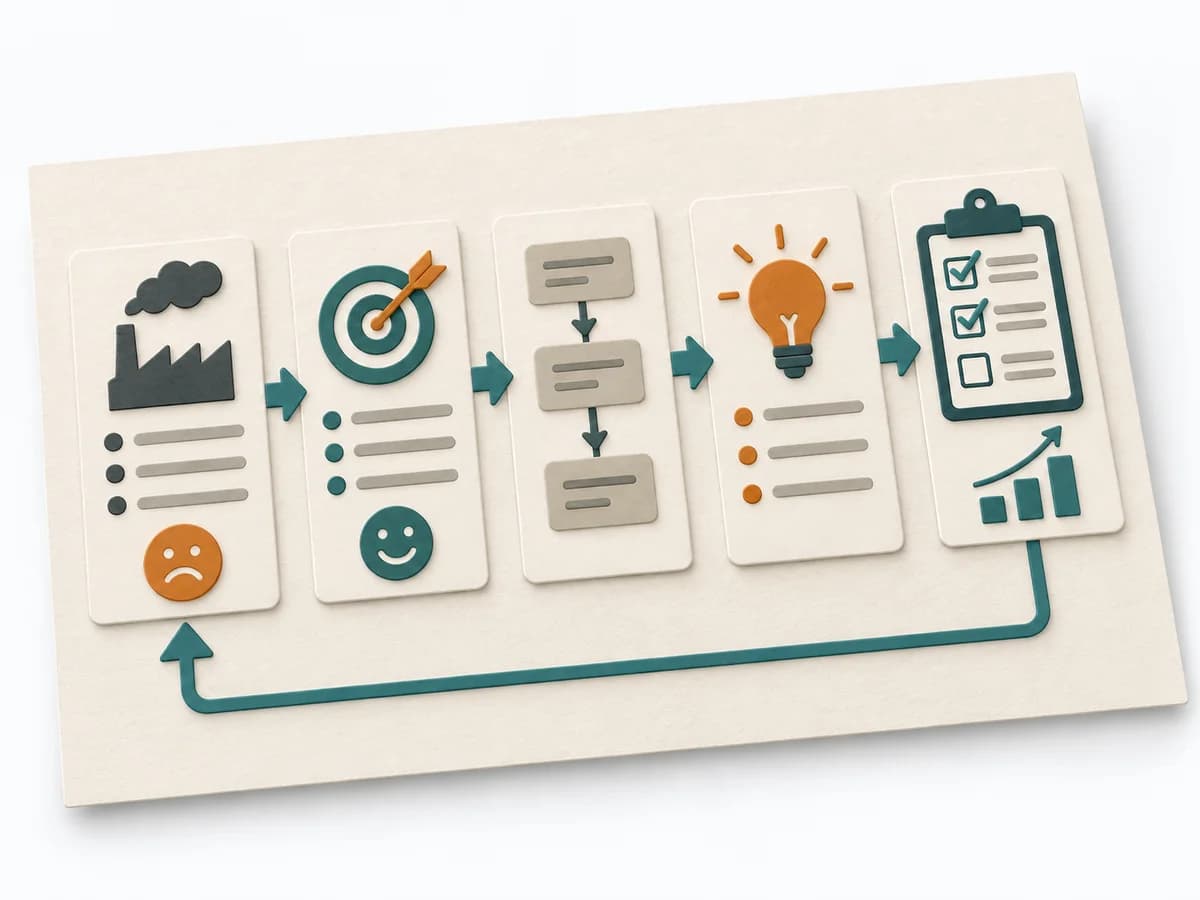 Operations A3 Problem Solving |  Operations Root Cause Analysis |  Operations Kepner-Tregoe |
|---|---|---|---|---|
Purposedifferent | When a topic gets stuck too quickly in the same thinking mode, Six Thinking Hats deliberately separates the perspectives. This means facts, risks, creativity, and emotional signals get worked through one after another instead of mixed together. | For a complex deviation with several people involved, the method bundles problem, analysis, and decision onto one page. It creates a shared working space where causes, countermeasures, and follow-up fit together. | When a problem keeps recurring and the cause stays unclear, the method exposes the underlying mechanism. It separates symptom, guess, and robust explanation from one another. | For a disturbance that's hard to pin down, the method cleanly separates problem, cause, and decision. It reduces mixing when symptoms allow several interpretations. |
Complexitydifferent | Medium | Medium | Medium | High |
Timedifferent | 45-90 min | 45-90 min | 1-4 h | 2-8 h |
Participantsdifferent | 4-12 | 2-5 | 3-8 | 2-8 |
Formatdifferent | Workshop | Workshop + async | Workshop + async | Workshop + async |
Outputdifferent | Perspective Notes, Decision Inputs, Action Items | A3 Report, Action Plan, Root Cause Analysis | Problem Statement, Cause Hypotheses, Confirmed Causes, Action Plan | Problem Analysis, Decision Analysis, Risk Plan |
Tagsno overlap | FacilitationOptionsDecision | LeanProblem solvingCoachingOperations | Root causeProblem solvingQualityIncident | Problem solvingRoot causeDecisionOperations |