View methods side by side.
Choose up to four methods. Add them using the search and share the comparison by copying its link.
| Criterion |  Knowledge Modeling Shape-First Modeling | 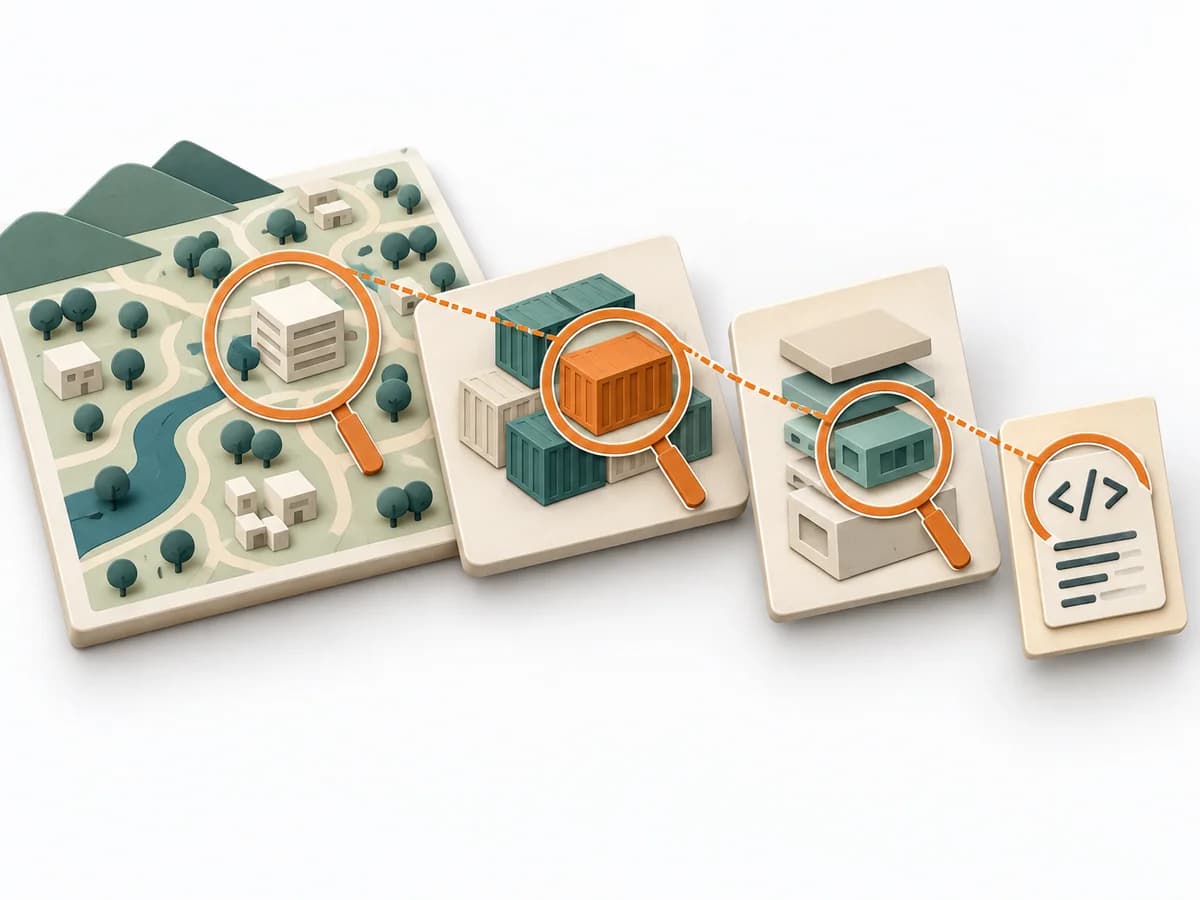 Architecture C4 Model |  Architecture Risk Storming |  Product Discovery Assumption Mapping |
|---|---|---|---|---|
Purposedifferent | Shape-First Modeling defines data quality through shapes before implementation or integration frays at the edges. The approach fits when validation and data contracts should be part of the design from the start. | The C4 Model makes a system legible across several resolution levels, from context down to code. It suits situations where different audiences need to understand the same architecture from different altitudes. | Helps clarify architecture context, options, and consequences in concrete terms. It organizes technical context, alternatives, and consequences. The result is captured as an Annotated Diagram, a Prioritized Risk List, and an Action Backlog. | When assumptions still sit unordered in the room, it weighs uncertainty against leverage. It makes visible which hypotheses should be checked first. |
Complexitydifferent | Medium | Low | Low | Medium |
Timedifferent | Halber Tag pro Domain Slice | 1-4 h | 60-90 min | 45-60 min |
Participantsdifferent | 1-4 | 1-5 | 4-12 | 2-8 |
Formatdifferent | Workshop + async | Workshop + async | Workshop | Workshop + async |
Outputdifferent | SHACL or ShEx Shapes, Validation Reports, Data Contracts, Shape Documentation | Context Diagram, Container Diagram, Component Diagram | Annotated Diagram, Prioritized Risk List, Action Backlog | Assumption map, Test backlog, Risk ranking |
Tagsno overlap | Knowledge graphValidationSemantic | ArchitectureCommunicationVisualization | RiskArchitectureWorkshopValidation | AssumptionsRiskExperimentsValidation |