View methods side by side.
Choose up to four methods. Add them using the search and share the comparison by copying its link.
| Criterion | 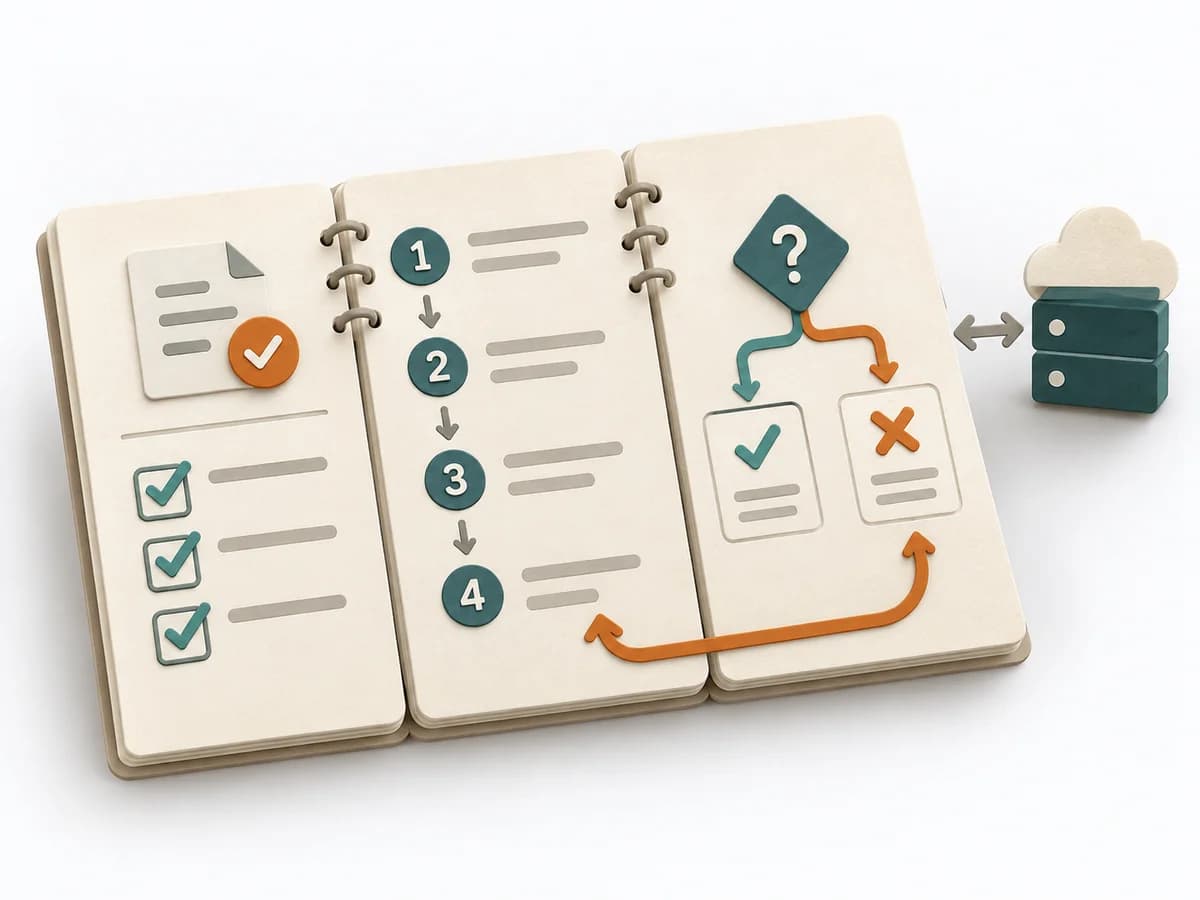 Operations Runbook |  Facilitation Six Thinking Hats |  DevOps Incident Command |  Decision Making Decision Tree |
|---|---|---|---|---|
Purposedifferent | For recurring operational tasks or incidents, the method keeps solid action logic ready. It reduces uncertainty when time pressure, role changes, or rare situations demand fast access. | When a topic gets stuck too quickly in the same thinking mode, Six Thinking Hats deliberately separates the perspectives. This means facts, risks, creativity, and emotional signals get worked through one after another instead of mixed together. | During an acute incident with several people involved, the method creates a clear leadership and communication structure. It reduces chaos when fast coordination and clean situational awareness are both needed at once. | For decisions with follow-on paths and dependencies, a linear comparison is often not enough. A Decision Tree shows how options branch under conditions and which consequences hang on each branch. |
Complexitydifferent | Low | Medium | Medium | Medium |
Timedifferent | 20-60 min | 45-90 min | As needed | 30-90 min |
Participantsdifferent | 1-4 | 4-12 | 4-15 | 1-6 |
Formatdifferent | Async | Workshop | Workshop + async | Workshop + async |
Outputdifferent | Runbook, Checklist, Escalation Path | Perspective Notes, Decision Inputs, Action Items | Incident Log, Action Tracker, Stakeholder Updates | Decision Tree, Option Map, Assumption List |
Tagsno overlap | OperationsReliabilityDocumentation | FacilitationOptionsDecision | IncidentOperationsReliability | DecisionTreeOptions |